Phu Quoc airport planning adjusted to serve APEC 2027

For 2021-2030, the Civil Aviation Authority of Vietnam proposed bringing forward the investment in a parallel taxiway system and a connecting taxiway north of Runway No. 2 at Phu Quoc International Airport, in order to connect with the aircraft maintenance and repair facility (hangar) planned for the northern area of ​​the airport.

The Civil Aviation Authority of Vietnam (CAAV) has proposed adjustments to the planning of several facilities at Phu Quoc International Airport in the Mekong Delta province of An Giang to serve the APEC Economic Leaders' Meeting 2027 (APEC 2027).

The proposal, submitted to the Ministry of Construction for appraisal and approval, covers the airport's master plan for 2021-2030, with a vision to 2050, including facilities to be developed immediately for the meeting.
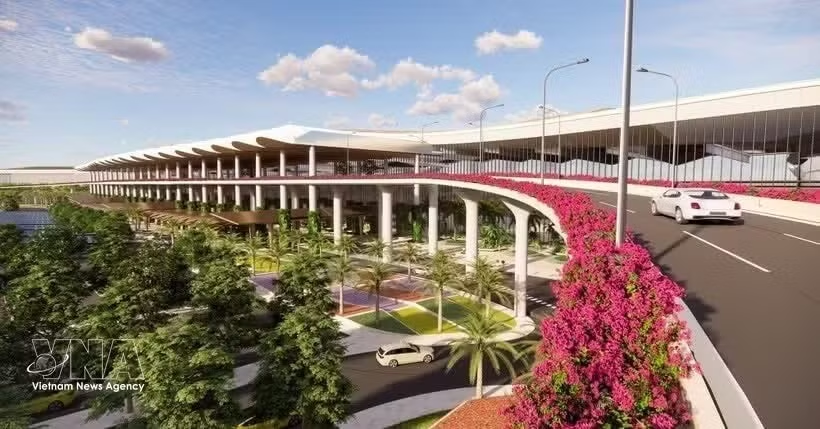
1-5542.jpg
A graphic image of Terminal 2 of Phu Quoc International Airport (Source: VietnamPlus)

For 2021-2030, the CAAV proposed bringing forward the investment in a parallel taxiway system and a connecting taxiway north of Runway No. 2, in order to connect with the aircraft maintenance and repair facility (hangar) planned for the northern area of the airport.

The plan also includes an apron in front of Terminal 2 and an expansion of the existing apron to provide about 42 aircraft positions. Another apron with about 45 positions would be built between the aprons serving Terminal 1 and the VIP/general aviation terminal, while the land west of the latter would be reserved for future expansion. To facilitate preparations for APEC 2027, several infrastructure components would be adjusted for immediate construction to ensure security, safety and smooth operations during the event.

Sections of service roads within the airfield would be realigned and extended to support patrols. The locations of some power supply and lighting substations would also be changed, with additional facilities to be installed as needed.

The internal road system would likewise be reconfigured, including the route from the main access road to Terminal 2. An elevated corridor linking Terminals 1 and 2 would be added to enable direct passenger transfers and improve operational efficiency.

The area west of the VIP/general aviation apron would also be reserved for a future cargo terminal, in line with the airport's long-term development plans.

Under the revised layout, the aviation catering facility would retain its planned scale and investment phasing through 2030, with a vision to 2050, but be relocated to an area of about 3ha east of Terminal 2.

The aviation fuel supply facility would similarly maintain its planned investment scale and phasing, while being moved to an area of more than 7ha in the northern part of the airport.

Repair and maintenance facilities for aviation vehicles and equipment would also retain their planned scales and investment schedules, but be relocated west of Terminal 1 to facilitate operations and preserve space for future apron expansion.

By 2050, the plan would allow the aircraft apron to be expanded on reserved land as demand increases.

The CAAV has asked the Ministry of Construction to approve the detailed Phu Quoc International Airport master plan adjustment for 2021-2030, with a vision to 2050.

It also recommended that An Giang province incorporate the revised airport master plan into its land-use and public transport plans, including routes connecting the airport with surrounding areas.
en.vietnamplus.vn

Other News

Logistics upgrade vital to 1-trillion-USD trade target: experts

Logistics upgrade vital to 1-trillion-USD trade target: experts

As trade expands, systemic bottlenecks across transport networks, warehousing, ports, border gates, and industrial zones are becoming more apparent. Experts emphasise the need to shift from a fragmented, project-by-project approach toward strategic management structured around trade corridors and integrated supply chains.

Ample room for Vietnam, US to deepen cooperation

Ample room for Vietnam, US to deepen cooperation

Do Ngoc Hung, Trade Counsellor and head of the Vietnam Trade Office in the US, said what stands out is not only the growth in trade volume but also the increasingly deep economic ties between the two countries.

Flexible fiscal policy helps drive economic growth

Flexible fiscal policy helps drive economic growth

According to the Ministry of Finance, State budget revenue in the first eight months of 2026 was estimated at 2.02 quadrillion VND (77.7 billion USD), equivalent to 80% of the annual estimate and up 16% year-on-year. Domestic revenue reached 1.75 quadrillion VND, accounting for 86.6% of total revenue and rising 16.6%.

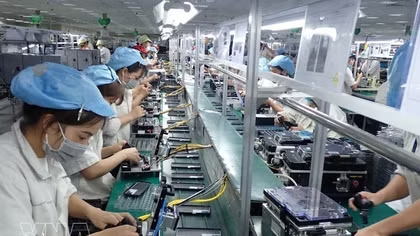
Electronic components are produced at a factory in Hanoi. (Photo: VNA)

Hanoi's imports surge 41% in first eight months of 2026

Hanoi aims to achieve average annual export growth of at least 12% during 2026-30, with the city seeking to diversify export markets, boost high-tech and value-added products and reduce reliance on traditional markets.

New opportunities for Vietnam's seafood exports

New opportunities for Vietnam's seafood exports

The Vietnam-EFTA Free Trade Agreement brings together two groups of highly complementary economies. EFTA members Switzerland, Norway, Iceland and Liechtenstein have strengths in technology, innovation, finance, clean energy and sustainable development, while Vietnam is one of Asia’s most dynamic economies and is emerging as a major regional manufacturing, trade and investment hub.

Ho Chi Minh City targets third-quarter growth of over 11%

Ho Chi Minh City targets third-quarter growth of over 11%

Ho Chi Minh City will continue to implement drastic measures to achieve double-digit growth, targeting GRDP growth of at least 11.07% in the third quarter of 2026, 9.43% in the first nine months and 12.3% in the fourth quarter, with a view to completing the full-year goal of 10% or more.

Vietnamese experts abroad join efforts to advance nuclear power development at home

Vietnamese experts abroad join efforts to advance nuclear power development at home

Held both in person and online, the seminar focused on the current status and opportunities for Vietnam’s nuclear power programme, human resources development, global trends in small modular reactors (SMRs), experience in ensuring safety and extending the operational life of nuclear power plants, and ways to mobilise Vietnamese experts abroad to contribute to the programme.

Port throughput in Hai Phong exceeds eight-month target

Port throughput in Hai Phong exceeds eight-month target

The strong performance followed a series of measures to optimise port capacity and improve the competitiveness of the city’s seaport system, with a focus on maximising the efficiency of the Lach Huyen international gateway port as new berths came into operation.

Vietnam, Mercosur begin trade negotiations

Vietnam, Mercosur begin trade negotiations

During the session, both sides reaffirmed their determination to advance the negotiations in a spirit of goodwill, with a view to reaching a balanced agreement that aligns with the interests of both Vietnam and Mercosur.

Vietnam poised to benefit from new wave of technology investment

Vietnam poised to benefit from new wave of technology investment

The successful development and production of high-end Pixel smartphones in Vietnam – a more complex process than manufacturing smartwatches and wireless earbuds – is reportedly giving Google confidence in moving its entire Pixel production out of China.