Vietnam seeks bigger share of global Halal market

Vietnam's Halal exports remain modest at around 900 million USD a year, accounting for less than 1% of the global market. Most exports are still raw agricultural and seafood products. Only around 1,000–1,300 Vietnamese businesses obtained or maintained Halal certification during 2024–2026.

Hanoi (VNA) – Vietnam is seeking to tap the multi-trillion-dollar global Halal market, but turning potential into export growth will require businesses to bridge gaps in certification, deep processing, supply chains and market-specific requirements.
5.jpg
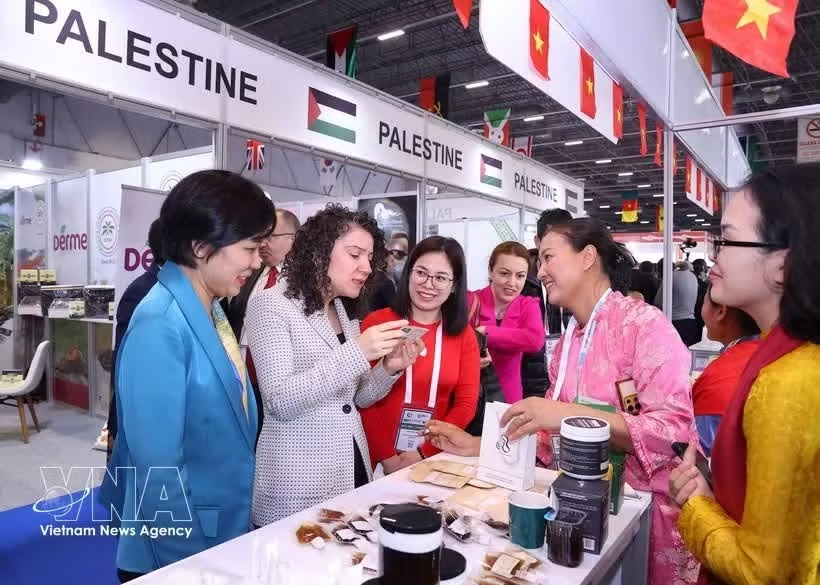
Delegates visit the booth of Hanoi Xanh Cooperative (Vietnam) at Halal Expo 2025 in Türkiye, November 2025. (Photo: VNA)

With around 2 billion Muslims across more than 110 countries, the Halal market is expanding beyond food into cosmetics, pharmaceuticals, fashion, logistics, finance and tourism.

Vu Ba Phu, Director of the Vietnam Trade Promotion Agency under the Ministry of Industry and Trade, said the global Halal economy was currently worth around 2.5-3 trillion USD a year and could reach 10 trillion USD by 2028.

Vietnam's Halal exports, however, remain modest at around 900 million USD a year, accounting for less than 1% of the global market. Most exports are still raw agricultural and seafood products. Only around 1,000–1,300 Vietnamese businesses obtained or maintained Halal certification during 2024–2026.

Vietnamese Trade Counsellor in Indonesia Pham The Cuong said Indonesia's Halal consumption reached 330.5 billion USD in 2025, with food and beverages projected at 360.5 billion USD in 2026. Vietnamese milk, confectionery, processed foods, noodles, processed fruit and seafood are among products with export potential.

In Malaysia, where Muslims account for 60.4% of the population, Vietnamese Trade Counsellor Phung Van Thanh said Vietnamese businesses had yet to fully tap the country's Halal food market, estimated at around 50 billion USD annually.

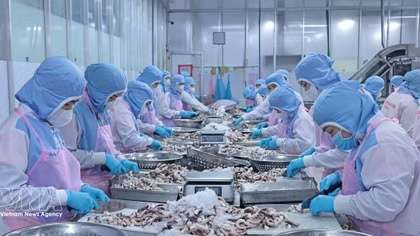
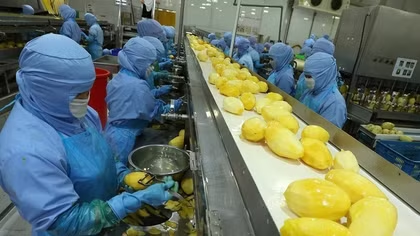
Vietnam's biggest challenge is moving beyond raw products, according to industry experts.
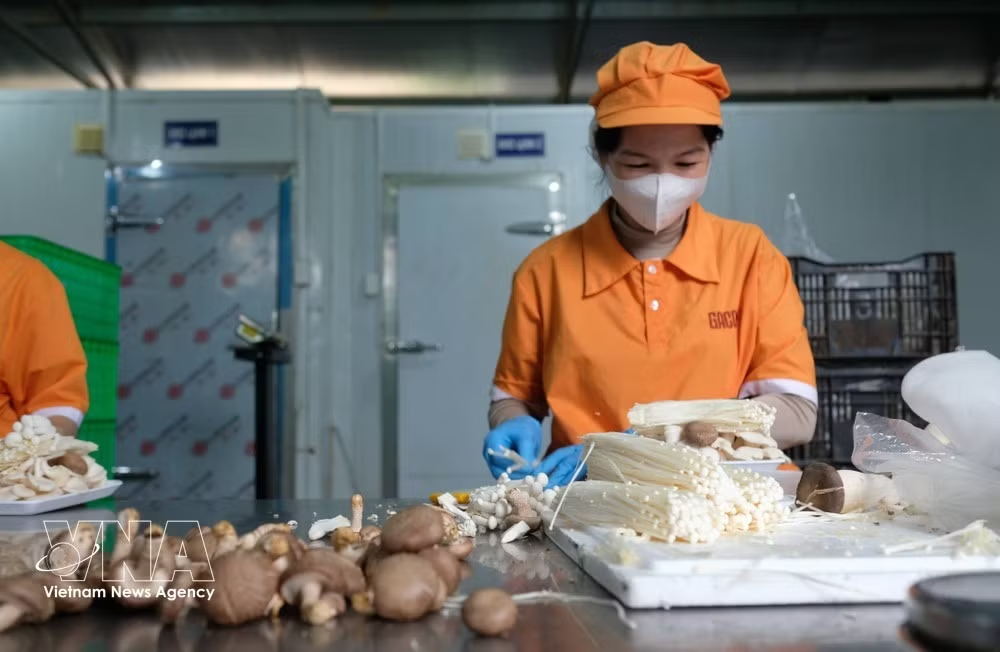
Many agricultural producers in Lam Dong province are preparing to tap the Halal market, with 38 businesses and establishments currently holding Halal certification in agriculture, food and tourism. As of May 2026, exports to Muslim-majority markets reached around 40 million USD. (Photo: VNA)

Ba Thi Nguyet Thu, Director of the HalalViet Promotion and Experience Centre, said deeply processed products remained limited, partly because Halal requirements cover ingredients, additives, flavourings and the entire production process.

Nguyen Tuan Anh, Acting Director of the Vietnam Certification Centre (QUACERT), said Halal certification was essential for entering Muslim markets but was not enough on its own. Requirements extend across production, storage, transport, labelling and traceability.

Businesses also face differences between national certification systems. Le Anh Ngoc, Head of the Ministry of Agriculture and Environment's National Authority of Agro-Forestry-Fishery Quality, Processing and Market Development, said certification recognised in Indonesia might not be accepted in Malaysia, while Malaysian certification might not meet requirements in GCC or UAE markets. Such differences raise compliance costs and complicate market access.

Experts said Vietnam needs to build integrated Halal value chains, from raw materials and processing to logistics and distribution, while investing more in deep processing and digital traceability.

Vu Thi Thanh Huyen, General Director of Nha Xanh Toan Cau Cooperative, said businesses also need clearer information on the requirements of individual markets, product compliance and supply capacity.

For Indonesia, Cuong recommended that Vietnamese exporters obtain local Halal certification, work with reputable importers, review labels and documentation, and expand online sales. Partnerships with established Halal businesses could also help build cross-border supply chains.

In Malaysia, businesses need to adapt products to local cultural and consumer preferences, while JAKIM certification remains an important requirement for access to the retail system.

The Ministry of Agriculture and Environment has called for stronger standards and greater mutual recognition among international certification systems, alongside enhanced market intelligence, business matchmaking and exporter support by trade-promotion agencies and Vietnamese Trade Offices abroad./.
en.vietnamplus.vn

Other News

Phu Quoc airport planning adjusted to serve APEC 2027

Phu Quoc airport planning adjusted to serve APEC 2027

For 2021-2030, the Civil Aviation Authority of Vietnam proposed bringing forward the investment in a parallel taxiway system and a connecting taxiway north of Runway No. 2 at Phu Quoc International Airport, in order to connect with the aircraft maintenance and repair facility (hangar) planned for the northern area of ​​the airport.

Policy, infrastructure emerge as new advantages in FDI attraction

Policy, infrastructure emerge as new advantages in FDI attraction

From policy and infrastructure to industrial real estate, Vietnam’s FDI advantages are broadening towards a more integrated production ecosystem, offering investors a stronger combination of conditions for high-value, technology-intensive and long-term projects.

Logistics upgrade vital to 1-trillion-USD trade target: experts

Logistics upgrade vital to 1-trillion-USD trade target: experts

As trade expands, systemic bottlenecks across transport networks, warehousing, ports, border gates, and industrial zones are becoming more apparent. Experts emphasise the need to shift from a fragmented, project-by-project approach toward strategic management structured around trade corridors and integrated supply chains.

Ample room for Vietnam, US to deepen cooperation

Ample room for Vietnam, US to deepen cooperation

Do Ngoc Hung, Trade Counsellor and head of the Vietnam Trade Office in the US, said what stands out is not only the growth in trade volume but also the increasingly deep economic ties between the two countries.

Flexible fiscal policy helps drive economic growth

Flexible fiscal policy helps drive economic growth

According to the Ministry of Finance, State budget revenue in the first eight months of 2026 was estimated at 2.02 quadrillion VND (77.7 billion USD), equivalent to 80% of the annual estimate and up 16% year-on-year. Domestic revenue reached 1.75 quadrillion VND, accounting for 86.6% of total revenue and rising 16.6%.

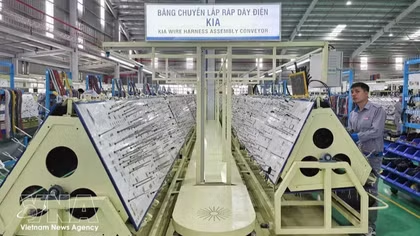
Electronic components are produced at a factory in Hanoi. (Photo: VNA)

Hanoi's imports surge 41% in first eight months of 2026

Hanoi aims to achieve average annual export growth of at least 12% during 2026-30, with the city seeking to diversify export markets, boost high-tech and value-added products and reduce reliance on traditional markets.

New opportunities for Vietnam's seafood exports

New opportunities for Vietnam's seafood exports

The Vietnam-EFTA Free Trade Agreement brings together two groups of highly complementary economies. EFTA members Switzerland, Norway, Iceland and Liechtenstein have strengths in technology, innovation, finance, clean energy and sustainable development, while Vietnam is one of Asia’s most dynamic economies and is emerging as a major regional manufacturing, trade and investment hub.

Ho Chi Minh City targets third-quarter growth of over 11%

Ho Chi Minh City targets third-quarter growth of over 11%

Ho Chi Minh City will continue to implement drastic measures to achieve double-digit growth, targeting GRDP growth of at least 11.07% in the third quarter of 2026, 9.43% in the first nine months and 12.3% in the fourth quarter, with a view to completing the full-year goal of 10% or more.

Vietnamese experts abroad join efforts to advance nuclear power development at home

Vietnamese experts abroad join efforts to advance nuclear power development at home

Held both in person and online, the seminar focused on the current status and opportunities for Vietnam’s nuclear power programme, human resources development, global trends in small modular reactors (SMRs), experience in ensuring safety and extending the operational life of nuclear power plants, and ways to mobilise Vietnamese experts abroad to contribute to the programme.

Port throughput in Hai Phong exceeds eight-month target

Port throughput in Hai Phong exceeds eight-month target

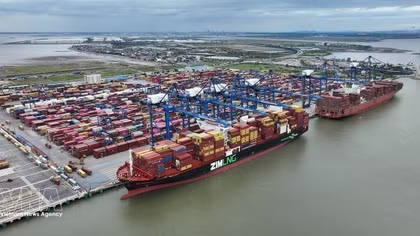
The strong performance followed a series of measures to optimise port capacity and improve the competitiveness of the city’s seaport system, with a focus on maximising the efficiency of the Lach Huyen international gateway port as new berths came into operation.