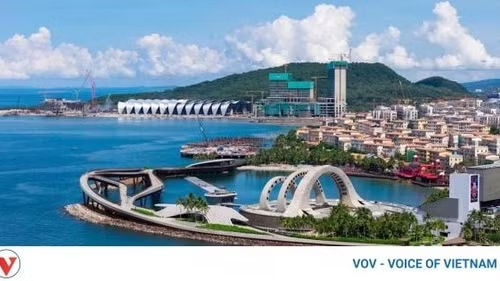
As the largest seaport city in northern Vietnam, Hai Phong plays an important role in helping establish Vietnam as a strong sea-based nation, particularly in modernising seaports and developing high-quality maritime human resources.
On July 28, 2026, the 14th Party Central Committee issued Resolution No. 20-NQ/TW on building and developing Vietnam into a strong maritime nation, specifying targets for 2030 and a vision to 2045.
Building smart, modern ports on solid foundation
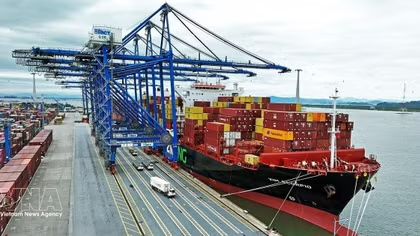
Established in 1857, the Hai Phong port system remains a key pillar of the city’s economy and has strengthened its position on the global navigation map.

According to the 2025 Container Port Performance Index (CPPI) released by the World Bank and S&P Global Market Intelligence in June 2026, the Hai Phong port cluster stands 13th among the world’s most efficient container ports, up 17 places from 2024. Meanwhile, Lloyd’s List ranked it 29th among the world’s top 100 container ports by throughput in 2025.
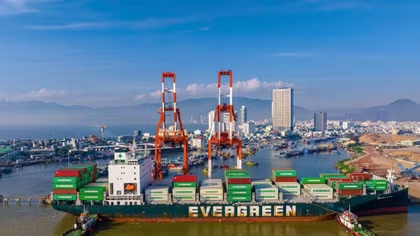
These achievements have been supported by Port of Hai Phong Joint Stock Company’s efforts to develop into a smart, modern, green, and sustainable port system. The firm’s deep-water berths No. 3 and No. 4 at Lach Huyen Port can handle 1.35–1.5 million TEUs annually, making Lach Huyen one of the deep-water ports capable of connecting Vietnam’s goods directly with the US West Coast.
Pham Hong Minh, Chairman of Port of Hai Phong Joint Stock Company, said Resolution No. 20-NQ/TW represents a strategic shift from developing the marine economy to building a strong maritime nation, with the marine economy placed within a broader framework of maritime governance, science – technology development, environmental protection, national defence and security, and national competitiveness enhancement.
He said the resolution creates favourable conditions for enterprises to expand deep-water ports, develop international container terminals, and perfect the logistics ecosystem, thus enabling the local port system to handle larger vessels, open new international shipping routes and strengthen Vietnamese goods’ connectivity with global markets.
Particularly, the resolution’s orientation towards a green maritime economy, smart ports, and digital transformation will also provide new momentum for Hai Phong Port to push ahead with technology, data, productivity, and quality-based development.
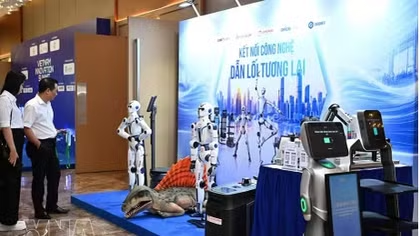
Minh noted that the company is promoting digital applications, including Big Data, Smart TOS, ERP and IoT platforms, while preparing to build a smart port ecosystem. At the same time, it is expanding its market network, strengthening cooperation with major shipping lines and promoting trade links in Europe, Singapore, the Republic of Korea, Taiwan (China) and mainland China.
These efforts are expected to enhance the port system’s international competitiveness and reinforce Hai Phong’s role in the regional logistics network, he added.
A hub for maritime human resources training
Established in 1956, Vietnam Maritime University is one of the country’s leading institutions in training high-quality human resources for navigation and marine economic sectors.
The university substantially contributed to the 2000 inclusion of Vietnam as one of the first 73 countries and territories named in the International Maritime Organisation (IMO)’s White List. It became the 44th full member of the International Association of Maritime Universities (IAMU) in 2004.
In 2025, the Government approved a project to develop Vietnam Maritime University into a key national institution supporting sustainable marine economy development towards 2030, with a vision to 2045. The goal is for the university to rank among ASEAN’s top five maritime training centres by 2030, and among the top three in ASEAN by 2035, with several fields reaching the Top 10 in Asia.
Assoc. Prof. Dr Pham Xuan Duong, Rector of the university, said Resolution No. 20-NQ/TW reflects a long-term vision for the ocean and the maritime economy. Notably, it identifies science, technology, innovation, digital transformation and high-quality human resources as key drivers for building a strong maritime nation.
He noted the resolution provides a foundation for universities to continue reforming training programmes, boosting technology application, and aligning training with market needs, helping prepare a high-quality manpower to transform Vietnam into a strong maritime nation.
According to Duong, implementing Resolution No. 20-NQ/TW requires higher education institutions to continuously update curricula in accordance with enterprises’ demand, especially in terms of such fields as shipbuilding, offshore engineering, port management, logistics, marine environmental protection and new marine economic sectors.
Universities must also strengthen cooperation with enterprises, specialised authorities and research organisations while applying simulation technology, modern training facilities and digital systems to narrow the gap between education and real-world operations, the rector went on.
With strong foundations in infrastructure and human resources, Hai Phong is expected to continue serving as a strategic driver in Vietnam’s journey towards becoming a strong maritime nation.