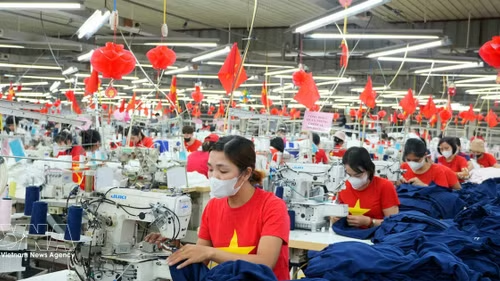
Hanoi (VNA) - Cutting administrative procedures, resolving legal bottlenecks and unlocking resources are key solutions to improve the business environment, give companies greater confidence to invest and strengthen their competitiveness, helping drive sustainable growth.
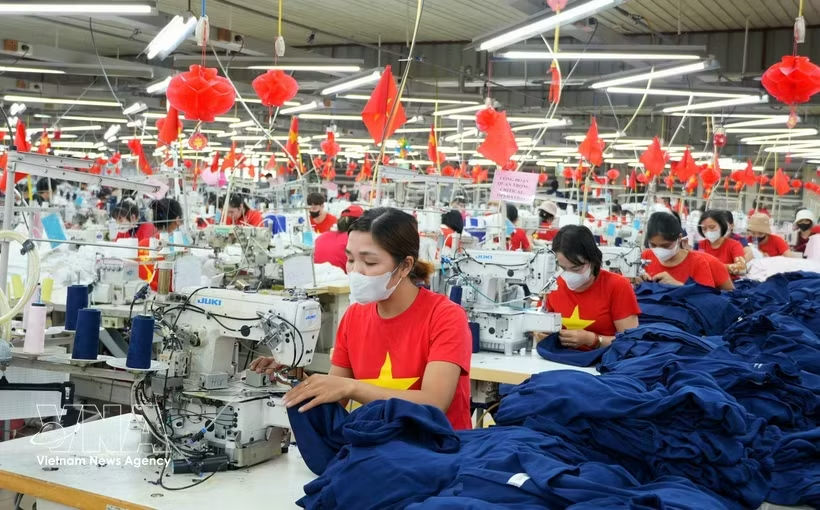
For businesses, the quality of the business environment is reflected in the time required to complete administrative procedures, compliance costs, access to capital and land, and policy stability. Institutional reform, therefore, should go beyond reducing red tape to build business confidence and encourage companies to invest and expand operations.
Nguyen Xuan Tho, Deputy Director of the Agency for Private Enterprise and Collective Economy Development under the Ministry of Finance, said the ministry has proactively reviewed practical conditions and advised the Government to issue Resolution No. 02/NQ-CP on key tasks and solutions to improve the business environment and enhance national competitiveness in 2026, with seven priority groups of measures and specific responsibilities assigned to ministries, sectors and localities.
The measures focus on improving the institutional framework, reviewing conditional business lines, streamlining administrative procedures, unlocking resources and supporting businesses. The goal is not merely to refine regulations, but to remove barriers directly affecting investment, production and business operations.
In the first nine months of 2026, efforts to review and improve the legal framework were stepped up. At the first session of the 16th National Assembly, lawmakers passed nine laws and 31 resolutions to promptly translate development policies into law.
The Ministry of Finance also advised on the refinement of various policies on investment, corporate income tax, personal income tax and tax administration, aiming to address shortcomings identified in practice.
One notable development has been the expansion of financial support for businesses. In the nine-month period, the ministry advised on and implemented tax, fee and charge exemptions, reductions and payment extensions worth a total of about 245.6 trillion VND (9.5 billion USD). These measures have helped ease cash-flow pressures, sustain business operations and free up resources for investment.
Another area of reform is strengthening dialogue with businesses and addressing their concerns. Tho said that, to date, ministries and agencies had responded to and fully resolved 146 of the 202 groups of business recommendations.
From the business community’s perspective, the gap between policy and implementation remains a major bottleneck in the business environment.
Ho Sy Hung, Chairman of the Vietnam Chamber of Commerce and Industry (VCCI), said businesses could have different experiences with the same regulation depending on the locality.
Decisive implementation can help companies benefit from policies sooner, while delays elsewhere may cause them to miss investment and business opportunities, he elaborated.
In July 2026, VCCI compiled nearly 900 specific concerns raised by businesses into 53 groups of issues across 10 sectors. The feedback showed that businesses need not only individual administrative procedures to be resolved, but also a stable, consistent and predictable policy environment, Hung said.
Hung said that while the previous phase focused on breakthroughs in institutional reform, the next should place greater emphasis on breakthroughs in implementation.
Reform should therefore be measured not simply by the number of amended regulations or procedures cut, but by whether policies are implemented consistently, processing times are genuinely shortened and business costs are reduced, he added.
To narrow this gap, Tho suggested ministries, sectors and localities improve the quality of lawmaking, resolutely remove barriers to market access, further simplify administrative procedures, make processes transparent and standardise how business recommendations are received and addressed.
Digital transformation in public service delivery should go hand in hand with reducing unnecessary face-to-face interactions, curbing informal costs and strengthening dialogue to resolve problems at an early stage, he said.
Tho also proposed reforming state management by shifting from pre-inspection to post-inspection, as appropriate for each sector, based on clear standards and technical regulations and stronger risk-based oversight.
Business environment reforms should also be aligned with the goal of improving growth quality. Nguyen Duc Hien, deputy head of the Party Central Committee’s Commission for Policy and Strategy, stressed that in the new phase, promoting the private sector, harnessing the potential of all economic sectors, and advancing science and technology, innovation and digital transformation are key foundations for achieving the target of double-digit economic growth.
Hien said traditional growth drivers need to be revitalised to meet new development requirements. For exports, the focus should go beyond increasing turnover to raising value added, boosting the share of value created domestically and setting appropriate development directions for each industry group.
Sectors with the potential to drive growth and generate spillover effects, including research and development (R&D), tourism, logistics, energy, and finance and banking, need to be promoted.
Meanwhile, established industries such as electronics, digital technology, textiles and garments, footwear, and food processing should continue to upgrade product quality, strengthen technological capabilities and increase domestic value added, Hien suggested./.