Vietnam ties FDI incentives to local supplier commitments

Incentives will increasingly hinge on investors’ performance and commitments, not just on landing projects. Key commitments include transferring technology to Vietnamese firms, training workers, providing technical support and opening FDI supply chains to domestic companies.

As localisation in FDI production chains currently stands at just 20-25%, Vietnam is moving to link investment incentives to foreign firms’ commitments to develop domestic suppliers, a shift expected to tighten business linkages, lift added value and sharpen competitiveness.

Technology transfer remains a bottleneck

Foreign-invested firms account for a large share of Vietnam’s exports, yet much of that value rests on imported raw materials and components. Domestic added value is below half, well behind other East and Southeast Asian economies, particularly in manufacturing and electronics. Most Vietnamese companies remain confined to simple processing and low-added-value stages of the value chain.
1.jpg
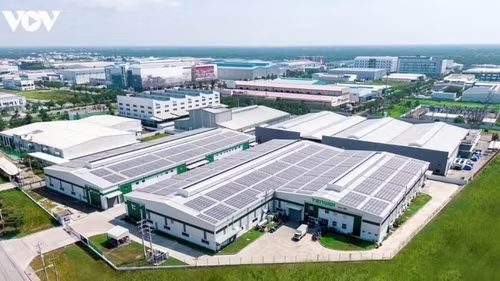
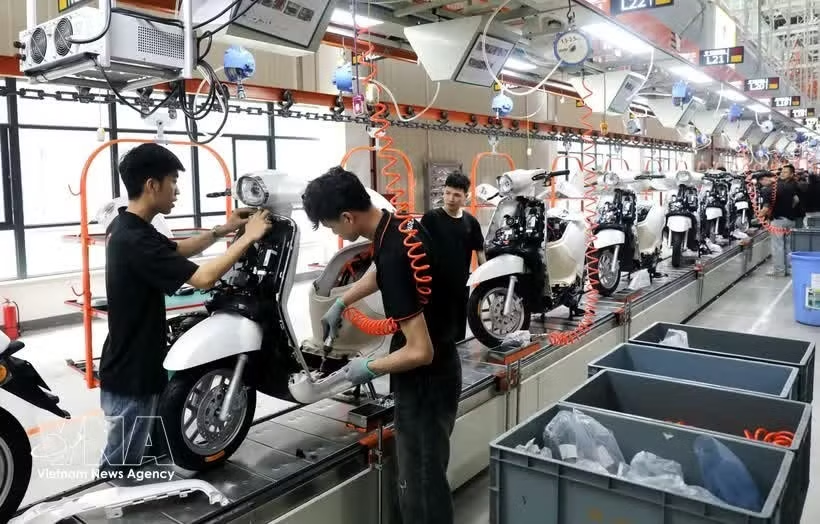
At Yadea Vietnam’s smart manufacturing plant in Tan Hung Industrial Park, Bac Ninh province (Photo: VNA)

Technology transfer from FDI enterprises remains limited and has improved only slowly, said Bui Thu Thuy, Deputy Director of the Foreign Investment Agency (FIA) under the Ministry of Finance (MOF).

Citing the Ministry of Science and Technology data, Thuy said only about 600 technology transfer contracts were registered nationwide in 2006-2016, equal to less than 4.3% of FDI projects. Around 400 were recorded in 2018-2022, mostly intra-company transfers between parent companies and their Vietnamese branches, aimed chiefly at supporting the foreign firms’ own production and operations. Transfers centred on technical support (77%), training (71%) and production processes (73%), while those involving intellectual property made up just 13%.

Under the Politburo’s Resolution 10-NQ/TW dated June 8, 2026 on developing the foreign-invested economy, Vietnam is fundamentally overhauling its approach to FDI, shifting from passive attraction to proactively selecting quality, hi-tech investment with spillover impacts on the domestic economy.

The MOF is studying amendments to the Investment Law to codify more generous preferential mechanisms, steering investment attraction toward selectivity rather than courting capital at any cost.
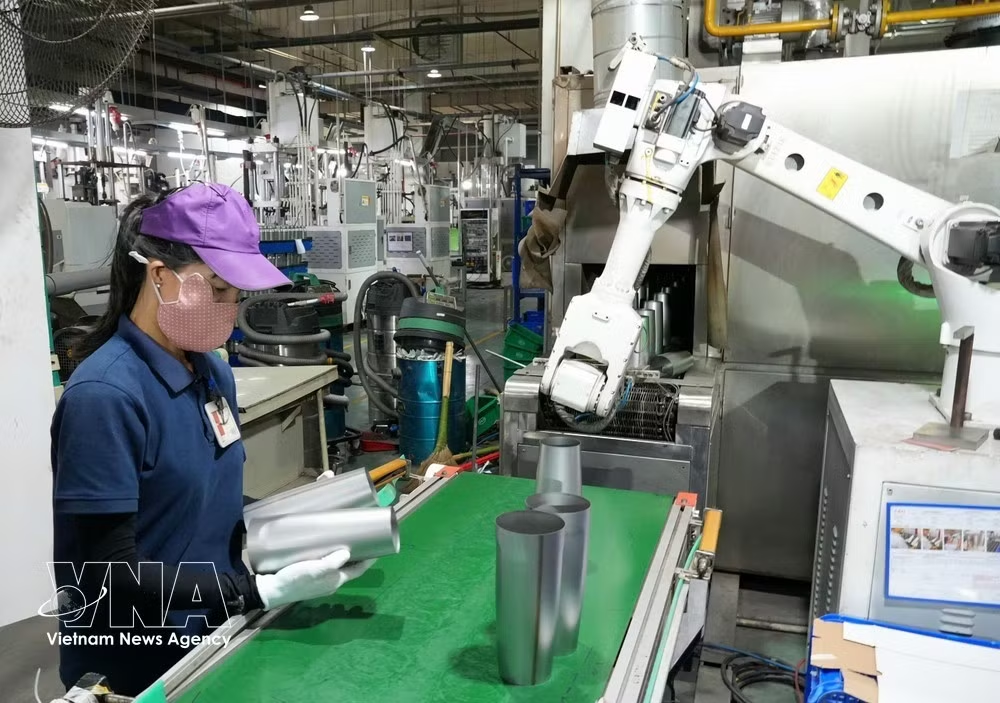
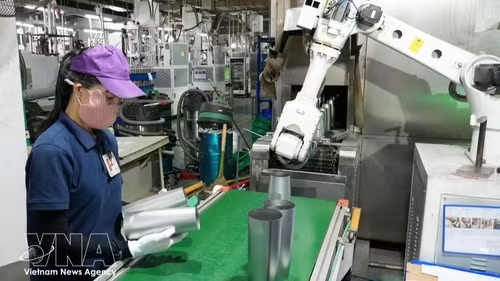
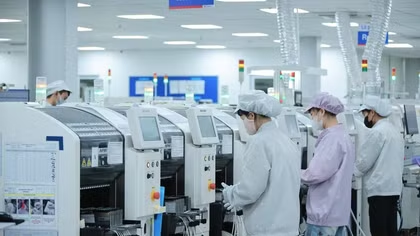
An automated robotic production line at Yen Phong II-C Industrial Park, Bac Ninh province (Photo: VNA)

Incentives will increasingly hinge on investors’ performance and commitments, not just on landing projects. Key commitments include transferring technology to Vietnamese firms, training workers, providing technical support and opening FDI supply chains to domestic companies.

Making Vietnam’s manufacturing ecosystem more competitive

Resolution 10-NQ/TW targets about 10,000 domestic firms in the value and supply chains of FDI enterprises by 2030, including 500-1,000 tier-1 suppliers. The 2026-2035 supporting industry development scheme, approved under Decision 929/2026/QD-TTg, makes developing supporting industries along global supply and value chains a priority, with leading enterprises’ technical requirements, quality standards and localisation rates serving as key criteria for support policies.

Many foreign-invested companies want to buy more from Vietnamese enterprises, Thuy said.

Cha Ji Ho, Samsung Vietnam’s Deputy General Director in charge of its procurement centre, said Samsung is shifting from boosting suppliers’ production capacity to building deeper specialised capabilities and a supplier ecosystem in Vietnam. The company plans to widen its support geographically, add participating firms and deepen their capabilities, extending from hubs like Bac Ninh and Ho Chi Minh City to Phu Tho, Hai Phong and Thai Nguyen, while stepping up cooperation with local suppliers.

Samsung proposed systematic cooperation among the Government, the company and Vietnamese enterprises, built on a supplier database and clear support policies and frameworks. The aim is to raise localisation rates, broaden access to supply chains and sharpen domestic manufacturers’ competitiveness.

It also suggested publishing an annual Supplier Development White Paper to establish a mechanism for cooperation and long-term monitoring of supply chain development.

Under this approach, ties between FDI and Vietnamese companies will move beyond simple buyer-supplier relationship toward joint development and sustainable partnerships, and better competitiveness of Vietnam’s manufacturing ecosystem as a whole.

en.vietnamplus.vn

Other News

Vietnam – a potential regional supply hub for Jatropha seed oil

Vietnam – a potential regional supply hub for Jatropha seed oil

Japan’s research on non-edible oil feedstocks showed that Jatropha is highly drought-tolerant and could grow well on wasteland, eroded sandy land and infertile soil. Given this, areas in central Vietnam, including Ninh Thuan, Binh Thuan and the Central Highlands, have climatic, sunlight and soil conditions suitable for achieving high seed yields and oil content.

Vietnam enters investment grade credit rating category for first time

Vietnam enters investment grade credit rating category for first time

Vietnam has maintained robust growth, outperforming other Southeast Asian economies. Its ongoing government reforms aimed at streamlining the state apparatus, promoting the private sector, improving the institutional framework and developing capital markets will strengthen the country’s growth potential and economic resilience.

Vietnam, Laos seek to expand room for trade, investment cooperation

Vietnam, Laos seek to expand room for trade, investment cooperation

Vietnam and Laos aim to boost bilateral trade in 2026 towards the milestone of 10 billion USD by 2030, a target said to be challenging but feasible as both Governments work to remove trade barriers, improve border-trade mechanisms, and strengthen transport and logistics connectivity.

Vietnam's national brand value jumps 45% to over 462 bln USD

Vietnam's national brand value jumps 45% to over 462 bln USD

Deputy Minister of Industry and Trade Luong Hoang Thai outlined Vietnam's National Brand Programme 's achievements, the role of business community and plans for brand development in a press interview ahead of the 10th Vietnam National Brand Product recognition ceremony on October 16.

Vietnam revises scheme to improve sovereign credit rating by 2030

Vietnam revises scheme to improve sovereign credit rating by 2030

Under the decision, Vietnam aims to become a developing country with modern industry and upper-middle income by 2030, while building a competitive and effective governance system and a dynamic economy driven by science, technology, innovation and digital transformation.

Vietnam posts GDP growth of 9.95% in Q3

Vietnam posts GDP growth of 9.95% in Q3

In the first nine months, Vietnam's GDP was estimated to increase 9.01% from the same period last year. Agriculture, forestry and fisheries grew 4.02%, contributing 5.35% to overall gross value added growth; industry and construction rose 11.21%, contributing 49.62%; and services expanded 8.69%, contributing 45.03%.

Vietnam sees 149,700 new businesses in nine months

Vietnam sees 149,700 new businesses in nine months

Vietnam recorded nearly 149,700 newly established enterprises in the first nine months of 2026, up 3.2% year-on-year, with total registered capital rising 32.7% to over 1.88 quadrillion VND (71.6 billion USD).

Vietnam accelerates innovation to boost growth, competitiveness

Vietnam accelerates innovation to boost growth, competitiveness

By 2030, Vietnam aims to rank among the world’s top 40 in the GII; raise total social investment in R&D to at least 2% of GDP, with non-State funding accounting for over 60%; increase international scientific publications by an average of 10% annually; and raise the number of patent applications and granted patents by an average of 16-18% annually.

Vietnam sees high growth prospects

Vietnam sees high growth prospects

Experts from the Institute of Vietnam and World Economy under the Vietnam Academy of Social Sciences noted the quality of recent growth as the high growth rate has been recorded against an increasingly higher comparative base.

Vietnam seeks bigger share of global Halal market

Vietnam seeks bigger share of global Halal market

Vietnam's Halal exports remain modest at around 900 million USD a year, accounting for less than 1% of the global market. Most exports are still raw agricultural and seafood products. Only around 1,000–1,300 Vietnamese businesses obtained or maintained Halal certification during 2024–2026.

Hanoi sets up inter-agency mechanism to operate carbon market

Hanoi sets up inter-agency mechanism to operate carbon market

Under a decision of the municipal People’s Committee on establishing an inter-agency working group, departments and agencies are responsible for identifying facilities subject to greenhouse gas inventories, developing emissions-reduction plans and studying projects capable of generating carbon credits.

Shrimp exports reach 3.3 billion USD in eight months

Shrimp exports reach 3.3 billion USD in eight months

According to data from the Vietnam Customs cited by the Vietnam Association of Seafood Exporters and Producers (VASEP), shrimp exports reached 478.5 million USD in August, up 4.2% from the same month last year. The eight-month total stood at 3.3 billion USD, representing a year-on-year increase of 12%.

Russian investors explore opportunities in Vietnam's real estate market

Russian investors explore opportunities in Vietnam's real estate market

Vietnam is seen as a potential market, with considerable room for growth in real estate, particularly commercial property, compared with some regional markets. Strong Vietnam-Russia ties and opportunities to establish foreign-invested enterprises are also considered favourable for Russian investors.