Vietnam targets higher-quality FDI under Resolution 10

During the first seven months of 2026, Vietnam attracted more than 38 billion USD in registered FDI, up nearly 58% year-on-year. More importantly, the increase was driven by large-scale, high-tech projects rather than a surge in the number of new investments, signalling a significant improvement in the quality of capital inflows.

Hanoi (VNA) – Vietnam is shifting its foreign direct investment (FDI) strategy from attracting capital to enhancing investment quality, with the Politburo’s Resolution No. 10 aiming to draw high-value projects, advanced technologies and stronger linkages between foreign investors and domestic enterprises to strengthen the country's long-term development capacity.
download-16.png
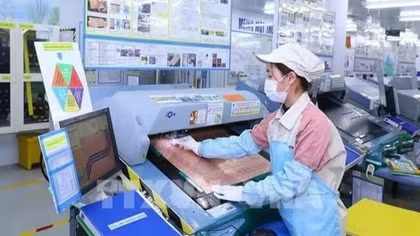
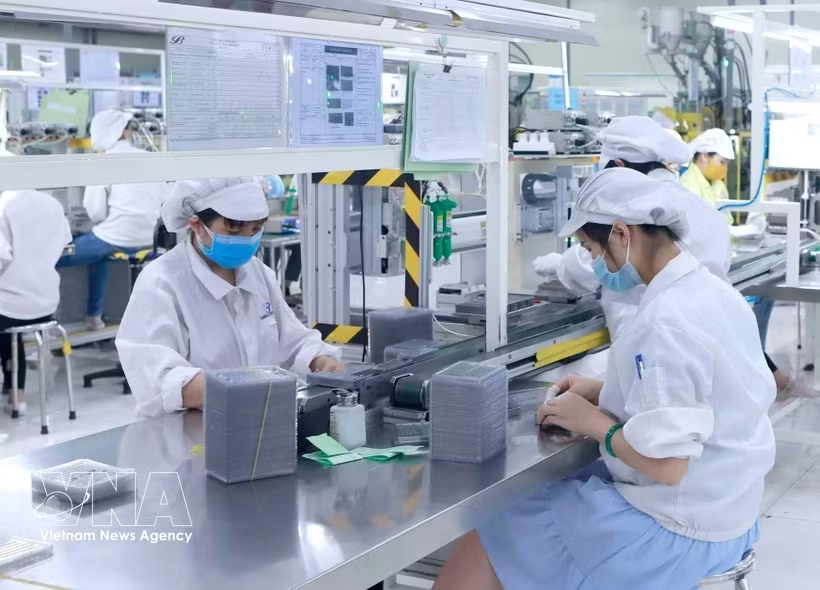
Production of electronic components at Star Engineers Vietnam Co. Ltd. in Binh Xuyen I Industrial Park in Phu Tho province. (Photo: VNA)

During the first seven months of 2026, Vietnam attracted more than 38 billion USD in registered FDI, up nearly 58% year-on-year. More importantly, the increase was driven by large-scale, high-tech projects rather than a surge in the number of new investments, signalling a significant improvement in the quality of capital inflows.

According to the Ministry of Finance, newly registered FDI projects rose only 7.8% year-on-year, while newly registered capital more than doubled to over 21 billion USD. The average capital size per project also increased substantially, reflecting a growing preference among multinational corporations for strategic investments.

The manufacturing and processing sector remained the largest recipient, attracting 18.68 billion USD in registered capital. Many new projects were concentrated in high-value industries such as semiconductors, electronics, information technology, science and technology, and energy infrastructure. A notable example is LG Innotek’s 1-billion-USD semiconductor plant in Hai Phong – the company’s first semiconductor manufacturing facility outside the Republic of Korea.

The quality of FDI is also reflected in investment implementation. Disbursed FDI reached more than 15.2 billion USD during the seven-month period, the highest level recorded for the same period in five years. Economists said the steady increase in disbursement demonstrates investors’ confidence in Vietnam’s business environment and long-term economic prospects.

Richard Barnsley, Head of Global Network Banking at HSBC Vietnam, said Vietnam has become one of the world’s leading destinations for FDI thanks to its competitive labour costs, political stability, an expanding network of free trade agreements and improving investment climate.

Today, the foreign-invested sector accounts for around three-quarters of Vietnam’s export value. However, he noted that the export-oriented FDI model has limitations. The country’s next stage of development requires not only attracting more investment but also capturing greater value from it.

These views align closely with Resolution No. 10, which sets ambitious targets for 2025–2030, including attracting 200–300 billion USD in newly registered FDI, disbursing 150–200 billion USD with about three-quarters of new investment comes from developed economies, integrating 10,000 Vietnamese enterprises into FDI supply chains, and attracting at least three leading global technology corporations to establish regional headquarters or R&D centres in Vietnam.
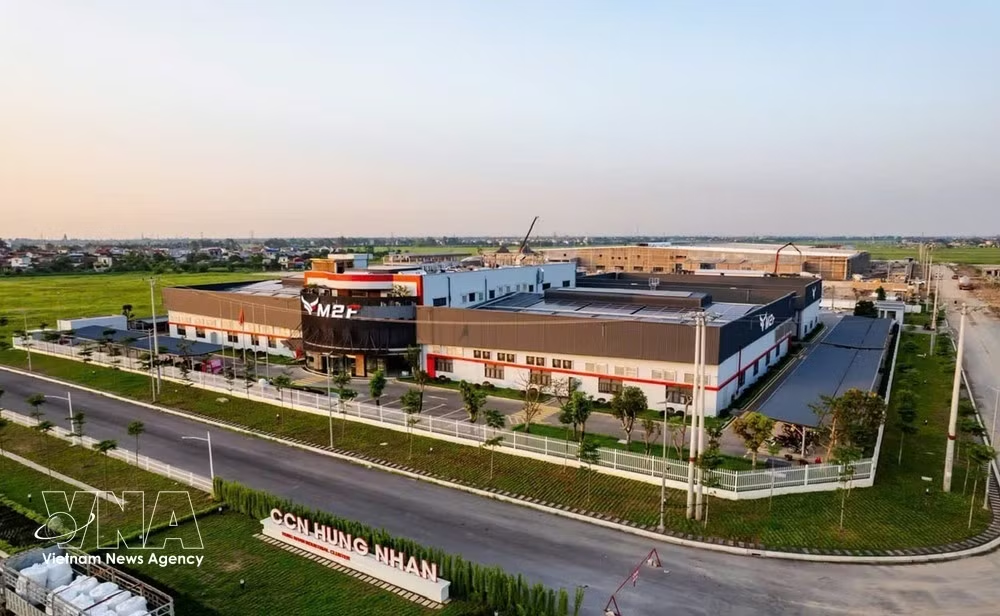
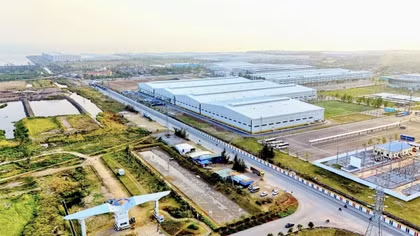
Hung Nhan Industrial Cluster in Hung Yen province. (Photo: VNA)

Tran Anh Tung, Head of the Business Administration Faculty at Ho Chi Minh City University of Economics and Finance, said Resolution No. 10 marks a fundamental shift in Vietnam’s FDI strategy. Instead of measuring success solely by investment volume, it prioritises the spillover effects of FDI, including technology transfer, innovation, localisation and the development of domestic suppliers.

The resolution also gives priority to next-generation industries such as semiconductors, artificial intelligence, biotechnology, green energy, data centres and R&D, while encouraging incentives based on investment quality rather than project size.

Nguyen Quoc Viet, head of the macroeconomic research team at the University of Economics under the Vietnam National University, Hanoi, said improving FDI quality will help Vietnam integrate more deeply into global supply chains, enhance export value and support long-term economic growth.

He stressed that future assessments of FDI performance should focus not only on registered capital or project numbers but also on implementation efficiency and the value retained within the domestic economy.

Tung said that as Vietnam moves beyond its traditional advantage of low-cost labour, high-quality FDI will become a key driver of technological advancement, innovation and productivity.

If effectively implemented, Resolution No. 10 could help transform Vietnam from a manufacturing hub into a regional centre for high-value industries, enabling the country to move from “Made in Vietnam” to “Created in Vietnam” in the era of artificial intelligence and the digital economy, he added./.
VNA
en.vietnamplus.vn

Other News

Policy, infrastructure emerge as new advantages in FDI attraction

Policy, infrastructure emerge as new advantages in FDI attraction

From policy and infrastructure to industrial real estate, Vietnam’s FDI advantages are broadening towards a more integrated production ecosystem, offering investors a stronger combination of conditions for high-value, technology-intensive and long-term projects.

Logistics upgrade vital to 1-trillion-USD trade target: experts

Logistics upgrade vital to 1-trillion-USD trade target: experts

As trade expands, systemic bottlenecks across transport networks, warehousing, ports, border gates, and industrial zones are becoming more apparent. Experts emphasise the need to shift from a fragmented, project-by-project approach toward strategic management structured around trade corridors and integrated supply chains.

Ample room for Vietnam, US to deepen cooperation

Ample room for Vietnam, US to deepen cooperation

Do Ngoc Hung, Trade Counsellor and head of the Vietnam Trade Office in the US, said what stands out is not only the growth in trade volume but also the increasingly deep economic ties between the two countries.

Flexible fiscal policy helps drive economic growth

Flexible fiscal policy helps drive economic growth

According to the Ministry of Finance, State budget revenue in the first eight months of 2026 was estimated at 2.02 quadrillion VND (77.7 billion USD), equivalent to 80% of the annual estimate and up 16% year-on-year. Domestic revenue reached 1.75 quadrillion VND, accounting for 86.6% of total revenue and rising 16.6%.

Electronic components are produced at a factory in Hanoi. (Photo: VNA)

Hanoi's imports surge 41% in first eight months of 2026

Hanoi aims to achieve average annual export growth of at least 12% during 2026-30, with the city seeking to diversify export markets, boost high-tech and value-added products and reduce reliance on traditional markets.

New opportunities for Vietnam's seafood exports

New opportunities for Vietnam's seafood exports

The Vietnam-EFTA Free Trade Agreement brings together two groups of highly complementary economies. EFTA members Switzerland, Norway, Iceland and Liechtenstein have strengths in technology, innovation, finance, clean energy and sustainable development, while Vietnam is one of Asia’s most dynamic economies and is emerging as a major regional manufacturing, trade and investment hub.

Ho Chi Minh City targets third-quarter growth of over 11%

Ho Chi Minh City targets third-quarter growth of over 11%

Ho Chi Minh City will continue to implement drastic measures to achieve double-digit growth, targeting GRDP growth of at least 11.07% in the third quarter of 2026, 9.43% in the first nine months and 12.3% in the fourth quarter, with a view to completing the full-year goal of 10% or more.

Vietnamese experts abroad join efforts to advance nuclear power development at home

Vietnamese experts abroad join efforts to advance nuclear power development at home

Held both in person and online, the seminar focused on the current status and opportunities for Vietnam’s nuclear power programme, human resources development, global trends in small modular reactors (SMRs), experience in ensuring safety and extending the operational life of nuclear power plants, and ways to mobilise Vietnamese experts abroad to contribute to the programme.

Port throughput in Hai Phong exceeds eight-month target

Port throughput in Hai Phong exceeds eight-month target

The strong performance followed a series of measures to optimise port capacity and improve the competitiveness of the city’s seaport system, with a focus on maximising the efficiency of the Lach Huyen international gateway port as new berths came into operation.

Vietnam, Mercosur begin trade negotiations

Vietnam, Mercosur begin trade negotiations

During the session, both sides reaffirmed their determination to advance the negotiations in a spirit of goodwill, with a view to reaching a balanced agreement that aligns with the interests of both Vietnam and Mercosur.