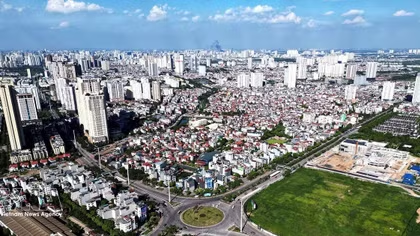
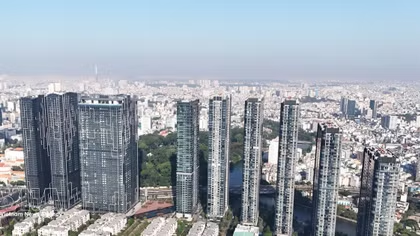
Ho Chi Minh City (VNA) – Half a century after being named after President Ho Chi Minh, Ho Chi Minh City has remained at the forefront of Vietnam’s economic transformation. From opening to foreign direct investment (FDI) in the first years of Doi Moi (Renewal), the city is now shifting from attracting capital to focusing on high-quality investment to support a new growth cycle.
From manufacturing hub to innovation centre
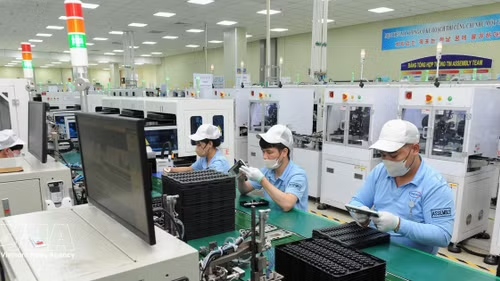
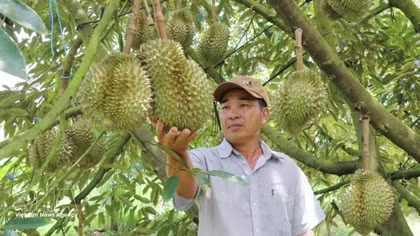
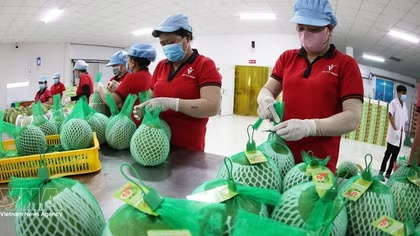
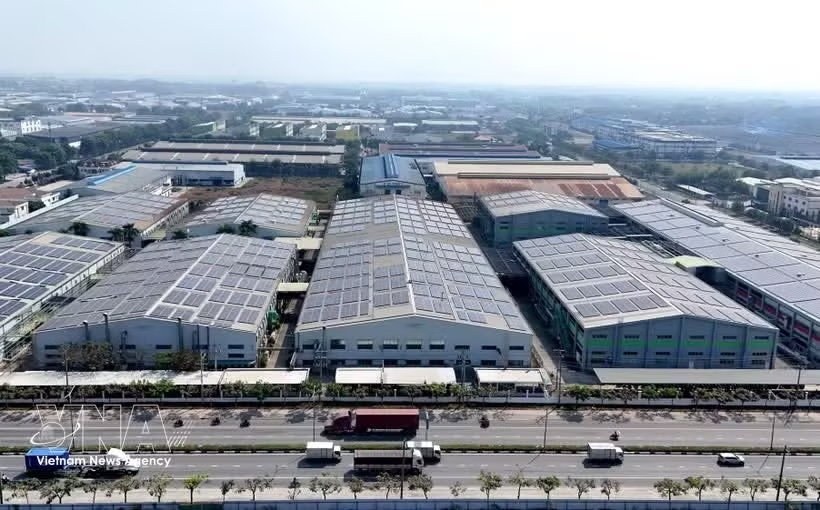
Since the early 1990s, Ho Chi Minh City has pioneered key investment models. Tan Thuan Export Processing Zone, established in 1991 as Vietnam’s first, marked the start of FDI inflows. It was followed by Saigon Hi-Tech Park in 2002 and the High-Tech Agricultural Park in 2004, shaping a shift towards technology- and innovation-driven investment.
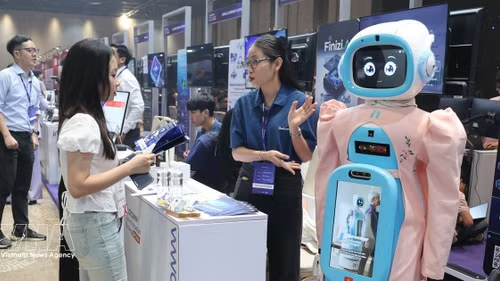
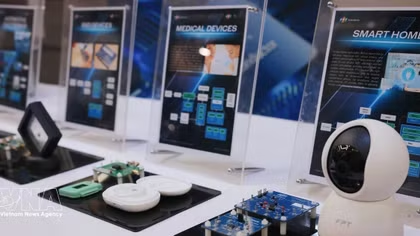
Today, the city is evolving from a production base into a destination for R&D and innovation serving global markets.
Germany’s Bosch is a typical example. Entering in 1994 with about 10 employees, Bosch established its legal entity in 2007 and now employs nearly 6,000 people in Vietnam.
The company has shifted from manufacturing to higher value-added activities. Bosch Vietnam General Director Andre de Jong said that while Vietnam’s manufacturing sector in 2008 focused on textiles, footwear and agriculture, the structure has since shifted toward electronics, semiconductors, AI and modern services, alongside a stronger supporting ecosystem.
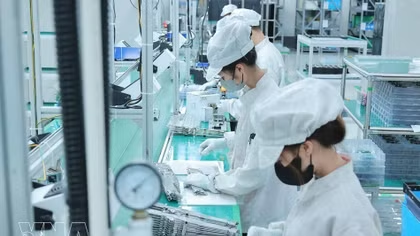
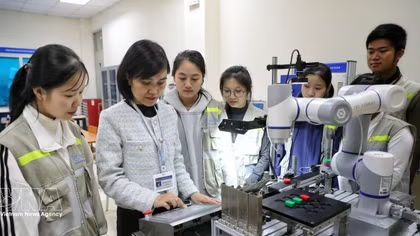
Bosch’s R&D strategy reflects confidence in Vietnam’s talent pool. Nearly 4,000 engineers in Vietnam now participate in global value chains, including automotive software, semiconductor design and MEMS sensor technologies. Bosch operates six legal entities, four R&D and innovation centres, and multiple shared service hubs.
Ho Chi Minh City offers favourable conditions, including high-quality human resources and an ecosystem supporting business, R&D and innovation, de Jong said.
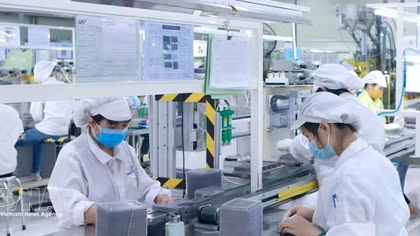
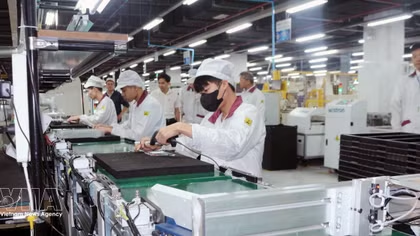
Other major firms such as Intel, Samsung and Nidec have also made Ho Chi Minh City their manufacturing and R&D base in Southeast Asia, reflecting a shift from cost advantages to talent and innovation-driven competitiveness.
The trend continues. In September 2025, the Czech Republic’s EmbedIT (PPF Group) opened its Southeast Asia development centre in the city.
EmbedIT Country Manager for Vietnam Jan Bergl cited Vietnam’s digital growth, stable political environment, young tech workforce and competitive costs as key advantages. Despite rapid AI-driven skill changes, Vietnamese engineers remain highly promising. The centre reflects EmbedIT’s long-term commitment.
Within a year, EmbedIT Vietnam grew from a small core team to nearly 100 engineers, targeting around 250 staff by 2027 to support ASEAN operations in lending platforms, AI, data, infrastructure and cybersecurity.
Building an ecosystem for next-generation investment
These cases illustrate Ho Chi Minh City’s transition from manufacturing to R&D and innovation hub, reshaping its FDI strategy.
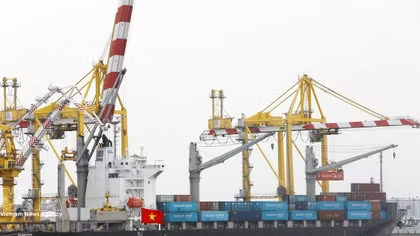
According to the Department of Finance, as of May 31, the city had nearly 21,000 active FDI projects worth over 143.3 billion USD, remaining Vietnam’s leading FDI destination. In the first half of 2026, FDI reached over 6.8 billion USD.
FDI contributes about 20% of GRDP and over 50% of exports, said Chairman of the municipal People’s Committee Nguyen Van Duoc at a conference on Resolution No. 10-NQ/TW.
He noted the traditional model based on low-cost labour, land and tax incentives has reached its limit. As global supply chains shift, competition now depends on institutions, business environment and innovation capacity.
This is why the city is prioritising an international financial centre as a strategic pillar.
Vietnam needs an estimated 1.5–1.6 trillion USD in investment for 2026–2035, while the state budget can meet only about 20%. Ho Chi Minh City alone needs about 3.2 quadrillion VND for 2026–2030, with only 1.2 quadrillion VND from public funds.
The international financial centre is expected to attract global institutions, funds and banks, and channel long-term capital into infrastructure, technology and innovation, while also bringing financial technology, governance standards, data systems and global networks.
Associate Professor Nguyen Huu Huan, Vice Chairman of the Vietnam International Financial Centre in Ho Chi Minh City (VIFC-HCMC) Executive Board, said the centre will enhance competitiveness and mobilise capital for infrastructure and innovation, strengthening global financial integration.
Standard Chartered Vietnam General Director Nguyen Thuy Hanh said the framework will increase attractiveness to global investors and improve access to international capital for Vietnamese firms.
With its shift from quantity to quality, technology spillovers and value creation, Ho Chi Minh City is building a new FDI ecosystem to reinforce its role as Vietnam’s economic engine and strengthen its regional position./.