SBV raises short-term capital lending cap to 40%

The new circular will help credit institutions have more room to provide capital to businesses and investment projects to support high economic growth in the next few years, while increasing flexibility in the SBV’s monetary policy management.

Hanoi (VNS/VNA) - The maximum ratio of short-term capital used for medium- and long-term lending by credit institutions will be raised from the current 30% to 40% from July 1, according to a newly issued circular from the State Bank of Vietnam (SBV).
4.jpg
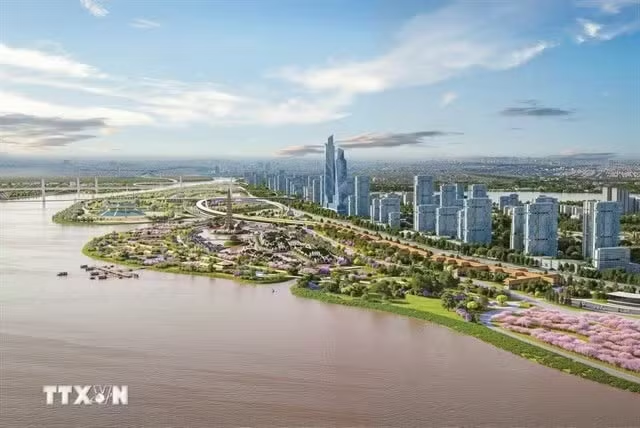
A mock-up of the Red River Landscape Boulevard project in Hanoi. Demand for capital for infrastructure projects is increasing sharply. (Photo: VNA)

Circular 25/2026/TT-NHNN on limits for ratios in banking operations in Việt Nam will also amend regulations on determining total deposits when calculating the loan-to-deposit ratio.

Under current regulations, when determining total deposits, credit institutions must exclude all demand deposits from the State treasury and exclude 80% of the treasury's time deposits. The new circular retains the exclusion of demand deposits from the State treasury, but adds a more flexible mechanism for time deposits.

In addition to the current 80% exclusion rate, the SBV’s governor can decide to apply a different rate depending on market developments.

According to the SBV, the amendments are based on the implementation of the Party and Government's policies on promoting economic growth in the next five years.

The new circular will give credit institutions more room to provide capital to businesses and investment projects to support higher economic growth in the next few years, while increasing flexibility in the SBV’s monetary policy management.

CEO of financial services provider AFA Capital Nguyen Minh Tuan said the adjustment is expected to support medium- and long-term capital for economic growth.

Tuan noted that Vietnam is entering a new development cycle with high demand for investment capital for infrastructure, production, energy and large-scale projects. As the capital market is still unable to fully meet its role in providing medium- and long-term capital, the banking system remains the main channel for capital flow in the economy.

Economic growth will require a very large amount of capital. Amid increasing demand for medium- and long-term capital, while the majority of mobilised capital remains short-term, creating more room for the banking system is a solution to support growth, he said.

Nguyen Quang Huy, CEO of Nguyen Trai University’s Finance and Banking Faculty, agreed, saying that raising the ratio to 40% will give commercial banks more room to provide medium- and long-term credit, while reducing the pressure to mobilise long-term capital at high costs.

Demand for capital for infrastructure projects in transportation, energy, logistics, industrial parks and manufacturing is increasing sharply. These are all sectors that require a lot of capital, have long payback periods and are crucial for expanding the production capacity of the economy.

At the same time, Huy said the new policy can create more favourable conditions for social housing projects, industrial real estate and projects with completed legal procedures, thus supporting an increase in supply to the market.

Do Bao Ngoc, deputy general director of Vietnam Construction Securities Company, said that raising the ratio to 40% will give banks more room for medium- and long-term lending without having to significantly increase long-term deposit mobilisation.

This contributes to reducing pressure on issuing securities, certificates of deposit or competition in long-term deposit interest rates among banks, supporting the ability to supply capital to the economy.

Although considered a growth-support move, experts believe that expanding medium- and long-term credit capacity also places higher demands on the governance of credit institutions.

Tuan said that banking operations are inherently linked to the process of converting maturities between mobilised capital and loans. Expansion of lending will therefore be accompanied by the requirement to improve asset and capital management capabilities and risk control.

According to analysts of the Vietcap Security Company, the entire banking sector will generally benefit from the new policy. However, some banks including Techcombank, VPBank and MB, whose ratios of short-term capital used for medium- and long-term lending as of the end of Q1 2026 were close to the regulated cap, will benefit more.

In addition, State-owned banks such as Vietcombank, BIDV and VietinBank, which have large outstanding loans in the infrastructure sector, will also benefit as the disbursement of their medium and long-term loans is accelerated./.
en.vietnamplus.vn

Other News

Green building trend flourishes in Ho Chi Minh City's real estate landscape

Green building trend flourishes in Ho Chi Minh City's real estate landscape

The International Finance Corporation (IFC) highlighted the city's dominance in green-certified building floor space in Vietnam, reflecting the rapid expansion of the green building market with 780 completed green buildings encompassing over 18.69 million sq.m by 2025, predominantly certified by EDGE and LEED.

UK supports Vietnam in wind power and green finance development

UK supports Vietnam in wind power and green finance development

The United Kingdom officially announced two new climate cooperation initiatives to support Vietnam in its energy transition and green growth journey. These programs focus on offshore wind power development and the creation of a sustainable green financial ecosystem.

Ample room remains for Vietnam–India logistics cooperation

Ample room remains for Vietnam–India logistics cooperation

The GTTCI expert noted that alongside logistics and integrated warehousing, e-commerce is expected to be a particularly high-growth sector in the coming years. He described it as a multi-billion-dollar market with significant untapped opportunities for cooperation between Vietnam and India.

Exports gain momentum from high-tech growth drivers

Exports gain momentum from high-tech growth drivers

According to the Ministry of Industry and Trade, Vietnam’s exports reached 215.66 billion USD in the first five months of 2026, up 19.5% year-on-year. Twenty-six export items generated more than 1 billion USD in revenue each, including seven with turnover exceeding 10 billion USD.

Vietnam–China crossings see spike in ASEAN fresh produce

Vietnam–China crossings see spike in ASEAN fresh produce

Since the start of the summer harvest season, China's two major border gates with Vietnam, Youyi Guan in Pingxiang and Beilun 2 Bridge in Dongxing, have entered their peak period for handling imports of fresh agricultural and seafood products from member states of the Association of Southeast Asian Nations (ASEAN).

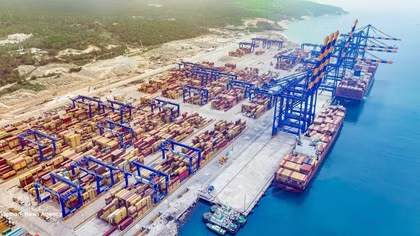
Cargo handling operations at Berths 3 and 4 of the Hai Phong International Gateway Port. (Photo: VNA)

AI reshapes logistics, raising bar for workforce skills

According to the Vietnam Logistics Business Association (VLA), the logistics sector will require around 2.2 million workers by 2030, including 1.6 million employees for logistics service providers and nearly 600,000 personnel supporting logistics operations in manufacturing and trading enterprises.

Robust dispute resolution framework key to Vietnam's IFC ambitions

Robust dispute resolution framework key to Vietnam's IFC ambitions

The development strategy for VIFC-HCMC envisions a comprehensive financial ecosystem encompassing green finance, carbon credits, financial technology (fintech), blockchain technology, digital assets, digital banking and other innovative business models. These highly internationalised sectors involve complex cross-border transactions and sophisticated legal structures.

North – South Expressway expands EV charging infrastructure

North – South Expressway expands EV charging infrastructure

According to the Department for Roads of Vietnam, the Vietnam National Petroleum Group (Petrolimex) is investing in nine rest stops. At the Mai Son–National Highway 45 rest area, 10 charging points have been installed on each side of the expressway. Each point has two charging ports, providing 20 EV charging spaces on each side.

A view of a container port in Singapore. (File photo: Xinhua/VNA)

Vietnam-Singapore trade cooperation gains fresh momentum

Analysts noted that Vietnam-Singapore ties are increasingly moving beyond traditional goods trade towards green growth, innovation and high-quality supply chains, laying a stronger foundation for more substantive and sustainable cooperation in the years ahead.

Vietnamese products make strong impression at Foodservice Australia 2026

Vietnamese products make strong impression at Foodservice Australia 2026

International visitors expressed positive impressions of Vietnamese products displayed at the fair. Nelma Sanjines, senior supervisor at ESP Catering in Sydney, praised the flavour of Vietnamese chilli sauce and soy sauce as well as the attractive packaging of confectionery products.

Digital technology helps standardise supply chains, sustain export competitiveness

Digital technology helps standardise supply chains, sustain export competitiveness

Experts noted that supply chain optimisation and risk management are no longer isolated tasks for individual companies but a requirement for the entire export ecosystem. With guidance from regulators, support from industry experts and their own efforts, Vietnamese exporters are expected to enhance their competitiveness and turn technical barriers and market volatility into opportunities for sustainable growth in global markets.