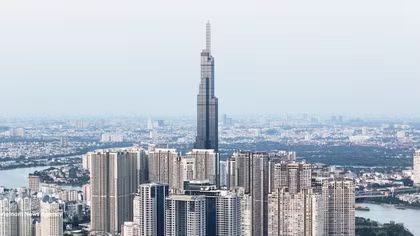
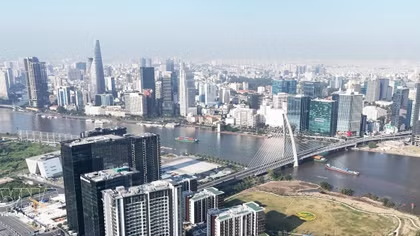
Ho Chi Minh City (VNS/VNA) – The Daikin Air Tower, located in Ho Chi Minh City, has become the first project worldwide to receive the highest platinum rating under three building certification systems: LEED for environmental performance, WELL for health and well-being, and Vietnam’s LOTUS green building standard.
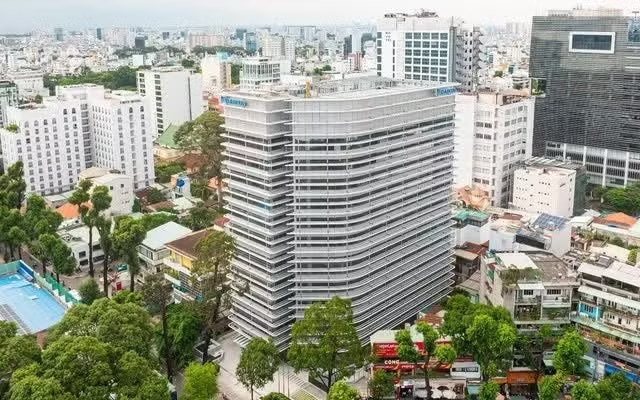
During a recent visit, the Consul General of Japan in Ho Chi Minh City and representatives of Japanese and Vietnamese organisations toured the building and reviewed several sustainability features incorporated into its design by Nikken Sekkei.
These include a facade using fins and high-performance glass to help reduce heat gain in Ho Chi Minh City’s climate, systems that collect rainwater and air-conditioning condensate for reuse, and an indoor air quality monitoring system that tracks indicators such as PM2.5, CO₂ and total volatile organic compounds (TVOC).
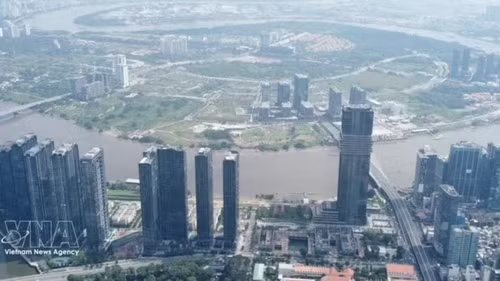
The Daikin Air Tower is among a growing number of certified green buildings in Ho Chi Minh City, alongside projects such as The Nexus, The Hallmark and Marina Central Tower, reflecting increasing interest in sustainable building practices as the city continues to develop.
Amidst stringent Environmental, Social, and Governance (ESG) commitments, businesses are strategically opting to embrace eco-friendly practices to remain competitive in the market.
International companies from the US, Europe, Japan, and Singapore are actively seeking eco-friendly office spaces and are willing to pay premium prices for green-certified buildings, further driving demand for sustainable real estate projects.
A report by property researchers forecast that the proportion of green projects in Ho Chi Minh City will grow to 31% by 2026.
The International Finance Corporation (IFC) highlighted the city's dominance in green-certified building floor space in Vietnam, reflecting the rapid expansion of the green building market with 780 completed green buildings encompassing over 18.69 million sq.m by 2025, predominantly certified by EDGE and LEED.
Founder of GreenViet Nguyen Thi Huong Thu emphasised the evolving trend of green buildings in Vietnam beyond office spaces, with a focus on integrating environmental standards, energy efficiency and user well-being into real estate projects.
The emphasis has shifted towards creating work environments that enhance comfort, health and overall quality of life for occupants, extending beyond traditional work hours.
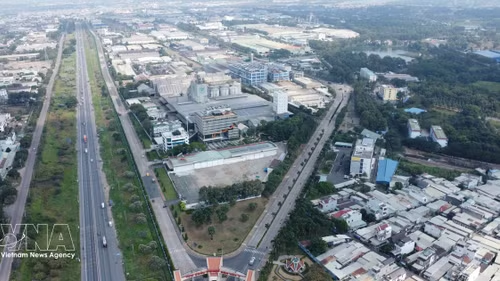
Despite the growth in green construction, the number of green buildings in Ho Chi Minh City still lags behind other regional cities. The city faces challenges related to increasing traffic congestion and air pollution, necessitating a greater emphasis on improving air quality and working conditions within office spaces.
To address these challenges, environment-friendly architecture and Transit-Oriented Development (TOD), an integrated urban planning approach incorporating public transportation systems, are gaining momentum.
In a recent discussion on green architecture and the TOD model, Wataru Tanaka from Nikken Sekkei's Global Business presented the potential of the TOD model, highlighting projects such as the Metro Line 1 development in Ho Chi Minh City and the comprehensive TOD master plan for the Thu Thiem station area as promising reference models.
As Ho Chi Minh City continues to embrace eco-conscious building practices and sustainable urban planning, the city is poised to not only enhance the quality of life for its residents but also establish itself as a frontrunner in sustainable real estate development on the global stage.
LEED (Leadership in Energy and Environmental Design) certification is widely recognised as one of the primary green building certification systems in Vietnam. Created by the US Green Building Council (USGBC), LEED advocates for sustainable design and construction practices, in line with the green development trends in Vietnam.
The WELL Standard is dedicated to assessing and appraising the impact of buildings on human health and well-being. Launched by the International WELL Building Institute (IWBI) in 2014, this certification has been implemented in over 5,700 projects spanning across 67 countries.
The EDGE (Excellence in Design for Greater Efficiencies) certification is a green building certification programme established by the International Finance Corporation (IFC), a part of the World Bank Group. This system encourages sustainable design and construction practices by evaluating the resource efficiency of buildings. The EDGE certification focuses on three key aspects: energy, water, and materials.
LOTUS represents a collection of voluntary green building rating systems devised by the Vietnam Green Building Council (VGBC). It offers a comprehensive evaluation of environmental performance throughout the lifecycle of buildings./.