Protecting users crucial in building digital trust: Experts

In Vietnam, digital transformation in the finance and banking sector is accelerating cashless payments, expanding access to financial services, improving market transparency and supporting economic growth and macroeconomic management.

As the Fourth Industrial Revolution and the rapid rise of artificial intelligence (AI) are reshaping the global financial system, digital transformation and the building of digital trust are no longer optional but essential for countries seeking to drive digital economic growth and enhance competitiveness, according to experts.

From financial digital transformation to building digital trust

In Vietnam, digital transformation in the finance and banking sector is accelerating cashless payments, expanding access to financial services, improving market transparency and supporting economic growth and macroeconomic management.

chungkhoan1-5706.jpg
A panel discussion on “Digital trust in the AI era: Security starts with the users” at the Digital Trust in Finance 2026 forum. Photo: nhandan.vn

However, increasing digitalisation has also heightened risks related to data security, online fraud, digital financial manipulation and declining user trust. According to the Ministry of Public Security, losses from online fraud in Vietnam exceeded 8 trillion VND (303.7 million USD) in 2025, highlighting growing threats to consumer confidence and the security of the financial ecosystem.

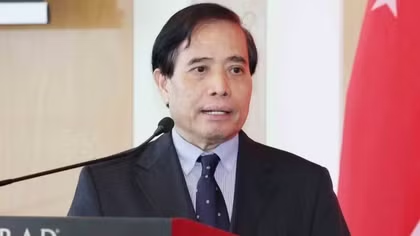
Speaking at the Digital Trust in Finance 2026 forum recently held in Hanoi, Deputy Minister of Public Security Pham The Tung stressed that sustainable growth of the digital economy, particularly in finance, depends on trust. If data is the fuel of the digital economy, trust is the soft infrastructure that enables the entire financial system to function effectively.

The banking sector has been among the leaders in digital transformation, but growing reliance on technology has created new vulnerabilities. Increasingly, cybercriminals are targeting users rather than banking systems themselves, underscoring the need to shift risk management towards protecting customers throughout the digital journey.

Digital financial security

Traditionally, digital financial security focused on protecting technical infrastructure such as servers, payment systems, banking data and networks. Today, users have become the most vulnerable link in the security chain.

Modern financial scams are becoming more sophisticated, such as AI-generated voice impersonation, deepfakes, fake banking applications, fraudulent impersonation of police officers or bank staff, malicious links and remote control of mobile devices. These tactics make it increasingly difficult for ordinary users to distinguish between legitimate and fraudulent activities.

Deputy Governor of the State Bank of Vietnam Pham Tien Dung said digital financial security in the AI era cannot rely solely on firewalls, encryption and intrusion prevention systems. Greater attention must be paid to protecting user awareness, digital behaviour and public trust. Building and safeguarding trust requires effective institutions, technology, risk management and inter-agency coordination.

At the same time, AI offers major opportunities to improve operational efficiency, automate processes, personalise services, enhance credit scoring, detect suspicious transactions and strengthen anti-fraud and anti-money laundering efforts. Advanced AI systems can identify abnormal transactions in real time, automatically block suspicious activities and learn from previous attacks to improve their defences. AI can also support personalised security through unique digital behavioural profiles for individual customers.

Recognising the importance of digital financial literacy, the Government has promoted nationwide digital literacy programmes aimed at helping citizens identify AI-enabled scams, strengthen cybersecurity awareness and develop habits of information verification. Technology companies have also expanded grassroots initiatives to provide digital tools and training for local communities.

Colonel Nguyen Hong Quan, Deputy Director of the Department of Cybersecurity and High-Tech Crime Prevention under the Ministry of Public Security, emphasised that building digital trust requires protecting users, safeguarding the broader ecosystem and establishing effective multi-stakeholder cooperation mechanisms.

As a result, building digital trust in finance is no longer solely the responsibility of the banking, financial or technology sectors, but has become a strategic requirement for the development of Vietnam’s digital economy as a whole, the official underlined.


en.vietnamplus.vn

Other News

Vietnam attends SAHA 2026 defence, aerospace exhibition in Türkiye

Vietnam attends SAHA 2026 defence, aerospace exhibition in Türkiye

Vietnam’s participation in SAHA 2026 International Defence & Aerospace Exhibition in Istanbul reflects the country’s consistent policy of enhancing international defence integration and promoting defence industry cooperation towards self-reliance, self-strengthening, modernisation and dual-use development.

SK Group partners to build AI ecosystem in Vietnam

SK Group partners to build AI ecosystem in Vietnam

SK Innovation and SK Telecom signed MoUs with Nghe An province and the National Innovation Centre of Vietnam to advance AI ecosystem development and support the country’s long-term growth strategy.

Vietnam Research Excellence Fellowship for 2026-2030 approved

Vietnam Research Excellence Fellowship for 2026-2030 approved

Under the Vietnam Research Excellence Fellowship (VREF) for the 2026–2030 period, PhD students are identified as a core research force directly contributing to breakthroughs in sci-tech and innovation. Investing in top-tier doctoral candidates is more than workforce development, but a high-stakes strategic bet to forge a cohort of world-class scientists and technologists who can power Vietnam’s long-term economic ambitions.

Strategic tech must address practical challenges: PM

Strategic tech must address practical challenges: PM

Prime Minister Pham Minh Chinh on March 28 said strategic technologies must tackle Vietnam’s practical challenges, while chairing a meeting of the Government’s Steering Committee for science and technology, innovation, digital transformation, and Project 06.

Ho Chi Minh City sets sights on becoming semiconductor hub

Ho Chi Minh City sets sights on becoming semiconductor hub

Ho Chi Minh City is stepping up efforts to attract investment from global leading groups and companies in the fields of electronic components, semiconductors and chip manufacturing as it seeks to position itself as a leading semiconductor industry hub in both the region and the world. 

Ho Chi Minh City launches upgraded technology exchange platform

Ho Chi Minh City launches upgraded technology exchange platform

The upgraded platform represents a comprehensive shift from a simple information-sharing model to a managed online technology trading system, enabling monitoring and measurement of real transaction outcomes. It is built on three pillars, namely new tradable technology products, a modern digital platform, and an improved operational model.

AI – unmissable opportunity for Vietnam: Experts

AI – unmissable opportunity for Vietnam: Experts

AI also emerges as a key enabler for Vietnam's ambition to build financial and technology hubs. Applications can boost efficiency, automate workflows, cut costs, and sharpen data analytics, which are essential pillars of a modern financial system.

PM calls for accelerated space technology development in Vietnam

PM calls for accelerated space technology development in Vietnam

Vietnam aims by 2030 to achieve a mid-level position in space science and technology development within Southeast Asia, and after 2030 to build national capabilities to independently develop satellite technologies and apply space data to address global challenges and national security needs.

High-level forum advances Vietnam–US technological cooperation

High-level forum advances Vietnam–US technological cooperation

A high-level executive leadership forum focusing on strengthening Vietnam - US relations through technology cooperation was jointly held in Washington D.C. on March 11 by the Embassy of Vietnam in the US, the Weatherhead East Asian Institute of Columbia University, and the US -ASEAN Business Council (USABC). 

AI Law takes effect, anchors national governance framework

AI Law takes effect, anchors national governance framework

While many countries are still drafting policy blueprints or issuing non-binding guidance, Vietnam has moved ahead with a standalone Law on Artificial Intelligence (AI), effective from March 1, placing it among a select group of nations to adopt dedicated AI legislation at the parliamentary level.