Vietnam needs full-spectrum workforce for nuclear power development: insiders

Developing nuclear power therefore requires a comprehensive ecosystem in which every component is supported by highly skilled personnel.

download-5.png
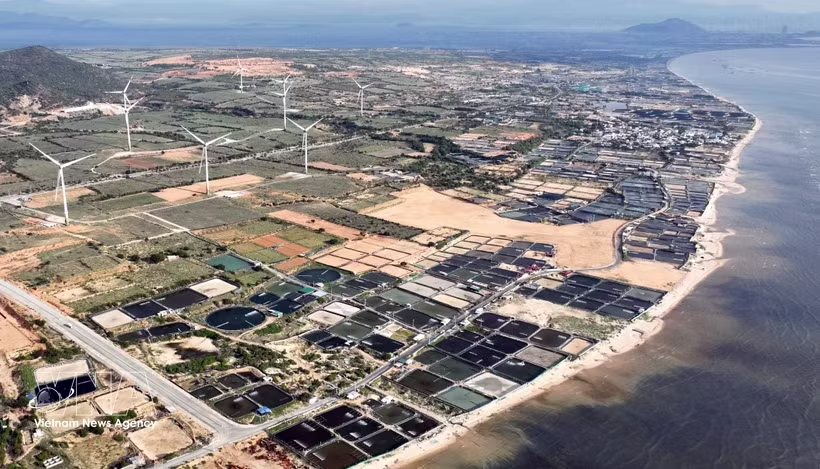
A view of the site designated for the Ninh Thuan 1 nuclear power plant project in Phuoc Dinh commune, Khanh Hoa province (Photo: VNA)

Vietnam must not only train enough personnel for future nuclear power plants but also build the core capabilities needed across the entire national nuclear ecosystem, ensuring every link in the system is fit for purpose and staffed by appropriately qualified human resources, said insiders.

Nguyen Tuan Khai, Deputy Director of the Vietnam Atomic Energy Institute (VINATOM) under the Ministry of Science and Technology, said while nuclear power is often associated only with plant operators, a nuclear power programme in fact requires the participation of a much broader workforce, including research institutions, state regulatory agencies, domestic and international technical support teams, training institutions, and authorities in the localities where the project is implemented.

Developing nuclear power therefore requires a comprehensive ecosystem in which every component is supported by highly skilled personnel. Given this, the challenge is not limited to preparing operators for future plants but also to strengthening the country's overall nuclear capabilities, a goal Vietnam identified early in its preparations for nuclear power development.

Vietnam had previously invested in workforce training during the preparation for the Ninh Thuan nuclear power project before 2016, when Vietnam Electricity (EVN) sent around 400 staff members to Russia and Japan for training in nuclear technology, and plant operation and management.

However, Tran Chi Thanh, Director of VINATOM, said nuclear power is among the world's most technologically complex and safety-critical industries, requiring multidisciplinary expertise spanning nuclear science, engineering, technology and stringent safety standards.

Building a core operating workforce typically takes at least a decade of education and practical experience, he said, noting that personnel must acquire broad knowledge in nuclear and reactor physics, electrical engineering, automation, materials science, thermodynamics, chemistry, as well as plant design, operation and economic evaluation.

Energy experts said nuclear power development should be viewed as a long-term national capability-building process, requiring interdisciplinary expertise, practical experience and a strong safety culture.

The International Atomic Energy Agency (IAEA) likewise recommends treating nuclear power development as a national programme rather than a single construction project. Such a programme encompasses legislation, a regulatory system, research capacity, technical infrastructure, human resources and safety arrangements throughout the entire nuclear power lifecycle.

Alongside plans to restart the Ninh Thuan nuclear power project, Vietnam has introduced some special policies and mechanisms and approved a national human resources training programme serving nuclear power development through 2035.

However, restarting the nuclear power programme also requires strengthening the State's regulatory capacity, with improving the Vietnam Agency for Radiation and Nuclear Safety under the Ministry of Science and Technology regarded as a key priority, laying the institutional foundation for the country’s nuclear power development programme in the time to come.

The agency is responsible for nuclear safety, security and safeguards, but its current organisational structure has yet to meet specialised requirements for regulating nuclear power plants.

To address this issue, the Government has approved a plan to strengthen the capabilities of the agency through 2035, aiming to develop it into a fully empowered national nuclear regulatory authority with the legal mandate, resources, and technical capacity to effectively carry out state management of radiation safety, nuclear safety, and nuclear security.

Experts said Vietnam's parallel efforts to strengthen investment, workforce development and regulatory capacity demonstrate that nuclear power is being pursued as a long-term national programme extending far beyond plant construction, covering operation, lifetime extension, decommissioning and spent fuel management./.
VNA
en.vietnamplus.vn

Other News

Protecting users crucial in building digital trust: Experts

Protecting users crucial in building digital trust: Experts

In Vietnam, digital transformation in the finance and banking sector is accelerating cashless payments, expanding access to financial services, improving market transparency and supporting economic growth and macroeconomic management.

Fostering skilled workforce for innovation era: experts

Fostering skilled workforce for innovation era: experts

Experts said close coordination among State management agencies, research institutes, universities, and businesses will improve training quality and serve the dual goals of quality education and practical research application.

Startup forum bridges Silicon Valley and local innovation ecosystem

Startup forum bridges Silicon Valley and local innovation ecosystem

The University of Economics Ho Chi Minh City (UEH), Saigon Asset Management (SAM), and Plug and Play Tech Centre co-hosted the “From Vietnam to Silicon Valley” forum, exploring AI innovation, venture capital, and pathways to integrate Vietnam’s startup ecosystem with Silicon Valley and global markets.

Experts call for stronger action against fake news online

Experts call for stronger action against fake news online

Experts have warned that fake news, misinformation and harmful online content are increasingly shaping public perceptions, particularly among young people, and stressed the need for stronger legal safeguards, technology tools and wider dissemination of credible information to tackle the problem effectively.

Protecting digital future in post-quantum, AI era

Protecting digital future in post-quantum, AI era

Participants highlighted the importance of building a proactive, synchronised and sustainable national cybersecurity ecosystem through closer cooperation among regulators, technology firms, research institutions and cybersecurity experts.

Vietnam attends SAHA 2026 defence, aerospace exhibition in Türkiye

Vietnam attends SAHA 2026 defence, aerospace exhibition in Türkiye

Vietnam’s participation in SAHA 2026 International Defence & Aerospace Exhibition in Istanbul reflects the country’s consistent policy of enhancing international defence integration and promoting defence industry cooperation towards self-reliance, self-strengthening, modernisation and dual-use development.

SK Group partners to build AI ecosystem in Vietnam

SK Group partners to build AI ecosystem in Vietnam

SK Innovation and SK Telecom signed MoUs with Nghe An province and the National Innovation Centre of Vietnam to advance AI ecosystem development and support the country’s long-term growth strategy.

Vietnam Research Excellence Fellowship for 2026-2030 approved

Vietnam Research Excellence Fellowship for 2026-2030 approved

Under the Vietnam Research Excellence Fellowship (VREF) for the 2026–2030 period, PhD students are identified as a core research force directly contributing to breakthroughs in sci-tech and innovation. Investing in top-tier doctoral candidates is more than workforce development, but a high-stakes strategic bet to forge a cohort of world-class scientists and technologists who can power Vietnam’s long-term economic ambitions.

Strategic tech must address practical challenges: PM

Strategic tech must address practical challenges: PM

Prime Minister Pham Minh Chinh on March 28 said strategic technologies must tackle Vietnam’s practical challenges, while chairing a meeting of the Government’s Steering Committee for science and technology, innovation, digital transformation, and Project 06.

Ho Chi Minh City sets sights on becoming semiconductor hub

Ho Chi Minh City sets sights on becoming semiconductor hub

Ho Chi Minh City is stepping up efforts to attract investment from global leading groups and companies in the fields of electronic components, semiconductors and chip manufacturing as it seeks to position itself as a leading semiconductor industry hub in both the region and the world.