Top leader calls for greater contribution from Vietnamese experts in Canada

At a meeting with representatives of the Canadian Vietnamese Scientists and Experts Association (CVSEA) on September 25 (local time), the top leader praised the contributions and professional capabilities of Vietnamese experts and intellectuals in Canada, describing them as a valuable intellectual resource and an important bridge connecting Vietnam with Canada and the wider world.

General Secretary of the Communist Party of Vietnam Central Committee and President To Lam has called on Vietnamese experts and intellectuals in Canada to contribute practical ideas and expertise to Vietnam’s development, particularly in science and technology, innovation and other strategic fields.

At a meeting with representatives of the Canadian Vietnamese Scientists and Experts Association (CVSEA) on September 25 (local time), the top leader praised the contributions and professional capabilities of Vietnamese experts and intellectuals in Canada, describing them as a valuable intellectual resource and an important bridge connecting Vietnam with Canada and the wider world. The meeting was held during his state visit to Canada, which resulted in the two countries elevating their relations to a Strategic Partnership.
potal-tong-bi-thu-chu-tich-nuoc-gap-dai-dien-mang-luoi-chuyen-gia-nha-khoa-hoc-viet-nam-tai-canada-9050334.jpg
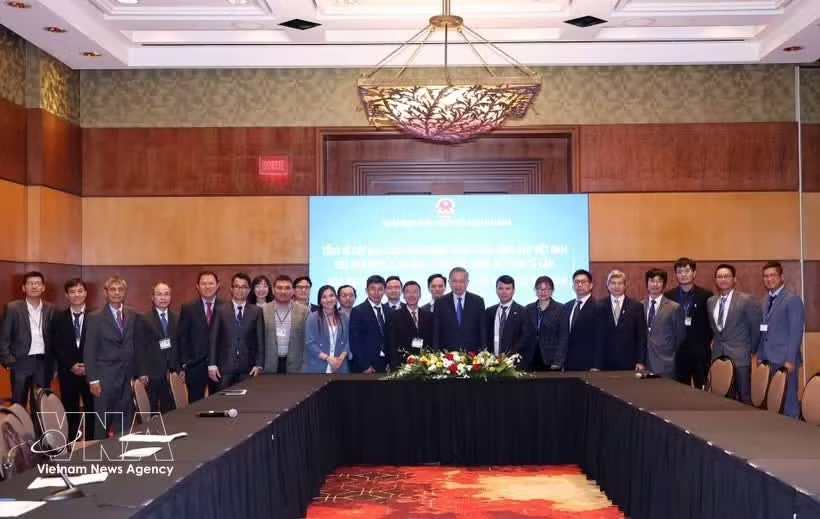
General Secretary of the Communist Party of Vietnam Central Committee and President To Lam and representatives of the Canadian Vietnamese Scientists and Experts Association (CVSEA) on September 25. (Photo: VNA)

More than 20 experts and intellectuals attended the meeting, representing fields including artificial intelligence (AI), semiconductors, cybersecurity, 5G/6G technology, start-ups and innovation, energy, strategic minerals, urban infrastructure, data and unmanned aircraft. The CVSEA brings together more than 150 Vietnamese scientists and experts working in key technologies, many of whom hold important positions at Canadian and North American universities, research institutes and technology companies.

Experts at the meeting proposed stronger Vietnam-Canada cooperation in strategic technologies such as AI, 6G, cybersecurity, quantum technology and semiconductors, as well as strategic minerals, climate change response, clean energy, nuclear technology and innovation. They also suggested developing joint research programmes, flexible co-financing mechanisms, technology transfer and stronger links between universities, research institutes and businesses.
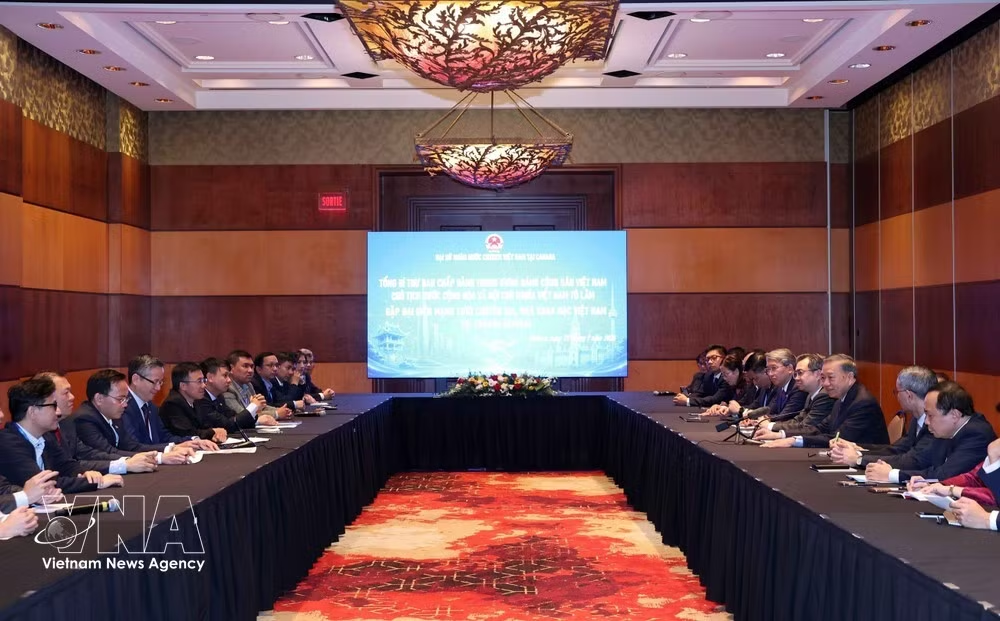
General Secretary of the Communist Party of Vietnam Central Committee and President To Lam meets with representatives of the Canadian Vietnamese Scientists and Experts Association (CVSEA) on September 25

General Secretary and President Lam said that to realise the country’s strategic development goals, Vietnam needs the active participation of overseas Vietnamese, especially experts and intellectuals.

He said the Party and State would continue to develop mechanisms and create the most favourable conditions for Vietnamese experts and intellectuals abroad to participate more deeply in the country’s development.

Policies should provide appropriate incentives, a transparent and competitive working environment, and opportunities for experts to contribute over the long term or remotely, he said. Valuable research, initiatives and products should also be recognised and effectively used for national development.

The top leader urged Vietnamese experts in Canada to continue providing ideas to address major national issues and priority areas, including AI, semiconductors, quantum technology, biotechnology, healthcare, clean energy, aerospace, digital transformation and high-quality human resources development.

He stressed that their recommendations should focus on specific issues, solutions and results.

The leader also called for stronger and more effective networks of experts and intellectuals. Such networks should serve as platforms for connecting expertise and sharing resources, while clearly understanding the capabilities and strengths of individual experts, research teams and businesses so that the right people can be matched with the right tasks when the country needs them.

Contributions to Vietnam, he said, do not necessarily require experts to return home for long periods. A research project, a cooperation programme, a training course, a technology transfer project or a successful connection can all create practical value for the country.

General Secretary and President Lam also asked Vietnamese experts and intellectuals to pay greater attention to younger generations by mentoring and inspiring Vietnamese students and researchers in Canada.

He said senior experts should serve as a source of support for Vietnamese students and postgraduates, helping them integrate into Canadian society while maintaining the Vietnamese language, cultural identity and a sense of attachment and responsibility toward their homeland.

“Taking care of the younger generation today is an investment in the country’s human resources and future,” he said.

The General Secretary and President further called on Vietnamese experts and intellectuals in Canada to strengthen their role as a bridge, contributing to deeper and more substantive Vietnam-Canada relations.

He said that through their expertise, reputation and achievements, Vietnamese experts in Canada could become “friendship ambassadors” connecting knowledge, technology, resources and cooperation opportunities between the two countries, particularly in science and technology, innovation, education, human resources development and green transition.

The Vietnamese top leader expressed his confidence that, with patriotism, national solidarity, knowledge, resilience and international experience, the Vietnamese community in Canada, including its experts and intellectuals, would continue to grow strongly, integrate successfully into Canadian society and make increasingly practical contributions to their homeland.
en.vietnamplus.vn

Other News

Hanoi approves controlled pilot of two technology projects

Hanoi approves controlled pilot of two technology projects

The two projects involve an intelligent autonomous transportation system developed by Phenikaa-X JSC and a technology for producing mixed rare-earth oxides with a purity of over 95% on a semi-industrial scale developed by the Mining Technology and Construction Consultancy JSC.

Banking industry in AI era: When data becomes competitive advantage

Banking industry in AI era: When data becomes competitive advantage

In just a few years, AI has evolved from an experimental technology into an “assistant” for many banks, supporting everything from customer service, credit approval, and fraud detection to risk management. However, as the technological gap between institutions narrows, a new question is emerging: What will determine banks' competitive advantage in the AI era?

Bac Ninh considers establishing AI centre of excellence

Bac Ninh considers establishing AI centre of excellence

A meeting has been held in Bac Ninh to discuss potential cooperation with Plug and Play in developing the northern province’s innovation ecosystem and establishing an artificial intelligence (AI) centre of excellence, with Standing Vice Chairman of the provincial People’s Committee Mai Son receiving a delegation from the global innovation platform.

Hanoi allows 24-month trial of autonomous vehicles at Hoa Lac

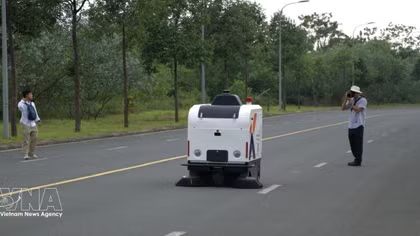
Hanoi allows 24-month trial of autonomous vehicles at Hoa Lac

The project aims to assess the safety, reliability and readiness of autonomous vehicles under real traffic conditions, as well as the effectiveness of autonomous public transport and compatibility with existing systems. Its results will contribute to developing technical standards, operating procedures and management models suited to Hanoi’s traffic conditions.

Singapore's experience suggests solutions to Vietnam's human resources challenge in AI era

Singapore's experience suggests solutions to Vietnam's human resources challenge in AI era

As Vietnam accelerates digital transformation and high-tech development, Singapore’s experience and the engagement of global technology companies demonstrate that human resources preparation must stay ahead of the curve. The ability to filter knowledge, collaborate, innovate and effectively use AI will increasingly become essential to helping workers adapt to a changing labour market and strengthening the competitiveness of Vietnam’s economy in the new era.

Protecting national security amid digital transformation, cyberspace

Protecting national security amid digital transformation, cyberspace

Cybersecurity, information security and data security risks must be identified and addressed early and from afar, with appropriate defensive measures ready to neutralise threats and protect national interests in cyberspace, said Lieutenant General Le Xuan Minh, Director of the Ministry of Public Security’s Department of Cybersecurity and Hi-tech Crime Prevention (A05).

Mekong Delta launches first robotics, AI research institute

Mekong Delta launches first robotics, AI research institute

Dr. Nguyen Van Quang, Rector of Nam Can Tho University, said the university is developing a value chain covering training, research, technology development, testing, technology transfer and commercialisation. The model is designed to link research more closely with practical needs, ensuring that technologies generate products and products create value for society.

Vietnam positioned to harness AI wave, World Bank report says

Vietnam positioned to harness AI wave, World Bank report says

The WB report identifies Vietnam as one of the few economies outside the European Union (EU) to have adopted a comprehensive AI regulatory framework as early as 2025. Vietnam applies a risk-tiered approach similar to that of the EU AI Act, imposing different obligations depending on whether an AI system poses “unacceptable,” “high,” “low” or “minimal” risks. The approach is viewed as a strategic step towards ensuring safe and transparent AI governance.

AI offers both opportunities, challenges for Vietnam's growth

AI offers both opportunities, challenges for Vietnam's growth

Dr. Ho Duc Thang, a full-time member of the National Assembly’s Committee for Cultural and Educational, said productivity is the key to sustaining double-digit economic growth, and AI has greater potential to improve productivity than any previous technology.

Top leader unveils people-centred vision for new development model

Top leader unveils people-centred vision for new development model

Vietnam's growth model, long fueled by low-cost labour, resource extraction, contract manufacturing, expanded investment, and capital accumulation, has run out of road. The country now needs a sweeping reform agenda to shift from extensive growth to a model driven by productivity, knowledge, science and technology, innovation, and digital transformation.