Ho Chi Minh City records 76% of administrative procedures processed online

One of the most visible achievements has been the rapid expansion of online public services. Ho Chi Minh City currently provides 1,636 fully online administrative procedures, accounting for more than 80% of the city’s total administrative services.

Nearly one year after implementing its two-tier administration model in tandem with the development of digital government, Ho Chi Minh City has reported significant progress in administrative reform, with online applications accounting for 76% of all administrative dossiers and public satisfaction continuing to rise.
Ho Chi Minh City records 76% of administrative procedures processed online -0
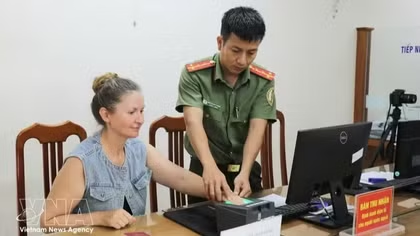
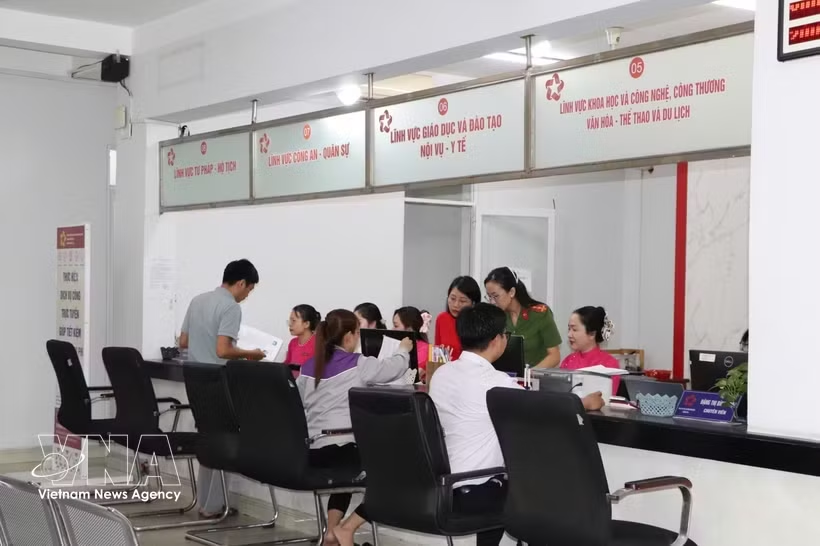
The Public Administrative Service Centre of Di An ward serves residents on the morning of July 1. (Photo: VNA)

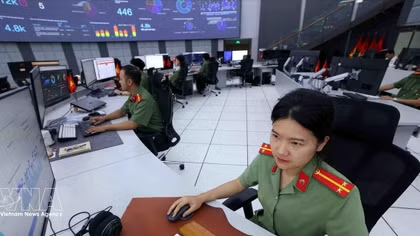
Tran Quang Thai, Deputy Director of the Ho Chi Minh City Public Administrative Service Centre, said on May 7 that the southern city is steadily shifting from traditional administrative processing methods to a digital operating model centred on citizens and businesses. A unified administrative procedure processing system has been deployed citywide and integrated with the National Public Service Portal as well as specialised databases, creating a synchronised digital platform for receiving, processing, and returning administrative results.

According to Thai, greater automation and data connectivity have helped streamline procedures, reduce manual processing, improve transparency, and shorten settlement times. Notably, the city has implemented administrative procedures independent of administrative boundaries for all eligible services, enabling citizens and businesses to complete procedures regardless of their place of residence or local jurisdiction.

One of the most visible achievements has been the rapid expansion of online public services. Ho Chi Minh City currently provides 1,636 fully online administrative procedures, accounting for more than 80% of the city’s total administrative services. Authorities have also introduced various measures to encourage digital adoption, including fee exemptions for selected online procedures and full integration of VNeID electronic identification accounts for unified login, authentication, and dossier tracking.

The effectiveness of digital transformation is clearly reflected in the structure of received applications, Thai said, noting that out of more than 4.28 million dossiers received, over 3.26 million, or 76 %, were submitted online.

Administrative processing quality has also improved markedly. Of the more than 4.12 million dossiers resolved, over 4.04 million were completed ahead of schedule, while overdue cases accounted for only a very small proportion.

He attributed these results to procedure restructuring, the reduction of intermediary steps, and the expanded use of shared databases instead of requiring citizens to repeatedly submit existing documents. The city’s dossier digitisation and electronic-result issuance rate has surpassed 91%, while data reuse now exceeds 92%.

Public satisfaction levels have remained exceptionally high. According to the service performance index, Ho Chi Minh City recorded a satisfaction rate of 99.44% in late 2025 and reached 100% during the opening months of 2026, reflecting tangible improvements in both administrative efficiency and service quality.

Despite these achievements, the centre acknowledged that challenges remain, including inconsistencies among certain central-level information systems and occasional technical issues in inter-agency connectivity. The city is continuing to coordinate with relevant authorities to further improve the system toward greater stability, efficiency, and user-friendliness.
VNA

Other News

Vietnam Research Excellence Fellowship for 2026-2030 approved

Vietnam Research Excellence Fellowship for 2026-2030 approved

Under the Vietnam Research Excellence Fellowship (VREF) for the 2026–2030 period, PhD students are identified as a core research force directly contributing to breakthroughs in sci-tech and innovation. Investing in top-tier doctoral candidates is more than workforce development, but a high-stakes strategic bet to forge a cohort of world-class scientists and technologists who can power Vietnam’s long-term economic ambitions.

Strategic tech must address practical challenges: PM

Strategic tech must address practical challenges: PM

Prime Minister Pham Minh Chinh on March 28 said strategic technologies must tackle Vietnam’s practical challenges, while chairing a meeting of the Government’s Steering Committee for science and technology, innovation, digital transformation, and Project 06.

Ho Chi Minh City sets sights on becoming semiconductor hub

Ho Chi Minh City sets sights on becoming semiconductor hub

Ho Chi Minh City is stepping up efforts to attract investment from global leading groups and companies in the fields of electronic components, semiconductors and chip manufacturing as it seeks to position itself as a leading semiconductor industry hub in both the region and the world. 

Ho Chi Minh City launches upgraded technology exchange platform

Ho Chi Minh City launches upgraded technology exchange platform

The upgraded platform represents a comprehensive shift from a simple information-sharing model to a managed online technology trading system, enabling monitoring and measurement of real transaction outcomes. It is built on three pillars, namely new tradable technology products, a modern digital platform, and an improved operational model.

AI – unmissable opportunity for Vietnam: Experts

AI – unmissable opportunity for Vietnam: Experts

AI also emerges as a key enabler for Vietnam's ambition to build financial and technology hubs. Applications can boost efficiency, automate workflows, cut costs, and sharpen data analytics, which are essential pillars of a modern financial system.

PM calls for accelerated space technology development in Vietnam

PM calls for accelerated space technology development in Vietnam

Vietnam aims by 2030 to achieve a mid-level position in space science and technology development within Southeast Asia, and after 2030 to build national capabilities to independently develop satellite technologies and apply space data to address global challenges and national security needs.

High-level forum advances Vietnam–US technological cooperation

High-level forum advances Vietnam–US technological cooperation

A high-level executive leadership forum focusing on strengthening Vietnam - US relations through technology cooperation was jointly held in Washington D.C. on March 11 by the Embassy of Vietnam in the US, the Weatherhead East Asian Institute of Columbia University, and the US -ASEAN Business Council (USABC). 

AI Law takes effect, anchors national governance framework

AI Law takes effect, anchors national governance framework

While many countries are still drafting policy blueprints or issuing non-binding guidance, Vietnam has moved ahead with a standalone Law on Artificial Intelligence (AI), effective from March 1, placing it among a select group of nations to adopt dedicated AI legislation at the parliamentary level. 

Vietnam International Defence Expo 2026 preparations move into high gear

Vietnam International Defence Expo 2026 preparations move into high gear

Vietnam International Defence Expo 2026, themed “Peace, Friendship, Cooperation and Development,” will be organised on a larger scale, featuring a wide array of weapons and technical equipment alongside product exhibitions, seminars and panel discussions, drills, live field demonstrations, and business networking activities.

Ministry requests urgent measures to counter UAVs threatening aviation safety

Ministry requests urgent measures to counter UAVs threatening aviation safety

Ministry of Construction requested the Ministry of National Defence, the Ministry of Public Security and provincial and municipal steering committees for counter-terrorism to strengthen the management, inspection and supervision of UAVs and other aerial devices, ensuring strict compliance with Decree No. 288/2025/ND-CP and relevant legal regulations.

International conference spotlights advanced microscopy in life sciences, materials

International conference spotlights advanced microscopy in life sciences, materials

The microscopy user community in Vietnam remains fragmented, lacking a common platform for sharing technical expertise, research experience and collaboration opportunities. This limited connectivity has, to some extent, curtailed the full potential of microscopy technologies in advancing scientific progress and industrial applications at home and abroad.