First national semiconductor chip prototyping support centre makes debut

Vietnam's semiconductor ecosystem now comprises around 60 chip design companies, some 7,000 chip design engineers and 166 universities offering semiconductor-related training programmes. Initial registrations from 12 organisations indicate demand for the prototyping of approximately 30,000 chips.

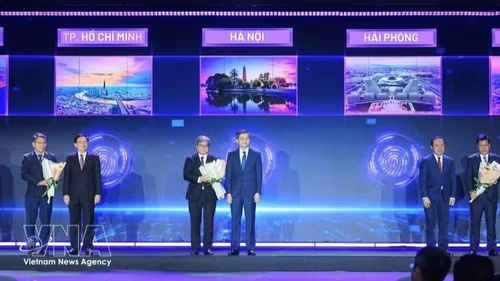
The Ministry of Science and Technology (MoST) on June 26 unveiled the Vietnam National Multi-Project Wafer Coordination Centre (VNMPW/CC) - the first national centre dedicated to supporting semiconductor chip prototyping, marking a key step in connecting domestic chip research and design with the global semiconductor manufacturing ecosystem.

Addressing the event, Minister of Science and Technology Vu Hai Quan said the centre demonstrates the ministry's determination to implement Vietnam's semiconductor industry development strategy through 2030 with a vision to 2050. He stressed that building a competitive semiconductor industry requires close collaboration among the Government, businesses, research institutes, universities, domestic and foreign experts, international partners, investors and the start-up and innovation community.

1-785.jpg
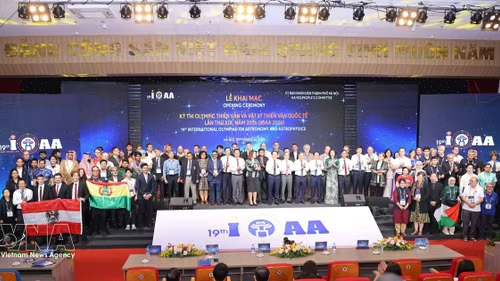
Delegates at the launch ceremony of the Vietnam National Multi-Project Wafer Coordination Centre (VNMPW/CC) on June 26. (Photo: VNA)

The minister described the centre as a bridge that will gradually strengthen Vietnam's technological self-reliance and help position the country as an important link in the global semiconductor supply chain.

Vietnam currently lacks industrial-scale semiconductor manufacturing capacity, while domestic research and prototyping infrastructure remains limited. Research institutions, universities and chip design companies have therefore had to rely on overseas foundries for prototype fabrication, resulting in higher costs, longer development cycles and slower commercialisation.
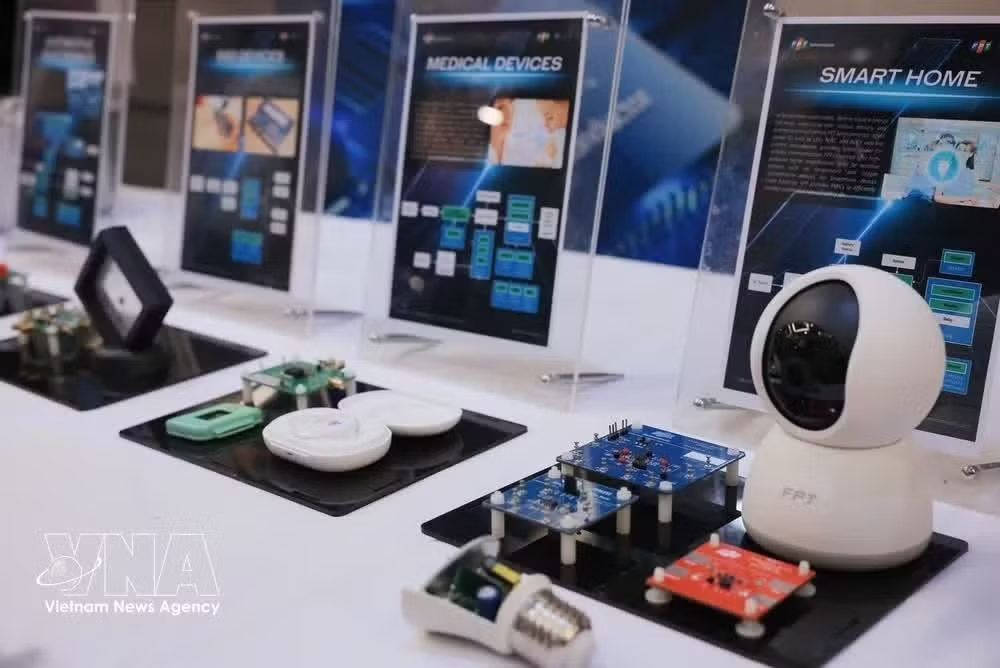
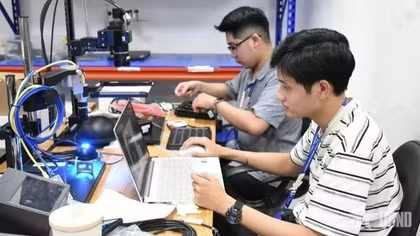
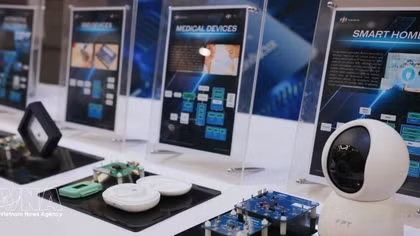
Smart products, chips and semiconductor materials on display on the sidelines of the launch ceremony of the Vietnam National Multi-Project Wafer Coordination Centre (VNMPW/CC) on June 26. (Photo: VNA)

According to the ministry, tape-out costs currently range from 30,000 USD to 200,000 USD per chip design, with production lead times typically lasting between 12 and 24 months. Vietnam's semiconductor ecosystem now comprises around 60 chip design companies, some 7,000 chip design engineers and 166 universities offering semiconductor-related training programmes. Initial registrations from 12 organisations indicate demand for the prototyping of approximately 30,000 chips.

Nguyen Khac Lich, Director of the ministry's Authority of Information Technology Industry (AITI), said the centre is expected to address these bottlenecks through the Multi-Project Wafer (MPW) model, which combines multiple chip designs in a single fabrication run to reduce costs and shorten product development time, thereby accelerating the development of "Make in Vietnam" semiconductor products.

According to Lich, Vietnam must address a fundamental bottleneck in order to move deeper into the global semiconductor value chain - the ability to turn chip designs into physical semiconductor products.

The centre’s establishment marks an important first step, reflecting the determination of the MoST, the AITI, and the domestic semiconductor community to gradually master strategic technologies, remove development bottlenecks, and build a competitive and sustainable semiconductor ecosystem, he said.

Operating under the AITI, the centre will provide shared infrastructure covering the entire semiconductor development process, from chip design and prototyping to packaging, testing and commercialisation. It will also offer design tools and verification services while coordinating with foundries, packaging and testing providers, and international technology partners to organise prototype production for domestic universities, research institutes and enterprises.

Following fabrication, the centre will support chip quality assessment and connect projects with the State’s support programmes and investment funds to accelerate commercialisation. It also plans to establish a post-silicon laboratory for testing and analysis.

From 2030, the centre aims to master advanced semiconductor technologies, expand international cooperation, and gradually establish itself as a reputable semiconductor chip prototyping support hub in Southeast Asia, towards strengthening Vietnam’s position in the regional and global semiconductor value chains.

At the launch ceremony, the centre signed memoranda of understanding with 19 domestic and international partners, including technology giants such as Intel, Infineon, Amkor, Cadence and Synopsys, major foundries TSMC and GlobalFoundries, leading Vietnamese universities, and domestic technology firms including Viettel, FPT and VSAP Lab.

It also announced the establishment of a 21-member advisory panel comprising semiconductor experts from technology companies, universities and research institutes in Vietnam and abroad.

en.vietnamplus.vn

Other News

Protecting users crucial in building digital trust: Experts

Protecting users crucial in building digital trust: Experts

In Vietnam, digital transformation in the finance and banking sector is accelerating cashless payments, expanding access to financial services, improving market transparency and supporting economic growth and macroeconomic management.

Fostering skilled workforce for innovation era: experts

Fostering skilled workforce for innovation era: experts

Experts said close coordination among State management agencies, research institutes, universities, and businesses will improve training quality and serve the dual goals of quality education and practical research application.

Startup forum bridges Silicon Valley and local innovation ecosystem

Startup forum bridges Silicon Valley and local innovation ecosystem

The University of Economics Ho Chi Minh City (UEH), Saigon Asset Management (SAM), and Plug and Play Tech Centre co-hosted the “From Vietnam to Silicon Valley” forum, exploring AI innovation, venture capital, and pathways to integrate Vietnam’s startup ecosystem with Silicon Valley and global markets.

Experts call for stronger action against fake news online

Experts call for stronger action against fake news online

Experts have warned that fake news, misinformation and harmful online content are increasingly shaping public perceptions, particularly among young people, and stressed the need for stronger legal safeguards, technology tools and wider dissemination of credible information to tackle the problem effectively.

Protecting digital future in post-quantum, AI era

Protecting digital future in post-quantum, AI era

Participants highlighted the importance of building a proactive, synchronised and sustainable national cybersecurity ecosystem through closer cooperation among regulators, technology firms, research institutions and cybersecurity experts.

Vietnam attends SAHA 2026 defence, aerospace exhibition in Türkiye

Vietnam attends SAHA 2026 defence, aerospace exhibition in Türkiye

Vietnam’s participation in SAHA 2026 International Defence & Aerospace Exhibition in Istanbul reflects the country’s consistent policy of enhancing international defence integration and promoting defence industry cooperation towards self-reliance, self-strengthening, modernisation and dual-use development.

SK Group partners to build AI ecosystem in Vietnam

SK Group partners to build AI ecosystem in Vietnam

SK Innovation and SK Telecom signed MoUs with Nghe An province and the National Innovation Centre of Vietnam to advance AI ecosystem development and support the country’s long-term growth strategy.

Vietnam Research Excellence Fellowship for 2026-2030 approved

Vietnam Research Excellence Fellowship for 2026-2030 approved

Under the Vietnam Research Excellence Fellowship (VREF) for the 2026–2030 period, PhD students are identified as a core research force directly contributing to breakthroughs in sci-tech and innovation. Investing in top-tier doctoral candidates is more than workforce development, but a high-stakes strategic bet to forge a cohort of world-class scientists and technologists who can power Vietnam’s long-term economic ambitions.

Strategic tech must address practical challenges: PM

Strategic tech must address practical challenges: PM

Prime Minister Pham Minh Chinh on March 28 said strategic technologies must tackle Vietnam’s practical challenges, while chairing a meeting of the Government’s Steering Committee for science and technology, innovation, digital transformation, and Project 06.

Ho Chi Minh City sets sights on becoming semiconductor hub

Ho Chi Minh City sets sights on becoming semiconductor hub

Ho Chi Minh City is stepping up efforts to attract investment from global leading groups and companies in the fields of electronic components, semiconductors and chip manufacturing as it seeks to position itself as a leading semiconductor industry hub in both the region and the world.