Cuban newspaper highlights Vietnam's offshore wind energy potential

The Global Wind Energy Council (GWEC) has been actively cooperating with Vietnam, which is regarded as one of Southeast Asia’s most promising offshore wind markets, Cuba’s e-newspaper Prensa Latina reported.

Havana (VNA) - Cuba’s e-newspaper Prensa Latina has highlighted Vietnam’s growing potential in offshore wind power following a meeting between Vietnamese Permanent Deputy Prime Minister Pham Gia Tuc and a delegation from the Global Wind Energy Council (GWEC), aimed at advancing the development of Southeast Asia’s promising offshore wind market.
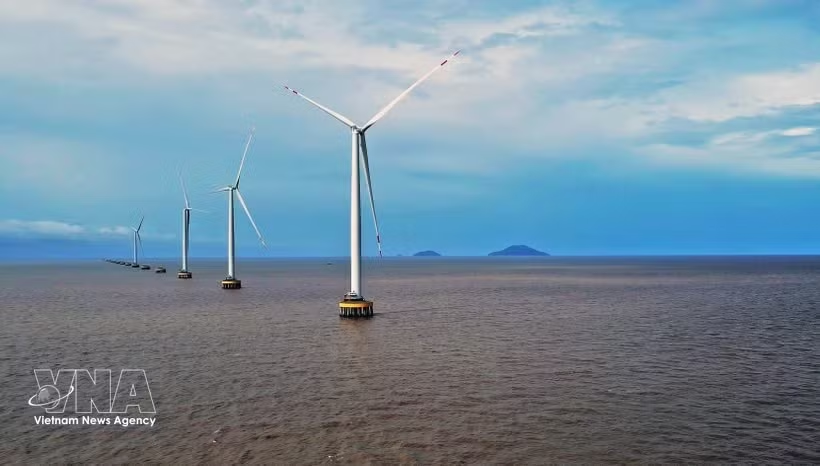
1.jpg
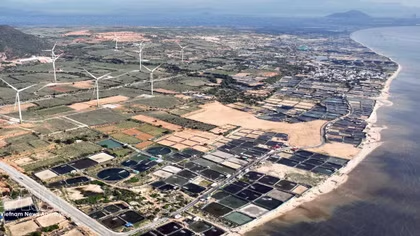
An offshore wind power project in Ca Mau province. (Illustrative photo: VNA)

Prensa Latina reported on June 10 that during his working session with GWEC Chief Executive Officer Ben Backwell, Tuc stated that wind energy is expected to account for approximately 14.7–16.6% of Vietnam’s total electricity generation by 2050.

He shared that the Vietnamese Government is currently finalising the national energy development framework and policies for the 2026–2030 period, with key priority given to removing obstacles related to marine-area surveys, streamlining investment approval procedures for offshore wind projects, and creating the most favourable conditions possible for capable and committed investors.

At the event, representatives of participating energy companies reaffirmed their interest in investing in the Indochina region. GWEC has been actively cooperating with Vietnam, which is regarded as one of Southeast Asia’s most promising offshore wind markets, the article reported.

The council’s activities in Vietnam focus on supporting policy development, mobilising capital and attracting investment, strengthening supply chains and localisation efforts, facilitating international knowledge exchange, and promoting the growth of the offshore wind sector.

Established in 2005, GWEC brings together project developers, investors, original equipment manufacturers, supply-chain companies and related organisations. GWEC members represent approximately 70% of the world’s installed wind power capacity.

en.vietnamplus.vn

Other News

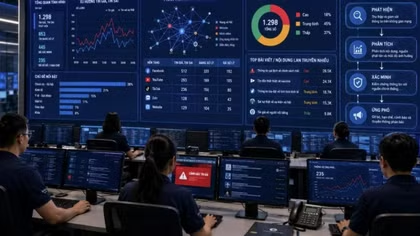
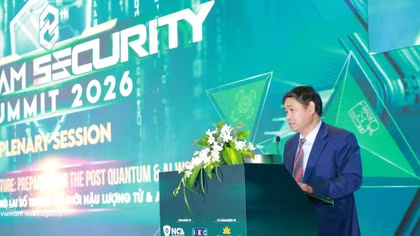
Protecting national security amid digital transformation, cyberspace

Protecting national security amid digital transformation, cyberspace

Cybersecurity, information security and data security risks must be identified and addressed early and from afar, with appropriate defensive measures ready to neutralise threats and protect national interests in cyberspace, said Lieutenant General Le Xuan Minh, Director of the Ministry of Public Security’s Department of Cybersecurity and Hi-tech Crime Prevention (A05).

Mekong Delta launches first robotics, AI research institute

Mekong Delta launches first robotics, AI research institute

Dr. Nguyen Van Quang, Rector of Nam Can Tho University, said the university is developing a value chain covering training, research, technology development, testing, technology transfer and commercialisation. The model is designed to link research more closely with practical needs, ensuring that technologies generate products and products create value for society.

Vietnam positioned to harness AI wave, World Bank report says

Vietnam positioned to harness AI wave, World Bank report says

The WB report identifies Vietnam as one of the few economies outside the European Union (EU) to have adopted a comprehensive AI regulatory framework as early as 2025. Vietnam applies a risk-tiered approach similar to that of the EU AI Act, imposing different obligations depending on whether an AI system poses “unacceptable,” “high,” “low” or “minimal” risks. The approach is viewed as a strategic step towards ensuring safe and transparent AI governance.

AI offers both opportunities, challenges for Vietnam's growth

AI offers both opportunities, challenges for Vietnam's growth

Dr. Ho Duc Thang, a full-time member of the National Assembly’s Committee for Cultural and Educational, said productivity is the key to sustaining double-digit economic growth, and AI has greater potential to improve productivity than any previous technology.

Top leader unveils people-centred vision for new development model

Top leader unveils people-centred vision for new development model

Vietnam's growth model, long fueled by low-cost labour, resource extraction, contract manufacturing, expanded investment, and capital accumulation, has run out of road. The country now needs a sweeping reform agenda to shift from extensive growth to a model driven by productivity, knowledge, science and technology, innovation, and digital transformation.

First national semiconductor chip prototyping support centre makes debut

First national semiconductor chip prototyping support centre makes debut

Vietnam's semiconductor ecosystem now comprises around 60 chip design companies, some 7,000 chip design engineers and 166 universities offering semiconductor-related training programmes. Initial registrations from 12 organisations indicate demand for the prototyping of approximately 30,000 chips.