Education ministry demands sweeping tech curricula revamp in strategic fields

The education ministry demanded a complete review of existing curricula, covering goals, learning outcomes, structure, content, teaching and assessment methods, and how emerging technologies like AI, semiconductors, automation, data science, and cybersecurity are embedded.

Education ministry demands sweeping tech curricula revamp in strategic fields -0
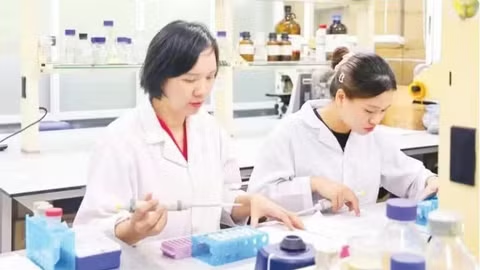
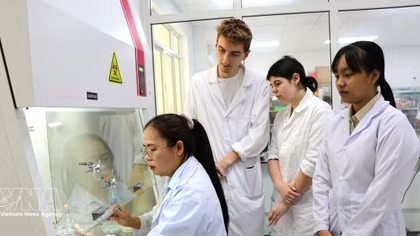
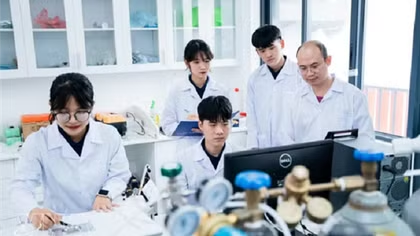
At national key laboratory of mechatronics and applications at the Da Nang University of Science and Technology (Photo: VNA)

The Ministry of Education and Training (MoET) has issued a dispatch to universities, academies, higher education institutions and research institutes with doctoral courses, requesting a sweeping review and overhaul of curricula in strategic technology fields.

Accordingly, they must review, update, and scale up courses in STEM, semiconductor microchips, information technology, artificial intelligence (AI), big data, cybersecurity, core and strategic technologies, and other hi-tech sectors.

The ministry demanded a complete review of existing curricula, covering goals, learning outcomes, structure, content, teaching and assessment methods, and how emerging technologies like AI, semiconductors, automation, data science, and cybersecurity are embedded.

Curricula must be revised to boost interdisciplinary integration, add courses on new and core technologies, and expand practice sessions, projects, and industry-linked research. They should also involve major enterprises, foreign-invested firms, and tech companies in training and graduate assessment, and are encouraged to develop English-medium courses.

The ministry tasked them with creating new courses in semiconductor design and manufacturing, AI, data science, and cybersecurity, as well as in core technologies that support digital transformation and Industry 4.0. The list of priority fields extends to energy storage, space monitoring, marine technology, smart agriculture, next-generation communications, connected intelligent transport, digital creative industries, next-generation energy, green food, smart healthcare and home appliances, advanced materials, Earth system science, bioresponsive materials, and smart electric mobility.

They must also review and build up their faculty to meet quantity, structure, and qualification requirements, with priority to doctoral-level lecturers with research and international collaboration experience. They are encouraged to recruit experts from companies and research institutes and use incentive policies to draw domestic and foreign talent.

At the same time, they should review and invest in infrastructure, including laboratories, research centres, technology systems, digital learning resources, and equipment for hi-tech training.

On partnerships, the ministry ordered them to expand ties with tech enterprises, domestic and international corporations, research institutes, innovation centres, and key national technology projects.

Collaboration should take the form of co-developing and co-delivering courses, internships, commissioned training, jointly supervised research and product development, and the creation of leading expert groups and strong research teams that connect academia, industry, research institutes, key technology programmes, and international partners.

They were also told to tap national projects for integrated infrastructure, smart workshops, and digital simulation tools; set up open labs, and expand university-enterprise collaboration to build innovation hubs and student research centres that support product design, testing, and improvement, thus spurring innovation and entrepreneurship.

A tripartite network involving academia, industry, and government should be formed to jointly design courses, run internship semesters, and fund studies. Companies are expected to advise on science, help develop curricula, evaluate graduates, promote dual training and applied research, and offer internships and jobs tied to practical skills.

The ministry is pushing for a boost in workforce R&D, tighter links between training and scientific research, and the creation of research groups in strategic technology fields. It also wants expanded postgraduate education, especially STEM and hi-tech doctoral courses, and innovation centres that offer consultancy, technology transfer, and innovation services. The establishment of sci-tech and intellectual property management firms, and investment mechanisms for such enterprises is also encouraged.

Relevant results must be reported to the ministry by June 15.
VNA

Other News

Vietnam Research Excellence Fellowship for 2026-2030 approved

Vietnam Research Excellence Fellowship for 2026-2030 approved

Under the Vietnam Research Excellence Fellowship (VREF) for the 2026–2030 period, PhD students are identified as a core research force directly contributing to breakthroughs in sci-tech and innovation. Investing in top-tier doctoral candidates is more than workforce development, but a high-stakes strategic bet to forge a cohort of world-class scientists and technologists who can power Vietnam’s long-term economic ambitions.

Strategic tech must address practical challenges: PM

Strategic tech must address practical challenges: PM

Prime Minister Pham Minh Chinh on March 28 said strategic technologies must tackle Vietnam’s practical challenges, while chairing a meeting of the Government’s Steering Committee for science and technology, innovation, digital transformation, and Project 06.

Ho Chi Minh City sets sights on becoming semiconductor hub

Ho Chi Minh City sets sights on becoming semiconductor hub

Ho Chi Minh City is stepping up efforts to attract investment from global leading groups and companies in the fields of electronic components, semiconductors and chip manufacturing as it seeks to position itself as a leading semiconductor industry hub in both the region and the world. 

Ho Chi Minh City launches upgraded technology exchange platform

Ho Chi Minh City launches upgraded technology exchange platform

The upgraded platform represents a comprehensive shift from a simple information-sharing model to a managed online technology trading system, enabling monitoring and measurement of real transaction outcomes. It is built on three pillars, namely new tradable technology products, a modern digital platform, and an improved operational model.

AI – unmissable opportunity for Vietnam: Experts

AI – unmissable opportunity for Vietnam: Experts

AI also emerges as a key enabler for Vietnam's ambition to build financial and technology hubs. Applications can boost efficiency, automate workflows, cut costs, and sharpen data analytics, which are essential pillars of a modern financial system.

PM calls for accelerated space technology development in Vietnam

PM calls for accelerated space technology development in Vietnam

Vietnam aims by 2030 to achieve a mid-level position in space science and technology development within Southeast Asia, and after 2030 to build national capabilities to independently develop satellite technologies and apply space data to address global challenges and national security needs.

High-level forum advances Vietnam–US technological cooperation

High-level forum advances Vietnam–US technological cooperation

A high-level executive leadership forum focusing on strengthening Vietnam - US relations through technology cooperation was jointly held in Washington D.C. on March 11 by the Embassy of Vietnam in the US, the Weatherhead East Asian Institute of Columbia University, and the US -ASEAN Business Council (USABC). 

AI Law takes effect, anchors national governance framework

AI Law takes effect, anchors national governance framework

While many countries are still drafting policy blueprints or issuing non-binding guidance, Vietnam has moved ahead with a standalone Law on Artificial Intelligence (AI), effective from March 1, placing it among a select group of nations to adopt dedicated AI legislation at the parliamentary level. 

Vietnam International Defence Expo 2026 preparations move into high gear

Vietnam International Defence Expo 2026 preparations move into high gear

Vietnam International Defence Expo 2026, themed “Peace, Friendship, Cooperation and Development,” will be organised on a larger scale, featuring a wide array of weapons and technical equipment alongside product exhibitions, seminars and panel discussions, drills, live field demonstrations, and business networking activities.

Ministry requests urgent measures to counter UAVs threatening aviation safety

Ministry requests urgent measures to counter UAVs threatening aviation safety

Ministry of Construction requested the Ministry of National Defence, the Ministry of Public Security and provincial and municipal steering committees for counter-terrorism to strengthen the management, inspection and supervision of UAVs and other aerial devices, ensuring strict compliance with Decree No. 288/2025/ND-CP and relevant legal regulations.

International conference spotlights advanced microscopy in life sciences, materials

International conference spotlights advanced microscopy in life sciences, materials

The microscopy user community in Vietnam remains fragmented, lacking a common platform for sharing technical expertise, research experience and collaboration opportunities. This limited connectivity has, to some extent, curtailed the full potential of microscopy technologies in advancing scientific progress and industrial applications at home and abroad.