Breakthroughs in Resolution 57 implementation need to be measured by results

With synchronised direction and unified implementation, ministries, sectors and localities are translating the Resolution into concrete institutions, mobilised resources and measurable outcomes.

More than a year after its rollout, the Politburo’s Resolution No. 57-NQ/TW on breakthroughs in science and technology development, innovation and national digital transformation has emerged as a strategic declaration charting a new development pathway for Vietnam.

With synchronised direction and unified implementation, ministries, sectors and localities are translating the Resolution into concrete institutions, mobilised resources and measurable outcomes.

Tailored groundbreaking mechanisms

As science, technology and innovation become key drivers of economic growth, building effective linkages between technology supply and enterprise demand has become imperative. Many localities have introduced context-specific mechanisms to accelerate technology transfer and application in production and business.
Breakthroughs in Resolution 57 implementation need to be measured by results -0
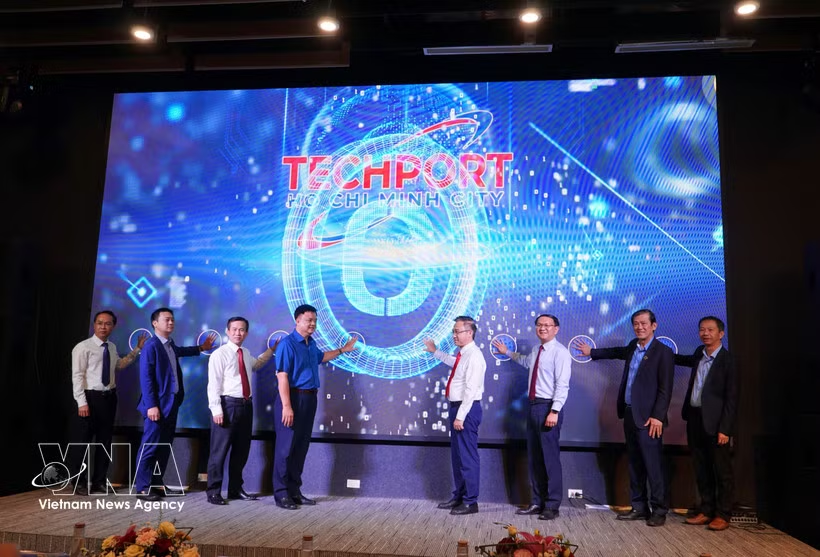
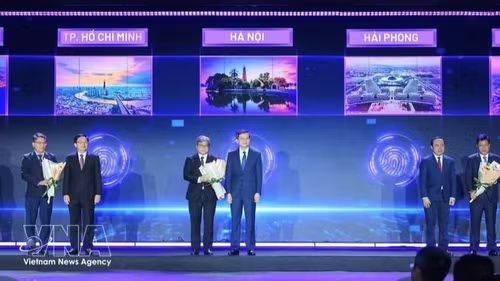
Ho Chi Minh City’s Technology Exchange (Techport) launched (Photo: VNA)

Ho Chi Minh City’s Technology Exchange in a new phase has been redesigned to bring technologies closer to production. The platform has shifted from information provision to transaction facilitation, from broad connections to targeted matching, and from general support to full-cycle support. Each enterprise’s technology demand is tracked, advised and supported until tangible results are achieved.

This transformation marks a significant step in strengthening intermediary infrastructure for the city’s science and technology market, promoting commercialisation of research outcomes and fostering an innovation ecosystem.

Aiming to turn Ho Chi Minh City into a hub for science, technology and innovation in Southeast Asia, the municipal People’s Committee has approved a scheme to develop internationally accredited Centres of Excellence (CoE). The Institute of Nano Materials and Molecular Structure (INOMAR) under Vietnam National University - Ho Chi Minh City was the first to join the scheme in June 2025, with funding of 85 billion VND (3.2 million USD). It has since merged with the Institute of Nanotechnology to form the Advanced Materials Technology Institute, operating under a university–research linkage model to support advanced research in new materials and nanotechnology.

Last October, the Research and Development Centre at the Saigon Hi-Tech Park was also approved to join the scheme, receiving nearly 96 billion VND to develop into a CoE in green transition and digital transformation. The centre focuses on highly applicable research serving enterprises and the market, including semiconductors, biotechnology, materials science and precision engineering–automation.

Meanwhile, Ca Mau province is promoting its strengths in the marine economy, agriculture, aquaculture and eco-tourism by fostering a robust startup ecosystem. Vice Chairman of the provincial People’s Committee Nguyen Minh Luan pledged to improve a transparent, enabling policy environment, reduce administrative barriers and encourage innovation with controlled risks.

The province is investing in a comprehensive startup support system, with its Innovation and Startup Centre acting as a hub to connect entrepreneurs with experts and investors, supporting projects from ideation to incubation, acceleration and commercialisation.

Promoting facilitating administration

An Giang province is advancing digital governance by encouraging public officials to propose initiatives, improve procedures and enhance service delivery. Its “One agency, one initiative” campaign for 2026 requires each department and local authorities to register at least one initiative with clear objectives, measurable outputs and compliance with legal regulations. Each solution must include at least two measurable indicators and before-and-after data to ensure substantive impact.

Similarly, Can Tho city has launched a comprehensive plan for implementing breakthroughs in science and technology development, innovation and digital transformation in 2026. The plan emphasises full digital transformation across three pillars—digital administration, digital economy and digital society with citizens and businesses at the centre. The city aims for 100% of business-related administrative procedures to be fully conducted online, over 80% of administrative transactions to be contactless, and complete digitisation of administrative records.

Can Tho targets digital economy to account for at least 14.5% of its GRDP, while promoting e-commerce, e-contracts and cashless payments to reach 80%. In the field of digital society, it aims for 95% of adults to have bank accounts and electronic health records, and for all general education schools to adopt digital management platforms and electronic transcripts.

Chairing the Government’s second meeting in 2026 on science, technology, innovation and digital transformation, Prime Minister Pham Minh Chinh stressed the need to identify the right tasks, assign the right people, ensure regular supervision, measure accurately, promptly address bottlenecks, and deliver tangible, effective results. With the Government's strong direction and coordinated implementation, these sectors are set to remain key breakthroughs, forming a pillar for Vietnam’s advancement in the digital era.
VNA

Other News

SK Group partners to build AI ecosystem in Vietnam

SK Group partners to build AI ecosystem in Vietnam

SK Innovation and SK Telecom signed MoUs with Nghe An province and the National Innovation Centre of Vietnam to advance AI ecosystem development and support the country’s long-term growth strategy.

Vietnam Research Excellence Fellowship for 2026-2030 approved

Vietnam Research Excellence Fellowship for 2026-2030 approved

Under the Vietnam Research Excellence Fellowship (VREF) for the 2026–2030 period, PhD students are identified as a core research force directly contributing to breakthroughs in sci-tech and innovation. Investing in top-tier doctoral candidates is more than workforce development, but a high-stakes strategic bet to forge a cohort of world-class scientists and technologists who can power Vietnam’s long-term economic ambitions.

Strategic tech must address practical challenges: PM

Strategic tech must address practical challenges: PM

Prime Minister Pham Minh Chinh on March 28 said strategic technologies must tackle Vietnam’s practical challenges, while chairing a meeting of the Government’s Steering Committee for science and technology, innovation, digital transformation, and Project 06.

Ho Chi Minh City sets sights on becoming semiconductor hub

Ho Chi Minh City sets sights on becoming semiconductor hub

Ho Chi Minh City is stepping up efforts to attract investment from global leading groups and companies in the fields of electronic components, semiconductors and chip manufacturing as it seeks to position itself as a leading semiconductor industry hub in both the region and the world. 

Ho Chi Minh City launches upgraded technology exchange platform

Ho Chi Minh City launches upgraded technology exchange platform

The upgraded platform represents a comprehensive shift from a simple information-sharing model to a managed online technology trading system, enabling monitoring and measurement of real transaction outcomes. It is built on three pillars, namely new tradable technology products, a modern digital platform, and an improved operational model.

AI – unmissable opportunity for Vietnam: Experts

AI – unmissable opportunity for Vietnam: Experts

AI also emerges as a key enabler for Vietnam's ambition to build financial and technology hubs. Applications can boost efficiency, automate workflows, cut costs, and sharpen data analytics, which are essential pillars of a modern financial system.

PM calls for accelerated space technology development in Vietnam

PM calls for accelerated space technology development in Vietnam

Vietnam aims by 2030 to achieve a mid-level position in space science and technology development within Southeast Asia, and after 2030 to build national capabilities to independently develop satellite technologies and apply space data to address global challenges and national security needs.

High-level forum advances Vietnam–US technological cooperation

High-level forum advances Vietnam–US technological cooperation

A high-level executive leadership forum focusing on strengthening Vietnam - US relations through technology cooperation was jointly held in Washington D.C. on March 11 by the Embassy of Vietnam in the US, the Weatherhead East Asian Institute of Columbia University, and the US -ASEAN Business Council (USABC). 

AI Law takes effect, anchors national governance framework

AI Law takes effect, anchors national governance framework

While many countries are still drafting policy blueprints or issuing non-binding guidance, Vietnam has moved ahead with a standalone Law on Artificial Intelligence (AI), effective from March 1, placing it among a select group of nations to adopt dedicated AI legislation at the parliamentary level. 

Vietnam International Defence Expo 2026 preparations move into high gear

Vietnam International Defence Expo 2026 preparations move into high gear

Vietnam International Defence Expo 2026, themed “Peace, Friendship, Cooperation and Development,” will be organised on a larger scale, featuring a wide array of weapons and technical equipment alongside product exhibitions, seminars and panel discussions, drills, live field demonstrations, and business networking activities.

Ministry requests urgent measures to counter UAVs threatening aviation safety

Ministry requests urgent measures to counter UAVs threatening aviation safety

Ministry of Construction requested the Ministry of National Defence, the Ministry of Public Security and provincial and municipal steering committees for counter-terrorism to strengthen the management, inspection and supervision of UAVs and other aerial devices, ensuring strict compliance with Decree No. 288/2025/ND-CP and relevant legal regulations.

International conference spotlights advanced microscopy in life sciences, materials

International conference spotlights advanced microscopy in life sciences, materials

The microscopy user community in Vietnam remains fragmented, lacking a common platform for sharing technical expertise, research experience and collaboration opportunities. This limited connectivity has, to some extent, curtailed the full potential of microscopy technologies in advancing scientific progress and industrial applications at home and abroad.