Controlled piloting of Starlink satellite Internet service to last for five years

As part of its deployment plan, Starlink will build four gateway stations in Phu Tho, Da Nang, and Ho Chi Minh City to ensure stable connectivity while complying with Vietnam’s cybersecurity requirements.

SpaceX’s Starlink Services Vietnam has received a licence from the Vietnam Telecommunications Authority (VNTA) to deploy a pilot low-Earth-orbit (LEO) satellite telecommunications service in the country, marking Vietnam’s first trial of large-scale satellite Internet connectivity.

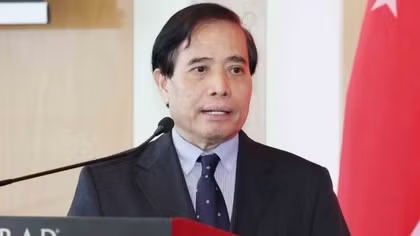
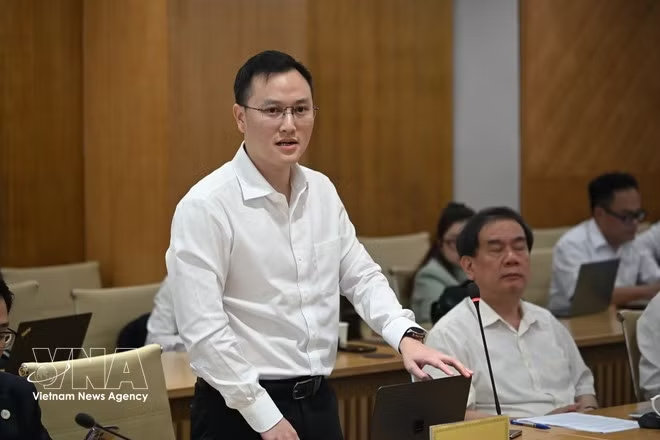
Speaking at the Ministry of Science and Technology’s regular press briefing on April 1, VNTA Deputy Director Nguyen Anh Cuong said the pilot period will last for five years and must conclude before 2031. The trial reflects a cautious regulatory approach aimed at evaluating the impact of emerging satellite technology on Vietnam’s national telecommunications infrastructure.
Controlled piloting of Starlink satellite Internet service to last for five years -0

To safeguard market stability, the Government has capped the service at a maximum of 600,000 subscribers. The ceiling is based on both the technical capacity of the satellite system and regulatory management considerations.

As part of its deployment plan, Starlink will build four gateway stations in Phu Tho, Da Nang, and Ho Chi Minh City to ensure stable connectivity while complying with Vietnam’s cybersecurity requirements.

Pricing has emerged as a key public concern. The satellite Internet service is expected to cost individual users 435 USD in the first month, including 350 USD for equipment and an 85 USD subscription fee. From the second month onward, the monthly charge will remain at approximately 85 USD.

Total first-year expenses are estimated at around 1,370 USD, equivalent to roughly 34–35 million VND. Annual costs from the second year are projected at about 1,020 USD, making the service five to ten times more expensive than fibre-optic Internet packages, which typically range from 200,000–400,000 VND per month, and significantly higher than mobile 4G/5G services.

Cuong emphasised that Starlink was licensed under a strictly controlled pilot framework in terms of both scope and scale. It must comply fully with Vietnam’s regulations on pricing and fair competition, similar to other telecommunications providers.

Authorities will closely monitor operations to make appropriate policy adjustments, maintain market balance, and prevent disruptions to the existing telecom ecosystem, he added.

Despite higher costs compared to conventional services, satellite Internet offers distinct advantages, notably its independence from terrestrial fibre-optic infrastructure. Users only need receiving equipment to access the service, making it particularly suitable for mountainous areas, sparsely populated regions, and remote offshore islands where fibre deployment is challenging or costly.

The service could also function as a backup connectivity solution for businesses, especially in cases of disruptions to international undersea fibre-optic cables that occasionally affect Internet speeds in Vietnam.

According to Cuong, given Vietnam’s already well-developed fixed broadband infrastructure, Starlink is unlikely to compete directly with existing providers. Instead, it is expected to complement current networks by expanding coverage to underserved areas and strengthening overall connectivity resilience.

If equipment importation and installation proceed smoothly, Vietnamese users may begin accessing Starlink satellite Internet services from mid-2026.
VNA

Other News

SK Group partners to build AI ecosystem in Vietnam

SK Group partners to build AI ecosystem in Vietnam

SK Innovation and SK Telecom signed MoUs with Nghe An province and the National Innovation Centre of Vietnam to advance AI ecosystem development and support the country’s long-term growth strategy.

Vietnam Research Excellence Fellowship for 2026-2030 approved

Vietnam Research Excellence Fellowship for 2026-2030 approved

Under the Vietnam Research Excellence Fellowship (VREF) for the 2026–2030 period, PhD students are identified as a core research force directly contributing to breakthroughs in sci-tech and innovation. Investing in top-tier doctoral candidates is more than workforce development, but a high-stakes strategic bet to forge a cohort of world-class scientists and technologists who can power Vietnam’s long-term economic ambitions.

Strategic tech must address practical challenges: PM

Strategic tech must address practical challenges: PM

Prime Minister Pham Minh Chinh on March 28 said strategic technologies must tackle Vietnam’s practical challenges, while chairing a meeting of the Government’s Steering Committee for science and technology, innovation, digital transformation, and Project 06.

Ho Chi Minh City sets sights on becoming semiconductor hub

Ho Chi Minh City sets sights on becoming semiconductor hub

Ho Chi Minh City is stepping up efforts to attract investment from global leading groups and companies in the fields of electronic components, semiconductors and chip manufacturing as it seeks to position itself as a leading semiconductor industry hub in both the region and the world. 

Ho Chi Minh City launches upgraded technology exchange platform

Ho Chi Minh City launches upgraded technology exchange platform

The upgraded platform represents a comprehensive shift from a simple information-sharing model to a managed online technology trading system, enabling monitoring and measurement of real transaction outcomes. It is built on three pillars, namely new tradable technology products, a modern digital platform, and an improved operational model.

AI – unmissable opportunity for Vietnam: Experts

AI – unmissable opportunity for Vietnam: Experts

AI also emerges as a key enabler for Vietnam's ambition to build financial and technology hubs. Applications can boost efficiency, automate workflows, cut costs, and sharpen data analytics, which are essential pillars of a modern financial system.

PM calls for accelerated space technology development in Vietnam

PM calls for accelerated space technology development in Vietnam

Vietnam aims by 2030 to achieve a mid-level position in space science and technology development within Southeast Asia, and after 2030 to build national capabilities to independently develop satellite technologies and apply space data to address global challenges and national security needs.

High-level forum advances Vietnam–US technological cooperation

High-level forum advances Vietnam–US technological cooperation

A high-level executive leadership forum focusing on strengthening Vietnam - US relations through technology cooperation was jointly held in Washington D.C. on March 11 by the Embassy of Vietnam in the US, the Weatherhead East Asian Institute of Columbia University, and the US -ASEAN Business Council (USABC). 

AI Law takes effect, anchors national governance framework

AI Law takes effect, anchors national governance framework

While many countries are still drafting policy blueprints or issuing non-binding guidance, Vietnam has moved ahead with a standalone Law on Artificial Intelligence (AI), effective from March 1, placing it among a select group of nations to adopt dedicated AI legislation at the parliamentary level. 

Vietnam International Defence Expo 2026 preparations move into high gear

Vietnam International Defence Expo 2026 preparations move into high gear

Vietnam International Defence Expo 2026, themed “Peace, Friendship, Cooperation and Development,” will be organised on a larger scale, featuring a wide array of weapons and technical equipment alongside product exhibitions, seminars and panel discussions, drills, live field demonstrations, and business networking activities.

Ministry requests urgent measures to counter UAVs threatening aviation safety

Ministry requests urgent measures to counter UAVs threatening aviation safety

Ministry of Construction requested the Ministry of National Defence, the Ministry of Public Security and provincial and municipal steering committees for counter-terrorism to strengthen the management, inspection and supervision of UAVs and other aerial devices, ensuring strict compliance with Decree No. 288/2025/ND-CP and relevant legal regulations.

International conference spotlights advanced microscopy in life sciences, materials

International conference spotlights advanced microscopy in life sciences, materials

The microscopy user community in Vietnam remains fragmented, lacking a common platform for sharing technical expertise, research experience and collaboration opportunities. This limited connectivity has, to some extent, curtailed the full potential of microscopy technologies in advancing scientific progress and industrial applications at home and abroad.