Robust dispute resolution framework key to Vietnam's IFC ambitions

The development strategy for VIFC-HCMC envisions a comprehensive financial ecosystem encompassing green finance, carbon credits, financial technology (fintech), blockchain technology, digital assets, digital banking and other innovative business models. These highly internationalised sectors involve complex cross-border transactions and sophisticated legal structures.

Hanoi (VNA) - As Vietnam develops its International Financial Centre in Ho Chi Minh City (VIFC-HCMC), establishing a modern, transparent and internationally aligned dispute resolution system is emerging as a key factor in attracting global capital, alongside financial infrastructure, technology and investment incentives.

1-2067.jpg
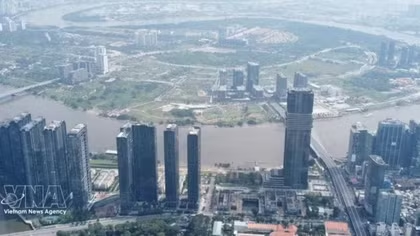
Financial buildings in downtown Ho Chi Minh City along the Saigon River. (Photo: VNA)

Hoang Huy Truong, Head of the Legal Affairs Division of the VIFC-HCMC Executive Agency, said the attractiveness and long-term sustainability of a financial centre are ultimately determined by “institutional trust”. As VIFC-HCMC aims to become a gateway connecting international capital flows with Vietnam, dispute resolution infrastructure is regarded as a critical component. Mechanisms such as specialised courts and arbitration centres could be employed to handle disputes.

The development strategy for VIFC-HCMC envisions a comprehensive financial ecosystem encompassing green finance, carbon credits, financial technology (fintech), blockchain technology, digital assets, digital banking and other innovative business models. These highly internationalised sectors involve complex cross-border transactions and sophisticated legal structures.

According to Truong, investors evaluate not only profit potential but also key legal considerations, including where disputes will be resolved, which language and legal framework will apply, and whether rulings can be effectively enforced. Experience shows that while markets can withstand volatility, uncertainty or a lack of transparency in dispute resolution mechanisms significantly increases risk costs and undermines investor confidence. As a result, dispute resolution systems are increasingly viewed as a form of strategic “soft infrastructure”.

Vietnam’s legal framework for the IFC is gradually taking shape under the National Assembly’s Resolution No. 222/2025/QH15 on IFC in Vietnam, together with regulations governing finance, banking, labour, immigration, arbitration, land and commodity transactions.

A notable feature is the parallel development of specialised dispute resolution institutions alongside the financial centre itself. Parties will be able to choose between specialised courts within the financial centre or international arbitration institutions. They will also have the option to apply foreign laws, international practices, conduct proceedings in English and select international, foreign or Vietnamese arbitrators. These provisions are expected to bring Vietnam’s IFC closer to the operational standards of leading financial hubs in the region.

Prof. Dr. Le Hong Hanh, President of the Vietnam International Arbitration Centre (VIAC), said that building a successful international financial centre requires not only advanced financial and technological infrastructure but also a transparent legal framework aligned with international practices.

Amid intensifying global competition, a commitment to efficient, investor-friendly and predictable dispute resolution mechanisms will be a decisive factor in enhancing the competitiveness of the financial centre.

Phan Duc Trung, Chairman of the Vietnam Blockchain and Digital Assets Association, noted that without specialised mediation, arbitration and dispute resolution mechanisms in place from the outset, disputes could become increasingly complex as emerging sectors expand. The recent launch of the VIAC Panel of FinTech & Digital Economy Dispute Specialists in Ho Chi Minh City is considered an important step in developing the legal expertise needed to support the IFC’s ecosystem.

Nguyen Khanh Ngoc, President of the Vietnam Lawyers Association, stressed that the establishment of Vietnam’s IFC must go hand in hand with a clear legal framework and reliable dispute resolution mechanisms to strengthen investor confidence and ensure the sustainable development of the business environment.

He noted that arbitration and other alternative dispute resolution methods offer significant advantages through their flexibility, confidentiality and specialised expertise, making them particularly well suited to the needs of modern financial transactions.

For Ho Chi Minh City, enhancing its international arbitration framework is about more than resolving disputes. It represents a commitment to creating a safe, transparent and internationally recognised investment environment. A modern, professional and internationally oriented arbitration system is expected to improve capital mobilisation, strengthen market attractiveness and provide a solid foundation for Vietnam’s IFC to establish its position on the global financial map./.
en.vietnamplus.vn

Other News

Vietnamese products make strong impression at Foodservice Australia 2026

Vietnamese products make strong impression at Foodservice Australia 2026

International visitors expressed positive impressions of Vietnamese products displayed at the fair. Nelma Sanjines, senior supervisor at ESP Catering in Sydney, praised the flavour of Vietnamese chilli sauce and soy sauce as well as the attractive packaging of confectionery products.

Digital technology helps standardise supply chains, sustain export competitiveness

Digital technology helps standardise supply chains, sustain export competitiveness

Experts noted that supply chain optimisation and risk management are no longer isolated tasks for individual companies but a requirement for the entire export ecosystem. With guidance from regulators, support from industry experts and their own efforts, Vietnamese exporters are expected to enhance their competitiveness and turn technical barriers and market volatility into opportunities for sustainable growth in global markets.

Vietnam seen as attractive investment destination for 2026–2035

Vietnam seen as attractive investment destination for 2026–2035

The article described Vietnam as strategically positioned along major regional maritime routes, including the East – West corridor linking the Americas, the Middle East, India and Europe, and the North – South corridor connecting China and Southeast Asia, helping make the country a gateway for international trade.

Eco-industrial parks seen as catalyst for higher-quality FDI

Eco-industrial parks seen as catalyst for higher-quality FDI

The eco-industrial park model will help Vietnam meet international environmental standards while creating opportunities to improve growth quality and economic competitiveness. Many multinational corporations now view green standards, emissions reduction and energy efficiency as key conditions when selecting investment destinations.

Promoting Vietnamese Brands at an International Food Fair in Gwangju

Promoting Vietnamese Brands at an International Food Fair in Gwangju

Alongside exhibition activities, trade promotion, and business networking programs, the “Gwangju Global Food Fair 2026” also witnessed the signing ceremony of a Memorandum of Understanding (MOU) between the Vietnam–Korea Businessmen & Investment Association (VKBIA) and the Gwangju Tourism Organization of South Korea.

Hanoi proposes subsidies to accelerate shift to electric vehicles

Hanoi proposes subsidies to accelerate shift to electric vehicles

Under a draft resolution currently open for public feedback by the municipal People’s Committee, residents with permanent or temporary residence registration in Hanoi for at least two consecutive years, who own petrol-powered motorbikes registered before the resolution takes effect, will be eligible for support when purchasing electric motorbikes priced at 10 million VND or more.

Private economic sector poised for breakthrough growth

Private economic sector poised for breakthrough growth

More than a year after the Politburo's Resolution No. 68-NQ/TW on private sector development came into effect, expectations now extend beyond increasing the number of enterprises. The goal is to build a stronger business community with greater resilience, larger ambitions and the capacity to compete in global supply chains.

Vietnam remains ASEAN growth leader in 2026 despite global headwinds: WB

Vietnam remains ASEAN growth leader in 2026 despite global headwinds: WB

Vietnam is expected to remain one of ASEAN’s fastest-growing economies in 2026, supported by resilient exports, strong investment inflows and an ambitious reform agenda, despite mounting global uncertainties, according to the World Bank’s latest Vietnam Economic Update released on May 15.

Ministry establishes monitoring framework for carbon market

Ministry establishes monitoring framework for carbon market

Under a new circular, the exchange of greenhouse gas emission quotas and carbon credits is conducted on the domestic carbon credit exchange through the carbon trading system, which is interconnected with the national registration system.