Government urges vigilance as inflation pressures mount in H2

The Government's inflation target remains within reach despite mounting headwinds. Several forecasts suggest inflation can stay below 4.5% this year if international oil prices continue to retreat. Extending domestic fuel tax incentives through year-end, along with stable electricity prices, healthcare fees and exchange rates, would offer additional relief.

Hanoi (VNA) – The Government has ordered ministries, agencies and local authorities to sharpen forecasting capabilities and build response scenarios to keep inflation contained.

They were told to manage prices of essential goods with caution and flexibility, warning that room to absorb price shocks is narrowing.
vna-i.jpg
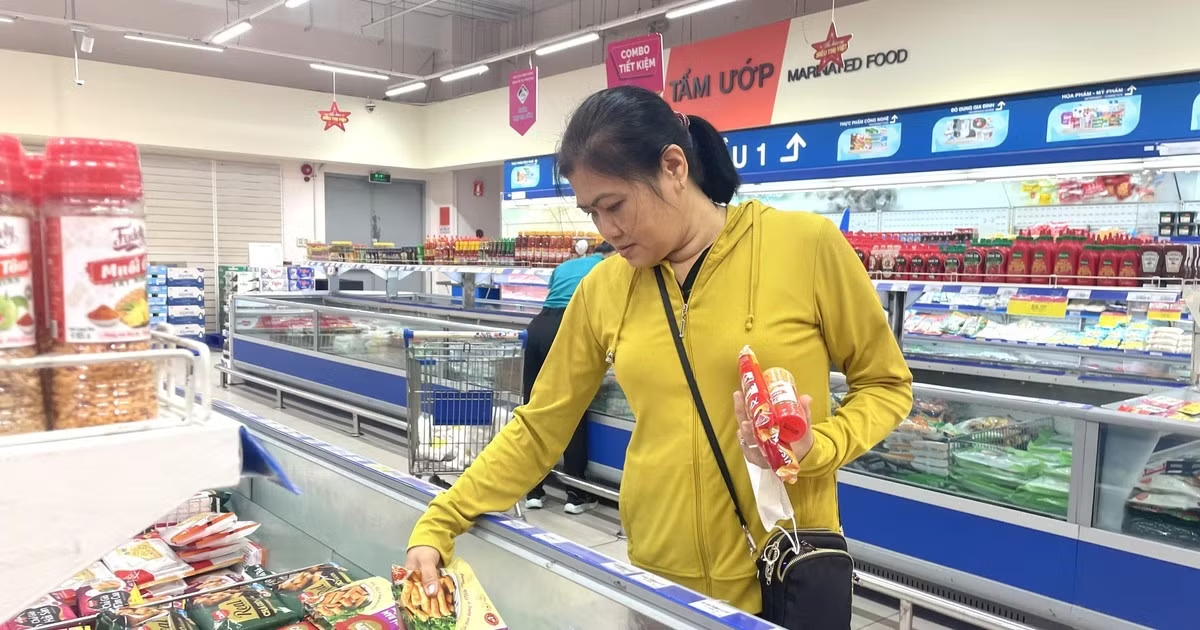
Vietnamese food is increasingly diverse in varieties and packaging, meeting domestic demand. (Photo: VNA)

Headline CPI closes in on target

According to the Ministry of Finance, the consumer price index (CPI) rose 4.38% year-on-year in the first half, while core inflation climbed 4.12%. Fuel prices were the main driver, surging an average 19.13% in the wake of the Middle East conflict and contributing roughly 1.35 percentage points to headline CPI growth.

Notably, coordinated fiscal and monetary policies, along with supply-demand balance, helped steady prices through the first half. Domestic fuel prices remained 10-15% lower than in neighbouring countries, while electricity rates were held unchanged.

The National Statistics Office (NSO) said first-half inflation picture reflected offsetting factors. Flexible fuel price management and ample food supplies eased pressures, but rising costs for household electricity, construction materials, housing and consumer services, stoked by higher input expenses and recovering demand, continued to push inflation higher.

Economist Ngo Tri Long from the Vietnam Association of Financial Consultants said inflation was under control in the first half, yet the tight spread between core and headline CPI signaled price pressures had broadened beyond volatile items like fuel and food into a wider basket of goods and services.

Speaking at the 2026 annual forum on Vietnam market and price trends, Phan Thi Thu Hoai from the Institute of Economics and Finance said domestic inflation is increasingly driven by a mix of factors rather than external shocks alone. Energy prices, exchange rates, logistics and food costs, monetary policy and market expectations are all fueling inflationary pressures, she said, arguing that price management now requires close fiscal-monetary coordination, stable supply of essential goods and more proactive market forecasting.

Mounting pressure toward year-end

Balancing the Government’s double-digit growth ambition for the remainder of the year with an annual inflation cap of around 4.5% will be a tall order, particularly given continued volatility in energy and raw material costs, freight and exchange rates, and geopolitical risks buffeting the highly open economy.

Economists flagged several factors likely to intensify inflation in the second half, including the July 2026 wage hike, expiration of tax cuts on certain petroleum products after September 30, stronger demand for electricity and production inputs tied to higher growth targets, faster public investment disbursement, and scheduled rises in state-managed goods and public service prices.

These require flexible price management, careful policy coordination and contingency planning, with adjustments to administered prices calibrated and timed to avoid locking in inflation expectations, they added.

Dr. Can Van Luc, member of the National Advisory Council on Financial and Monetary Policies, said the Government's inflation target remains within reach despite mounting headwinds. Several forecasts suggest inflation can stay below 4.5% this year if international oil prices continue to retreat. Extending domestic fuel tax incentives through year-end, along with stable electricity prices, healthcare fees and exchange rates, would offer additional relief.

Under its updated policy scenario, the ministry said hitting the 4.5% annual target would require average month-on-month CPI growth of just 0.05% for the rest of the year. The scenario assumes full-year fuel prices rise about 11.85%, while key administered services, such as electricity, health care and education, stay unchanged per the current adjustment roadmap.

The NSO said authorities must keep a close watch on inflation, exchange and interest rates, and financial markets in the coming months to safeguard macroeconomic stability and financial system safety./.
VNA
en.vietnamplus.vn

Other News

RoK picks Vietnam as K-Food logistics hub for ASEAN expansion

RoK picks Vietnam as K-Food logistics hub for ASEAN expansion

Demand for Korean food in Vietnam has continued to grow rapidly alongside the popularity of the Korean Wave, or Hallyu, making the country a strategic market in the RoK's plan to expand agricultural and food exports to ASEAN, the RoK's Ministry of Agriculture, Food and Rural Affairs said.

Nearly 68,000 smuggling, trade fraud, counterfeit cases uncovered in H1

Nearly 68,000 smuggling, trade fraud, counterfeit cases uncovered in H1

Authorities detected and handled 67,937 violations in the first half of the year, up 36.66% year-on-year. Budget revenue from enforcement reached nearly 9.65 trillion VND (nearly 367 million USD), an increase of 49.36%, while investigation was launched into 1,676 criminal cases involving 2,789 suspects.

Vietnam joins global push for energy efficiency

Vietnam joins global push for energy efficiency

Participation in the Montreal Declaration also provides a foundation for Vietnam to explore deeper engagement with the IEA's multilateral energy efficiency initiatives, offering opportunities to access data, policy experience, technical tools and public-private partnership models in energy conservation.

Vietnam's Q2 GDP rises 8.39% amid broad-based economic growth

Vietnam's Q2 GDP rises 8.39% amid broad-based economic growth

Releasing the country's socio-economic data for the second quarter and the first half of the year on July 3, NSO Director Nguyen Thi Huong said Vietnam sustained positive growth across most industries and sectors despite a challenging international economic environment.

Public-private partnerships drive low-emission rice farming

Public-private partnerships drive low-emission rice farming

Experts agreed that integrating nutrient management, biotechnology, mechanisation and digital technologies will enhance productivity, reduce greenhouse gas emissions and accelerate the transition towards greener, more sustainable rice production.

Vietnam's tilapia exports maintain strong growth

Vietnam's tilapia exports maintain strong growth

Vietnam's tilapia export revenue in the first five months of 2026 hit 62 million USD, more than doubling that in the same period last year, reflecting a strong recovery in international demand

Vietnam's domestic carbon exchange launched

Vietnam's domestic carbon exchange launched

The carbon exchange creates a mechanism that enables businesses to optimise emission-reduction costs through trading emission quotas and carbon credits, encourages technological innovation, and supports sustainable development while maintaining the principle of not sacrificing the environment for economic growth.

SBV raises short-term capital lending cap to 40%

SBV raises short-term capital lending cap to 40%

The new circular will help credit institutions have more room to provide capital to businesses and investment projects to support high economic growth in the next few years, while increasing flexibility in the SBV’s monetary policy management.

Business confidence in Vietnam rebounds strongly: UOB

Business confidence in Vietnam rebounds strongly: UOB

The study found that 85% of Vietnamese enterprises reported positive business sentiment, a sharp increase from 48% in 2025, when business confidence was weighed down by uncertainties surrounding US tariff policies and related trade developments.

Bac Ninh seeks high-quality foreign investment for sustainable growth

Bac Ninh seeks high-quality foreign investment for sustainable growth

According to Vice Chairman of the provincial People’s Committee Pham Van Thinh, the province aims to maintain stable and sustainable growth, improve the competitiveness of both the economy and local businesses, and make better use of free trade agreements (FTAs) to expand and diversify export markets.

Green building trend flourishes in Ho Chi Minh City's real estate landscape

Green building trend flourishes in Ho Chi Minh City's real estate landscape

The International Finance Corporation (IFC) highlighted the city's dominance in green-certified building floor space in Vietnam, reflecting the rapid expansion of the green building market with 780 completed green buildings encompassing over 18.69 million sq.m by 2025, predominantly certified by EDGE and LEED.