Timely regulation keeps fuel market stable as hoarding declines

Since March 8, following the latest price adjustment by the Ministry of Industry and Trade (MoIT) and the Ministry of Finance (MoF), cases of fuel hoarding and queues for stockpiling have declined.

Prompt policy measures by the Government and relevant ministries have helped stabilise Vietnam’s fuel market and curb hoarding, despite sharp global oil price fluctuations driven by tensions in the Middle East.
Timely regulation keeps fuel market stable as hoarding declines -0
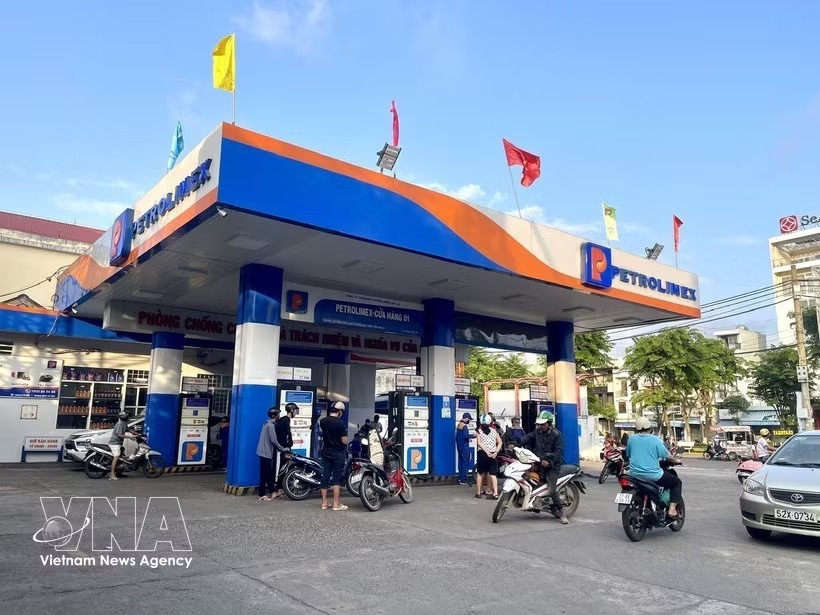
People buy fuel at a petrol station. (Photo: VNA)

Domestic fuel prices have been adjusted in line with global refined petroleum price movements. According to reports from local Departments of Industry and Trade, since March 8, following the latest price adjustment by the Ministry of Industry and Trade (MoIT) and the Ministry of Finance (MoF), cases of fuel hoarding and queues for stockpiling have declined.

Measures under Government Resolution No. 36/NQ-CP are also being implemented to diversify crude oil sources for domestic refineries. MoIT continues to inspect key fuel traders to ensure compliance with the minimum supply requirements for 2026, while working with relevant forces to strengthen market supervision and prevent speculation and stockpiling. The ministry is coordinating with MoF to develop price stabilisation measures, including the possible use of the fuel price stabilisation fund and proposals to reduce certain taxes and fees.

According to the task force for energy security, retail fuel prices in several countries have recently surged due to the impact of the Middle East conflict. Domestically, Vietnam’s two major refineries, Dung Quat Oil Refinery and Nghi Son Refinery and Petrochemical LCC, currently meet around 70% of the country’s fuel demand.

The remaining 30% is supplied through imports. Fuel importers reported that supply for March 2026 remains largely secure, though imports in April may face challenges as global prices rise and some countries limit exports to safeguard their own energy security.

In response to global price movements and in line with Resolution No. 36, MoIT and MoF have adjusted domestic fuel prices accordingly. Under the price adjustment on March 7, the base price of RON95-III gasoline rose to 27,047 VND (1.03 USD) per litre, up 4,707 VND or 21.07% compared with the previous period, while diesel 0.05S increased to 30,239 VND per litre, up 7,202 VND or 31.26%.

Alongside price management aligned with global trends, market inspection and supervision have also been intensified. According to MoIT, following the price adjustment at 3pm on March 7, fuel distributors in Hanoi reported stable supply conditions for the coming days. Daily sales between March 4 and 8 increased by about 50% compared with the average level recorded in January.

In recent days, concerns over rising prices and potential supply disruptions prompted some people to rush to purchase and store fuel in various forms, causing a short-term surge in demand. Such behaviour was more common in northern provinces, particularly in Hanoi, while the phenomenon was less pronounced in central and southern regions./.
VNA

Other News

Vietnam accelerates innovation to boost growth, competitiveness

Vietnam accelerates innovation to boost growth, competitiveness

By 2030, Vietnam aims to rank among the world’s top 40 in the GII; raise total social investment in R&D to at least 2% of GDP, with non-State funding accounting for over 60%; increase international scientific publications by an average of 10% annually; and raise the number of patent applications and granted patents by an average of 16-18% annually.

Vietnam sees high growth prospects

Vietnam sees high growth prospects

Experts from the Institute of Vietnam and World Economy under the Vietnam Academy of Social Sciences noted the quality of recent growth as the high growth rate has been recorded against an increasingly higher comparative base.

Vietnam seeks bigger share of global Halal market

Vietnam seeks bigger share of global Halal market

Vietnam's Halal exports remain modest at around 900 million USD a year, accounting for less than 1% of the global market. Most exports are still raw agricultural and seafood products. Only around 1,000–1,300 Vietnamese businesses obtained or maintained Halal certification during 2024–2026.

Hanoi sets up inter-agency mechanism to operate carbon market

Hanoi sets up inter-agency mechanism to operate carbon market

Under a decision of the municipal People’s Committee on establishing an inter-agency working group, departments and agencies are responsible for identifying facilities subject to greenhouse gas inventories, developing emissions-reduction plans and studying projects capable of generating carbon credits.

Shrimp exports reach 3.3 billion USD in eight months

Shrimp exports reach 3.3 billion USD in eight months

According to data from the Vietnam Customs cited by the Vietnam Association of Seafood Exporters and Producers (VASEP), shrimp exports reached 478.5 million USD in August, up 4.2% from the same month last year. The eight-month total stood at 3.3 billion USD, representing a year-on-year increase of 12%.

Russian investors explore opportunities in Vietnam's real estate market

Russian investors explore opportunities in Vietnam's real estate market

Vietnam is seen as a potential market, with considerable room for growth in real estate, particularly commercial property, compared with some regional markets. Strong Vietnam-Russia ties and opportunities to establish foreign-invested enterprises are also considered favourable for Russian investors.

Phu Quoc airport planning adjusted to serve APEC 2027

Phu Quoc airport planning adjusted to serve APEC 2027

For 2021-2030, the Civil Aviation Authority of Vietnam proposed bringing forward the investment in a parallel taxiway system and a connecting taxiway north of Runway No. 2 at Phu Quoc International Airport, in order to connect with the aircraft maintenance and repair facility (hangar) planned for the northern area of ​​the airport.

Policy, infrastructure emerge as new advantages in FDI attraction

Policy, infrastructure emerge as new advantages in FDI attraction

From policy and infrastructure to industrial real estate, Vietnam’s FDI advantages are broadening towards a more integrated production ecosystem, offering investors a stronger combination of conditions for high-value, technology-intensive and long-term projects.

Logistics upgrade vital to 1-trillion-USD trade target: experts

Logistics upgrade vital to 1-trillion-USD trade target: experts

As trade expands, systemic bottlenecks across transport networks, warehousing, ports, border gates, and industrial zones are becoming more apparent. Experts emphasise the need to shift from a fragmented, project-by-project approach toward strategic management structured around trade corridors and integrated supply chains.

Ample room for Vietnam, US to deepen cooperation

Ample room for Vietnam, US to deepen cooperation

Do Ngoc Hung, Trade Counsellor and head of the Vietnam Trade Office in the US, said what stands out is not only the growth in trade volume but also the increasingly deep economic ties between the two countries.

Flexible fiscal policy helps drive economic growth

Flexible fiscal policy helps drive economic growth

According to the Ministry of Finance, State budget revenue in the first eight months of 2026 was estimated at 2.02 quadrillion VND (77.7 billion USD), equivalent to 80% of the annual estimate and up 16% year-on-year. Domestic revenue reached 1.75 quadrillion VND, accounting for 86.6% of total revenue and rising 16.6%.

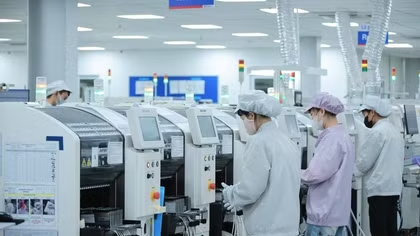
Electronic components are produced at a factory in Hanoi. (Photo: VNA)

Hanoi's imports surge 41% in first eight months of 2026

Hanoi aims to achieve average annual export growth of at least 12% during 2026-30, with the city seeking to diversify export markets, boost high-tech and value-added products and reduce reliance on traditional markets.