Vietnam races to achieve 74-billion-USD target from agro-forestry-aquatic exports

The country's agro-forestry-aquatic product exports reached nearly 42.8 billion USD in the January–July period, up 7.5% year-on-year and equivalent to almost 60% of the annual target of 74 billion USD.
Hanoi (VNA) – Vietnam’s agro-forestry-aquatic product exports are on track to meet the Government’s 2026 target after maintaining solid growth in the first seven months of the year.

The country's agro-forestry-aquatic product exports reached nearly 42.8 billion USD in the January–July period, up 7.5% year-on-year and equivalent to almost 60% of the annual target of 74 billion USD.

download-15.png
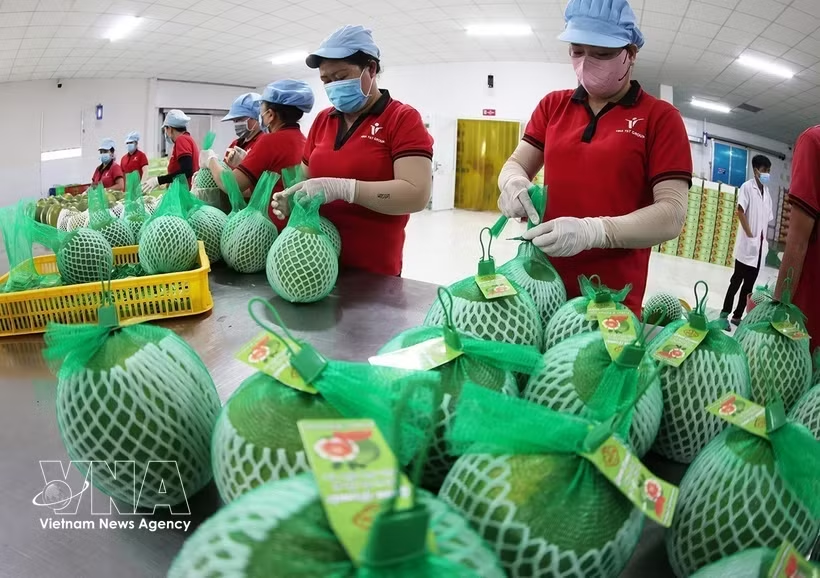
Workers prepare pomelo for export to Australia. (Photo: VNA)

Exports in July alone were estimated at 6.67 billion USD, an increase of 11.9% from a year earlier, indicating that the sector’s recovery continues to gain strength. The seven-month growth rate was also higher than the figure of 6.7% recorded in the first half of the year.

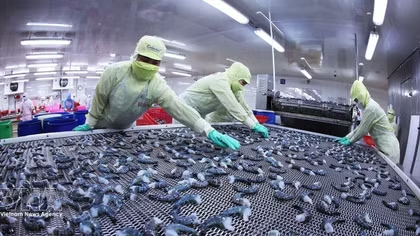
Crop products remained the largest export category with nearly 22.2 billion USD, followed by forestry products at almost 11 billion USD and seafood at 6.85 billion USD, up 12.7% year-on-year. Exports of livestock products, agricultural production inputs and salt also posted double-digit growth.

Several major export items continued to perform well. Fruits and vegetables generated 4.83 billion USD, up nearly 25%, while wood and wood products earned more than 10 billion USD. Pepper exports exceeded 1 billion USD, and seafood maintained strong growth.

Director of the Department of Quality, Processing and Market Development under the Ministry of Agriculture and Environment Ngo Hong Phong said stable domestic consumption and the implementation of new-generation free trade agreements have continued to create opportunities for Vietnamese agricultural products.
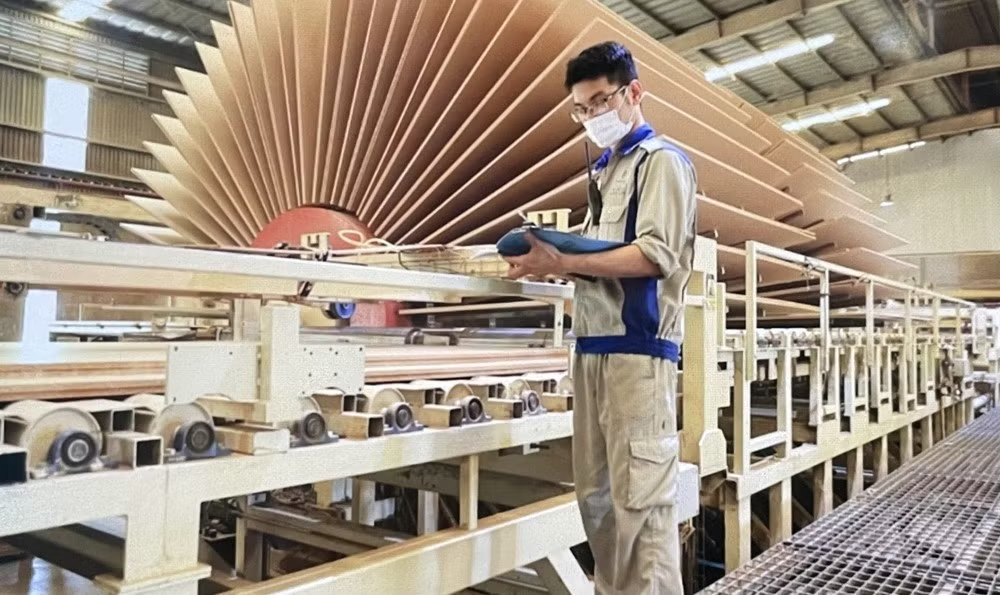
MDF wood production at Quang Tri Wood Company (Photo published by VNA)

However, despite the encouraging figures, the sector still faces challenges.

Several key commodities recorded higher export volumes but lower export values as global prices have dropped. Coffee exports reached 5.45 billion USD, down more than 11%, while rice exports fell 6.7% to 2.64 billion USD despite a slight increase in export volume. Rubber, tea and cassava also experienced declines in export earnings.

The ministry attributed the trend to recovering global supplies, weaker demand in major markets and increasingly stringent technical requirements related to product traceability, environmental standards and carbon emissions.

Domestic challenges also remain. Weak production linkages, limited deep-processing capacity, inadequate post-harvest preservation and high logistics costs continue to undermine the competitiveness of many export products.

The wood industry, one of Vietnam’s largest agricultural export earners, is also under pressure. Exports totalled 10.1 billion USD in the first seven months, up just 4.9% year-on-year.

Ngo Sy Hoai, General Secretary of the Vietnam Timber and Forest Products Association, said exporters are facing increasing challenges in the US market because of multiple tax layers and trade defence measures. The US remains Vietnam’s largest market for wooden furniture, importing more than 9 billion USD worth of products annually.

Under the Government’s Resolution No. 168/NQ-CP, the agricultural, forestry and fishery sector is expected to grow by 4% this year while exports surpass 74 billion USD.

To achieve the target, the Ministry of Agriculture and Environment has identified five priorities, including institutional reform, export promotion, faster public investment, digital transformation and stronger support for businesses.

One key reform took effect on August 1, reducing the processing time for granting planting area codes from 10 days to 3 days, helping exporters speed up shipments of products subject to strict import requirements, including durian.

Meanwhile, the National Agricultural, Forestry and Fishery Traceability System officially came into operation on July 1, providing a transparent supply chain platform to meet increasingly demanding import standards.

Minister of Agriculture and Environment Trinh Viet Hung has instructed the sector to shift from a management mindset to one centred on serving businesses and farmers, while eliminating administrative harassment and making greater use of traceability data to respond proactively to technical barriers in export markets.

Deputy Minister Vo Van Hung said the goal of exceeding 74 billion USD remains achievable if the sector continues to closely monitor market developments, adjust policies flexibly and accelerate restructuring towards higher-value production, science and technology application, and market diversification in the remaining months of the year./.
VNA
en.vietnamplus.vn

Other News

Ho Chi Minh City targets third-quarter growth of over 11%

Ho Chi Minh City targets third-quarter growth of over 11%

Ho Chi Minh City will continue to implement drastic measures to achieve double-digit growth, targeting GRDP growth of at least 11.07% in the third quarter of 2026, 9.43% in the first nine months and 12.3% in the fourth quarter, with a view to completing the full-year goal of 10% or more.

Vietnamese experts abroad join efforts to advance nuclear power development at home

Vietnamese experts abroad join efforts to advance nuclear power development at home

Held both in person and online, the seminar focused on the current status and opportunities for Vietnam’s nuclear power programme, human resources development, global trends in small modular reactors (SMRs), experience in ensuring safety and extending the operational life of nuclear power plants, and ways to mobilise Vietnamese experts abroad to contribute to the programme.

Port throughput in Hai Phong exceeds eight-month target

Port throughput in Hai Phong exceeds eight-month target

The strong performance followed a series of measures to optimise port capacity and improve the competitiveness of the city’s seaport system, with a focus on maximising the efficiency of the Lach Huyen international gateway port as new berths came into operation.

Vietnam, Mercosur begin trade negotiations

Vietnam, Mercosur begin trade negotiations

During the session, both sides reaffirmed their determination to advance the negotiations in a spirit of goodwill, with a view to reaching a balanced agreement that aligns with the interests of both Vietnam and Mercosur.

Vietnam poised to benefit from new wave of technology investment

Vietnam poised to benefit from new wave of technology investment

The successful development and production of high-end Pixel smartphones in Vietnam – a more complex process than manufacturing smartwatches and wireless earbuds – is reportedly giving Google confidence in moving its entire Pixel production out of China.

Energy infrastructure underpins marine economy development

Energy infrastructure underpins marine economy development

The integrated investment in energy infrastructure will provide a vital infrastructure foundation for effectively harnessing the marine potential, helping realise the goal of making Vietnam a strong maritime nation and achieving sustainable and prosperous development from the sea.

Ho Chi Minh City hosts International Innovation Forum and Exhibition 2026

Ho Chi Minh City hosts International Innovation Forum and Exhibition 2026

InnoEx 2026 focuses on major shifts reshaping the global economy, including artificial intelligence (AI), data, automation, green transition, international trade and new business models. It also provides a platform connecting businesses, startups, investors and solution providers, facilitating partnerships, investment and access to knowledge and technologies.

Vietnamese enterprises renew growth model to move up global value chains

Vietnamese enterprises renew growth model to move up global value chains

The resolution identifies enterprises as the centre of the renewal process, urging them to shift from cost-based competition to productivity, technology, quality and market responsiveness; from operating independently to joining industrial ecosystems; and from participating in value chains to mastering and eventually leading them.

Khanh Hoa province explores Halal ecosystem development

Khanh Hoa province explores Halal ecosystem development

Khanh Hoa aims to estabish itself as a Halal-friendly destination while supporting businesses in expanding export markets, attracting strategic partners and investors, and drawing projects from countries with strong Halal logistics, tourism, manufacturing, processing and agriculture sectors.

Data-driven land valuation to curb speculation: Experts

Data-driven land valuation to curb speculation: Experts

From a property-market perspective, Do Thi Thu Giang, National Director of Valuation and Advisory at Savills Vietnam, said the orientations under Resolution No. 21-NQ/TW could make the market more transparent and efficient, with property values increasingly tied to actual development and use potential.