An Giang aims to become leading maritime economic hub

Under the province's master plan for 2021–2030 with a vision to 2050, An Giang will prioritise investment in five strategic sectors: strategic infrastructure; processing industries and clean energy; trade, services, logistics and border-gate economy; high-quality tourism; and high-tech agriculture, ecological development and the circular economy.

With a strategic vision, the Mekong Delta province of An Giang is working towards becoming one of Vietnam's leading maritime economic hubs by 2030, contributing to the country's overall maritime ambition.

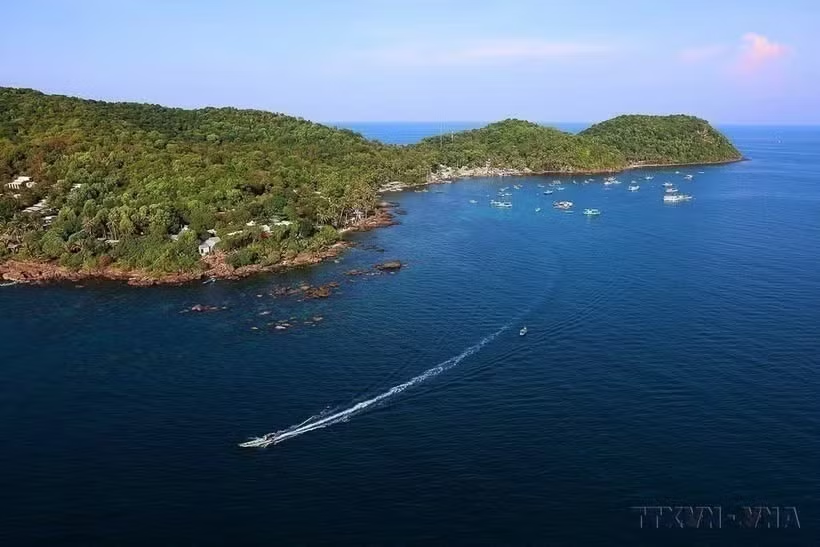
The province boasts a maritime area of 63,290 sq.km, a 200-km coastline, and more than 140 islands, 40 of which are inhabited. Among them is Phu Quoc, Vietnam's largest island, which offers exceptional potential for marine-based economic development.
phu-quoc.jpg
A corner of Phu Quoc special zone in An Giang province (Photo: VNA)

Le Huu Toan, Director of the provincial Department of Agriculture and Environment, said that more than seven years after the implementation of Resolution No. 36-NQ/TW on the strategy for the sustainable development of Vietnam's marine economy to 2030, with a vision to 2045, An Giang has made significant progress across a broad range of related sectors, making an important contribution to the province's socio-economic development.

The marine economy now accounts for around 80% of the province's gross regional domestic product (GRDP), serving as a strategic pillar driven by associated tourism and services, aquaculture and transport. Meanwhile, coastal infrastructure has been steadily upgraded, strengthening connectivity between the mainland and islands.

The province has also implemented comprehensive measures to combat illegal, unreported and unregulated (IUU) fishing, helping address the European Commission's "yellow card" warning while meeting traceability requirements, and expanding seafood export markets

Local marine aquaculture has continued to expand, with six large-scale projects covering more than 3,287 hectares and attracting a total registered investment of 1.12 trillion VND (42.53 million USD). Seafood exports have recorded annual growth of nearly 10%.

Notably, the Phu Quoc International Airport is expected to strengthen the Phu Quoc special zone’s role as an international tourism, trade and logistics hub by enhancing direct global connectivity.

Chairman of the An Giang People's Committee Ho Van Mung said the province's marine economic strategy focuses on developing specialised growth zones that together form a comprehensive maritime economic ecosystem.

Under this strategy, Phu Quoc is being developed into an international centre for tourism and commerce, serving as the province's principal growth engine.

At the same time, Rach Gia is positioned as the province's political, administrative and economic centre, with strengths in industry and the marine economy, while Ha Tien is set to become a major hub for the marine economy, tourism and border trade in the southwestern region, supporting greater regional connectivity and international economic integration.

To unlock the full potential of its marine economy, An Giang is prioritising the comprehensive development of strategic infrastructure. This includes completing regional expressways, upgrading Phu Quoc and Rach Gia airports, and building a new airport in the Tho Chau special zone. The Chau Doc-Can Tho-Soc Trang expressway is expected to become a vital transport corridor, significantly reducing the time required to move goods from inland areas to seaports.

The Kiss Bridge in Phu Quoc, an iconic architectural landmark that has become a new symbol of love and tourism in Vietnam. (Photo: VNA)

An Giang is also focusing on expanding and improving key ports, including Phu Quoc international port, Hon Chong port and the planned Nam Du deep-water port, with the aim of creating modern multi-purpose ports serving logistics, international trade and marine tourism.

Mung said that under the province's master plan for 2021–2030 with a vision to 2050, An Giang will prioritise investment in five strategic sectors: strategic infrastructure; processing industries and clean energy; trade, services, logistics and border-gate economy; high-quality tourism; and high-tech agriculture, ecological development and the circular economy.

These sectors offer substantial growth potential and strong spillover effects while aligning with the province's sustainable development objectives, particularly those linked to the marine economy.
en.vietnamplus.vn

Other News

PM's conclusions set to clear bottlenecks, spur corporate growth

PM's conclusions set to clear bottlenecks, spur corporate growth

The PM called on the business community, business associations and the Vietnam Chamber of Commerce and Industry (VCCI) to strengthen self-reliance, innovation and competitiveness by improving governance, adopting advanced technologies, enhancing product quality and using capital more efficiently.

Incentive policies for high-tech agricultural zones

Incentive policies for high-tech agricultural zones

Under Decree No. 263/2026/ND-CP, qualified projects are given priority to participate in State support programmes as well as funds and policies on research and development, technological innovation, technology transfer, human resource training, investment promotion and trade promotion.

Major works at Long Thanh International Airport gather pace towards completion

Major works at Long Thanh International Airport gather pace towards completion

The ACV said on July 20 that contractors are deploying additional workers and equipment to speed up construction under Component Project 3, which covers the airport's essential aviation infrastructure. Major facilities, including the first and second runways, taxiways, aircraft aprons, the passenger terminal apron and the aircraft fuel supply system, are approaching completion.

GDP expands 8.18%, with new growth drivers taking shape

GDP expands 8.18%, with new growth drivers taking shape

According to the National Statistics Office under the Ministry of Finance, GDP expanded by 8.39% in the second quarter, up from 8.14% a year earlier. Growth for the first six months reached 8.18%, exceeding the 7.63% recorded in the same period of 2025. The performance reflected broad-based contributions from both the supply and demand sides of the economy.

Vietnamese economy sustains momentum on strong industrial production

Vietnamese economy sustains momentum on strong industrial production

The National Statistics Office (NSO) under the Ministry of Finance reported that the manufacturing and processing sector remained the principal driver of economic growth, accounting for 33.07% of the economy's total value-added growth during the first six months of the year.

Government urges vigilance as inflation pressures mount in H2

Government urges vigilance as inflation pressures mount in H2

The Government's inflation target remains within reach despite mounting headwinds. Several forecasts suggest inflation can stay below 4.5% this year if international oil prices continue to retreat. Extending domestic fuel tax incentives through year-end, along with stable electricity prices, healthcare fees and exchange rates, would offer additional relief.

Plan issued to develop agricultural logistics system

Plan issued to develop agricultural logistics system

A key target is that by 2030, all concentrated agricultural, forestry and fisheries production areas will have access to essential services, including product traceability, quarantine, testing, quality certification, processing and market development. The move reflects growing international demand for stricter food safety, quality and traceability standards, which have become increasingly important for agricultural exports.

Vietnam seeks stronger export growth in H2

Vietnam seeks stronger export growth in H2

Despite the encouraging performance, Vietnam's exports remain heavily dependent on a limited number of major markets and product groups, while the domestic value added of many export products remains relatively low because of their reliance on imported raw materials and components.

RoK picks Vietnam as K-Food logistics hub for ASEAN expansion

RoK picks Vietnam as K-Food logistics hub for ASEAN expansion

Demand for Korean food in Vietnam has continued to grow rapidly alongside the popularity of the Korean Wave, or Hallyu, making the country a strategic market in the RoK's plan to expand agricultural and food exports to ASEAN, the RoK's Ministry of Agriculture, Food and Rural Affairs said.

Nearly 68,000 smuggling, trade fraud, counterfeit cases uncovered in H1

Nearly 68,000 smuggling, trade fraud, counterfeit cases uncovered in H1

Authorities detected and handled 67,937 violations in the first half of the year, up 36.66% year-on-year. Budget revenue from enforcement reached nearly 9.65 trillion VND (nearly 367 million USD), an increase of 49.36%, while investigation was launched into 1,676 criminal cases involving 2,789 suspects.

Vietnam joins global push for energy efficiency

Vietnam joins global push for energy efficiency

Participation in the Montreal Declaration also provides a foundation for Vietnam to explore deeper engagement with the IEA's multilateral energy efficiency initiatives, offering opportunities to access data, policy experience, technical tools and public-private partnership models in energy conservation.