Seafood exports see opportunities to accelerate growth at year-end

Vietnam's seafood exports could exceed 12 billion USD this year if demand from China remains strong and peak-season orders proceed without disruption, according to VASEP.

Hanoi (VNA) – Rising consumer demand during the year-end festive season, inventory restocking and positive signals from several markets are creating opportunities for Vietnam’s seafood exports to accelerate in the final months of 2026.
tai-xuong-7.png
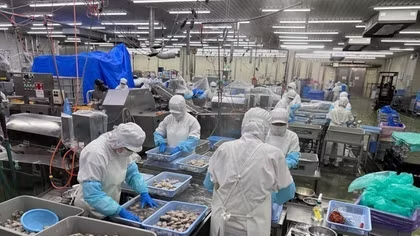
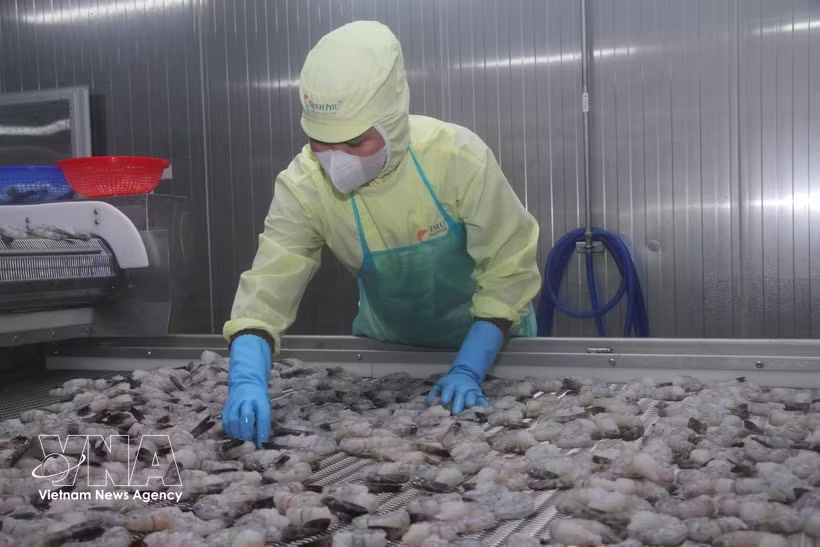
Shrimp exports reach 3.29 billion USD in the first eight months of 2026, up 12.3% year on year and accounting for about 41% of total seafood export revenue. (Photo: VNA)

These factors are expected to help the sector achieve or exceed its annual export target of 12 billion USD, despite continued pressure from tariffs, traceability requirements and compliance costs.

Tran Gia Long, Deputy Director of the Department of Planning and Finance under the Ministry of Agriculture and Environment, said seafood exports need to generate around 1 billion USD per month in the remaining months of the year to help the agricultural, forestry and fishery sector meet its overall export target of 74 billion USD in 2026. Shrimp is expected to remain the main driver of seafood exports.

According to the Vietnam Association of Seafood Exporters and Producers (VASEP), shrimp exports reached 3.29 billion USD in the first eight months of 2026, up 12.3% year on year and accounting for about 41% of total seafood export revenue. China was the main growth driver, with imports from Vietnam rising 37.6% to 1.13 billion USD.

This offers significant room for businesses to expand shipments during the year-end peak season, when demand in Asian markets typically rises ahead of festivals and the Lunar New Year. Importers’ efforts to replenish inventories after a period of cautious ordering could also boost exports.

However, the US market remains challenging for Vietnamese shrimp. Shipments to the market have declined considerably, while a 12.5% Section 301 tariff, compared with 10% for some competitors, puts Vietnamese exporters at a price disadvantage. The final results of an anti-dumping duty review, expected to be announced in late September, are also set to directly affect orders in the fourth quarter.

Le Hang, VASEP Deputy Secretary-General, said the anti-dumping duty and Section 301 tariff would influence US orders, quoted prices and exporters’ decisions to shift to other markets. If tariffs remain high, more shipments could be redirected to Asia, adding pressure on selling prices.

Despite these challenges, opportunities remain in the US for deeply processed, high-value-added products. Le Van Quang, General Director of Minh Phu Seafood Corporation, said the US had overtaken Japan to become the company’s largest market. Although Vietnamese shrimp faces an additional 12.5% tariff, the price gap with shrimp from India and Ecuador is not yet large enough to undermine the competitiveness of value-added products.

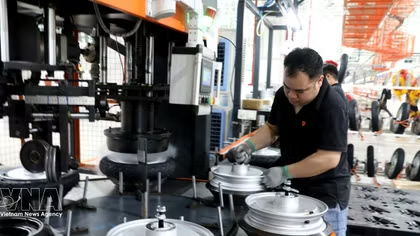
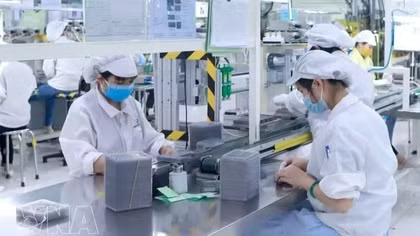
To meet rising demand, Minh Phu is accelerating automation, aiming to automate 70-80% of its production operations. Quang said that even with all of its three factories running at full capacity, the company could not meet all demand and might consider building another plant if the market continued to grow.

Labour shortages are also speeding up modernisation. According to the company, a robot can perform work equivalent to that of about three workers and operate across three shifts. Older factories will have their equipment replaced gradually, while Minh Phu Khanh An Seafood Processing Plant in Ca Mau, designed to process 35,000 tonnes of products annually, is equipped with a higher level of automation and robotics.

Vietnam also has an advantage in certified shrimp production. Barbara Janker, Aquaculture Stewardship Council (ASC)’s commercial director for Europe and Asia-Pacific, said Vietnam ranked third globally in certified shrimp production by volume under the Aquaculture Stewardship Council (ASC), giving exporters an edge as demand for certified shrimp in Europe continues to rise.

Beyond shrimp, tra fish has room to expand in China, the EU and the Middle East as exports to the US decline. In Europe, shortages of wild-caught whitefish and high cod prices are creating opportunities for Vietnamese tra fish.

Other products face mixed prospects. Tuna, squid, octopus and wild-caught seafood remain dependent on compliance with origin-traceability requirements, while crab exports have shown more positive signs despite high compliance costs. Tilapia is also attracting attention, with its gradual introduction into sushi and sashimi dishes pointing to opportunities in higher-value segments.

VASEP said seafood exports could exceed 12 billion USD this year if demand from China remains strong and peak-season orders proceed without disruption. However, fourth-quarter performance is expected to vary across product groups, with shrimp facing US tariff pressure, pangasius relying more heavily on markets outside the US, and squid, octopus, crab and some molluscs offering potential bright spots./.
VNA
en.vietnamplus.vn

Other News

Vietnam-Japan trade machine has room to run

Vietnam-Japan trade machine has room to run

Economic, trade and investment cooperation remains the core pillar and the main engine of comprehensive, sustainable bilateral ties. General Secretary of the Communist Party of Vietnam Central Committee and President To Lam’s official visit to Japan is therefore a key moment to reinforce political trust, deepen the Comprehensive Strategic Partnership and open new cooperation opportunities in the next growth phase.

Vietnamese goods eye greater access to the Australian market

Vietnamese goods eye greater access to the Australian market

Participants at the Vietnam-Western Australia Business Forum 2026 in Perth on November 6 highlighted strong prospects for Vietnamese rice, agricultural produce and food products in the Australian market as local businesses seek to diversify supply chains.

WTO hails Vietnam's 20-year journey since accession

WTO hails Vietnam's 20-year journey since accession

Joining the World Trade Organisation (WTO) was a strategic choice for Vietnam, closely associated with its Doi Moi (Renewal) process, opening-up policy and international economic integration. Over the past two decades, international economic integration has become a driving force for institutional reforms, trade expansion, foreign investment attraction and enhancement of the country's international standing.

US to send largest-ever agricultural trade mission to Vietnam

US to send largest-ever agricultural trade mission to Vietnam

The USDA’s statistics show that Vietnam was the seventh-largest export market for American agricultural and related products in 2025, with import turnover of nearly 5.6 billion USD. The US’s 2025 agricultural exports to Vietnam increased 38% from 2024.

APEC 2027 seen as fresh impetus for Vietnam-Russia cooperation

APEC 2027 seen as fresh impetus for Vietnam-Russia cooperation

VOV.VN - Vietnam’s hosting of the Asia-Pacific Economic Cooperation (APEC) summit in 2027 is expected to create new momentum for cooperation between Vietnam and Russia, with opportunities to expand ties across a range of areas of mutual interest, according to Russian expert Tatyana Gorchakova.

Vietnam and Denmark expand cooperation in high-tech healthcare

Vietnam and Denmark expand cooperation in high-tech healthcare

Ambassador Nguyen Le Thanh called on Vietnamese and Danish partners to identify priority areas and promote research and training programmes, knowledge transfer and technology application in line with Politburo's Resolution No. 57-NQ/TW on breakthroughs in science – technology development, innovation and national digital transformation.

Improving FDI quality to strengthen growth momentum

Improving FDI quality to strengthen growth momentum

Rapid growth in registered capital is encouraging, but unless these commitments are promptly converted into implemented projects and productive capacity, their contribution to economic growth will remain constrained.

Vietnam well-positioned to attract high-quality European investment: insiders

Vietnam well-positioned to attract high-quality European investment: insiders

Vietnam has established a considerable manufacturing and export base, giving it an advantage in attracting investment from European corporations. However, amid the restructuring of global supply chains, the key objective is not merely to attract more investment, but also to enhance the quality of investment and the value it generates.

Vietnam needs 1,000 aircraft over next 20 years

Vietnam needs 1,000 aircraft over next 20 years

Air travel in Vietnam will grow at twice the global average, meaning the country will need to add 1,000 aircraft to its fleet over the next two decades, according to a recent forecast by Airbus.

Vietnam–EU forum to explore green economy, new value chains

Vietnam–EU forum to explore green economy, new value chains

By linking policy dialogue with businesses' practical needs, the forum is expected to help translate Vietnam–EU cooperation potential into concrete trade and investment opportunities. It will also provide an opportunity for both sides to make more effective use of the EVFTA, expand markets for Vietnamese goods and businesses, and tap into Europe's capital, technology and management expertise.

Viet Nam's trade surpasses 1 trillion USD in 10 months

Viet Nam's trade surpasses 1 trillion USD in 10 months

Viet Nam recorded a trade surplus of an estimated 6.8 billion USD in October, marking the second consecutive month of surplus and narrowing the cumulative trade deficit for the first 10 months to around 12.7 billion USD.