Chinese auto investment tests Vietnam's industrial ambitions

Chinese carmakers are putting new pressure on prices and technology while testing Vietnam’s ability to retain more value.

Hanoi (VNS/VNA) - The rapid rise of Chinese carmakers in Vietnam is putting growing pressure on the country’s automotive industry, reshaping competition over prices, technology and production as the market shifts from imported vehicles towards local manufacturing.
5.jpg
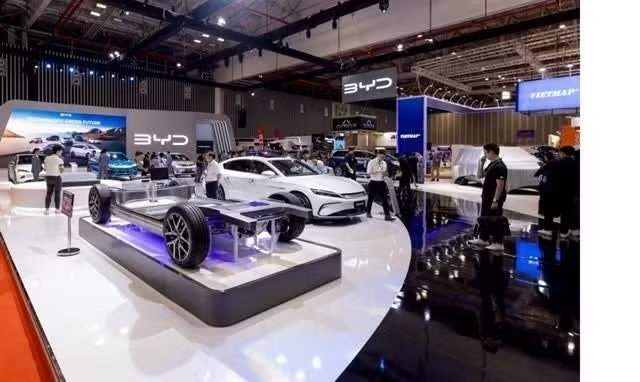
Visitors view electric vehicles and technology at an auto exhibition in Vietnam. (Photo: vov.vn)

Cars imported from China were worth about 1.26 billion USD in the first half of 2026, making China Vietnam’s leading source of imported cars by import value, according to data from the Department of Customs under the Ministry of Finance.

The figure reflects the rapid expansion of Chinese brands in a market where they are competing with established manufacturers from Japan, the Republic of Korea and elsewhere.

The pressure is most visible in prices. Chinese brands have brought SUVs, MPVs and electric and hybrid vehicles with increasingly high levels of equipment into price ranges traditionally occupied by mainstream Japanese and Korean models.

Established automakers have ramped up major promotions – from massive cash discounts by Hyundai Thanh Cong (up to 220 million VND) and Toyota’s registration fee waivers to Ford’s extended warranties. While discounting is a longstanding sales tactic, the influx of competitively priced Chinese models has intensified price pressure across the entire market.

The pressure is now moving beyond showrooms.

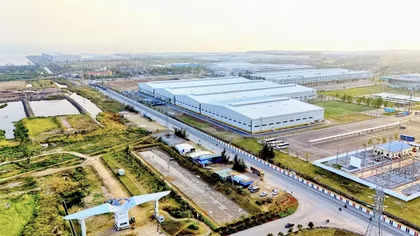
Several Chinese automakers are establishing or planning production facilities in Vietnam, moving from selling imported vehicles to building a local manufacturing base.

Chery, with its Omoda and Jaecoo brands, set to begin production at a new factory in northern Hung Yen province in mid-2026. The plant will initially produce 30,000-60,000 vehicles a year, with capacity potentially rising to 200,000 by 2030 and investment reaching 800 million USD at full scale.

SAIC Motor, which operates the MG brand, is also preparing for local assembly. According to its Vietnam operation, the company is in advanced talks with partners over a plant and expects the project to be launched from late 2027.

Earlier, one of the most advanced plans is the partnership between Tasco and Geely Auto. Their joint venture is set to develop a CKD assembly plant at the Tien Hai Industrial Park in former Thai Binh province (now part of Hung Yen province), with planned investment of about 168 million USD.

The 30ha plant is designed to produce up to 75,000 vehicles a year in its first phase, including Geely and Lynk & Co models. The partners also plan to attract suppliers and develop an R&D centre serving the Southeast Asian market.

These projects show how competition is changing. Chinese manufacturers are no longer relying only on imported vehicles and competitive prices. Local assembly could give them lower logistics costs, greater control over supply and a stronger position in the Vietnamese market.

For Vietnam, however, the benefits will depend on how much of the production chain develops locally.

According to automotive expert Nguyen Minh Dong, the tightening in the US on rules of origin was a growing concern for Vietnam’s automotive and supporting industries, as the country could face closer scrutiny over whether it was being used as a transit point for goods from third countries.

Dong said incentives for foreign investment should be linked to technology transfer, local production and the development of Vietnamese suppliers.

“If they only open assembly plants, we will not learn much about technology,” he told AutoNews, noting that Vietnam has already had decades of experience in vehicle assembly.

This is becoming more important as the industry moves towards electric and hybrid vehicles. Batteries, electric motors, power electronics and software are becoming key parts of the automotive value chain, while Vietnamese companies remain limited in many of these higher-value areas.

Bui Quoc Huy, deputy head of the Automotive Engineering Department at Phu Tho College of Agricultural Mechanics, said Chinese manufacturers were putting pressure on the industry not only through prices but also through the speed of technological development.

“Chinese cars are competing through the speed of technological innovation and their ability to integrate technology into vehicles,” he said.

The growing presence of Chinese manufacturers could therefore benefit consumers by bringing more choices and new technology to the market. It could also push manufacturers and suppliers in Vietnam to improve their products and services.

But there is a risk that the country could gain more assembly capacity without developing a stronger domestic supply chain.

Experts said Vietnam needs performance-based policies that reward companies for increasing local production, developing domestic suppliers, investing in R&D and transferring technology such as VAT and corporate income tax, rather than focusing mainly on the size of investment projects.

The growing presence of Chinese carmakers is bringing more competition and new technology to Vietnam, but it also puts pressure on the country to strengthen its own automotive supply chain. The longer-term benefit will depend on whether more parts, technology and value are produced locally./.
en.vietnamplus.vn

Other News

Vietnam – one of most attractive destinations for leading US semiconductor companies: expert

Vietnam – one of most attractive destinations for leading US semiconductor companies: expert

Vietnam has built a solid semiconductor and electronics industry before joining ITSI, attracting major US semiconductor companies. Intel Products Vietnam is one of Intel's largest assembly and testing facilities worldwide, while chip design companies such as Synopsys, Cadence, Marvell and Qualcomm have established engineering and research centres in the Southeast Asian country.

Vietnam targets higher-quality FDI under Resolution 10

Vietnam targets higher-quality FDI under Resolution 10

During the first seven months of 2026, Vietnam attracted more than 38 billion USD in registered FDI, up nearly 58% year-on-year. More importantly, the increase was driven by large-scale, high-tech projects rather than a surge in the number of new investments, signalling a significant improvement in the quality of capital inflows.

Manufacturing, engineering drive hiring growth in H1: report

Manufacturing, engineering drive hiring growth in H1: report

Manufacturing and engineering posted the strongest recruitment growth, with hiring demand surging 70% year-on-year, driven by production expansion, supply chain restructuring and sustained investment inflows in high-tech manufacturing.

Government proposes special mechanisms to unblock APEC 2027 projects in Phu Quoc

Government proposes special mechanisms to unblock APEC 2027 projects in Phu Quoc

The projects in Phu Quoc have been implemented under tight deadlines. Since May 2025, the Prime Minister has directed preparations for APEC 2027, including accelerated infrastructure development on the special zone. An Giang province and investors have subsequently launched a number of major projects involving complex technical requirements and demanding construction schedules.

Financial market reform plan targets high, sustained growth through 2045

Financial market reform plan targets high, sustained growth through 2045

The plan seeks to develop a balanced and modern financial market that is closely integrated with regional and global markets, strengthens the mobilisation and allocation of domestic and foreign capital, and enhances the market’s role as a key provider of medium- and long-term capital for the economy and as a major driver of sustained high economic growth.

An Giang aims to become leading maritime economic hub

An Giang aims to become leading maritime economic hub

Under the province's master plan for 2021–2030 with a vision to 2050, An Giang will prioritise investment in five strategic sectors: strategic infrastructure; processing industries and clean energy; trade, services, logistics and border-gate economy; high-quality tourism; and high-tech agriculture, ecological development and the circular economy.

Lien Khuong International Airport set to reopen on August 19

Lien Khuong International Airport set to reopen on August 19

Once operations stabilise, Lien Khuong International Airport in the Central Highlands province of Lam Dong is projected to serve approximately 6,800 passengers a day, nearly 1,000 more than before its temporary closure. Passenger throughput during the final four months of 2026 is forecast to reach around 816,000.

Global buyers turn to Ho Chi Minh City for sourcing

Global buyers turn to Ho Chi Minh City for sourcing

The growing number of international retailers and importers choosing Ho Chi Minh City as a sourcing destination underscores the city's transformation from a trade promotion venue into a regional procurement hub.

PM's conclusions set to clear bottlenecks, spur corporate growth

PM's conclusions set to clear bottlenecks, spur corporate growth

The PM called on the business community, business associations and the Vietnam Chamber of Commerce and Industry (VCCI) to strengthen self-reliance, innovation and competitiveness by improving governance, adopting advanced technologies, enhancing product quality and using capital more efficiently.

Incentive policies for high-tech agricultural zones

Incentive policies for high-tech agricultural zones

Under Decree No. 263/2026/ND-CP, qualified projects are given priority to participate in State support programmes as well as funds and policies on research and development, technological innovation, technology transfer, human resource training, investment promotion and trade promotion.

Major works at Long Thanh International Airport gather pace towards completion

Major works at Long Thanh International Airport gather pace towards completion

The ACV said on July 20 that contractors are deploying additional workers and equipment to speed up construction under Component Project 3, which covers the airport's essential aviation infrastructure. Major facilities, including the first and second runways, taxiways, aircraft aprons, the passenger terminal apron and the aircraft fuel supply system, are approaching completion.