Financial market reform plan targets high, sustained growth through 2045

The plan seeks to develop a balanced and modern financial market that is closely integrated with regional and global markets, strengthens the mobilisation and allocation of domestic and foreign capital, and enhances the market’s role as a key provider of medium- and long-term capital for the economy and as a major driver of sustained high economic growth.
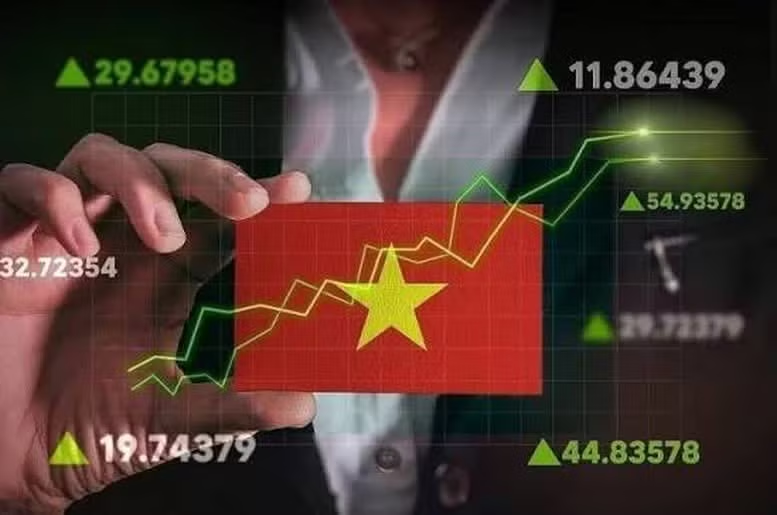
Deputy Prime Minister Nguyen Van Thang has signed a decision approving a comprehensive reform plan for Vietnam's financial market, laying the groundwork for a modern, integrated financial system to support high and sustained economic growth through 2045.

The plan seeks to develop a balanced and modern financial market that is closely integrated with regional and global markets, strengthens the mobilisation and allocation of domestic and foreign capital, and enhances the market’s role as a key provider of medium- and long-term capital for the economy and as a major driver of sustained high economic growth.

1-1.jpg
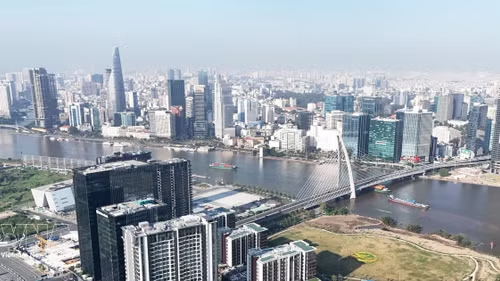
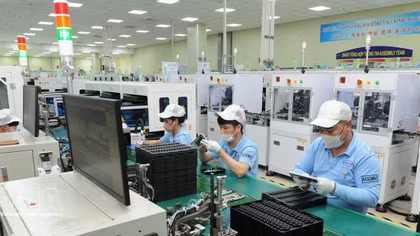
Illustrative image (Photo: baochinhphu.vn)

By 2045, Vietnam aims to establish a high-standard financial market operating on market principles, with internationally aligned institutions, infrastructure, financial products, investors and regulatory mechanisms.

The stock market needs to become the core capital market, with a safe banking sector, an expanding insurance market, and Vietnam International Financial Centre (IFC) connecting regional capital flows, financial services, and financial institutions.

The plan also targets a more balanced and integrated financial market, with stronger linkages among its segments. It prioritises expanding transparent capital and securities markets to enhance medium- and long-term financing for businesses and the economy, promote public equity and bond offerings, and improve the performance of securities firms and other financial intermediaries.

A sustainable investor base is another priority, with greater emphasis on institutional investors such as investment funds, pension funds and insurers. By 2030, foreign investors' assets in Vietnam's capital market are expected to reach around 15% of GDP, while net assets of securities investment funds should equal 5% of GDP. Pension fund assets are targeted to grow by an average of 11.5% annually during 2026-2030.

The scheme will also pay attention to modernising the banking system, improving credit quality, expanding digital banking and financial inclusion while safeguarding the stability and safety of credit institutions. It further aims to develop a comprehensive, safe and sustainable insurance market that contributes to financial stability, social security and long-term investment.

The plan also prioritises developing financial infrastructure and promoting digital transformation. Vietnam aims to establish a modern and autonomous payment system connected to regional and global payment networks by 2028; introduce a central counterparty clearing mechanism for the stock market in 2027; develop a shared financial market database during 2030-2035; effectively operate new products and markets, alongside issuing breakthrough policies to strengthen the capital market's scale and liquidity.

To achieve these objectives, the plan outlines groups of policy measures, focusing on reviewing and amending financial legislation, studying the introduction of a law on financial market supervision, and updating development strategies for banking, securities, insurance and the IFC.

The plan also calls for diversifying financial products, including green equities, green corporate bonds, ESG investment funds and digital assets, while developing green stock indices and expanding the Government bond market with products such as green, sustainable and inflation-linked bonds.

Other measures focus on restructuring institutional investors, simplifying market access for foreign investors, strengthening financial intermediaries, and encouraging banks to adopt Basel III standards. Other areas include accelerating bad debt resolution, modernising payment infrastructure, promoting risk-based financial supervision, upgrading the stock market, expanding international financial integration, and developing a highly skilled financial workforce.
en.vietnamplus.vn

Other News

Ho Chi Minh City targets third-quarter growth of over 11%

Ho Chi Minh City targets third-quarter growth of over 11%

Ho Chi Minh City will continue to implement drastic measures to achieve double-digit growth, targeting GRDP growth of at least 11.07% in the third quarter of 2026, 9.43% in the first nine months and 12.3% in the fourth quarter, with a view to completing the full-year goal of 10% or more.

Vietnamese experts abroad join efforts to advance nuclear power development at home

Vietnamese experts abroad join efforts to advance nuclear power development at home

Held both in person and online, the seminar focused on the current status and opportunities for Vietnam’s nuclear power programme, human resources development, global trends in small modular reactors (SMRs), experience in ensuring safety and extending the operational life of nuclear power plants, and ways to mobilise Vietnamese experts abroad to contribute to the programme.

Port throughput in Hai Phong exceeds eight-month target

Port throughput in Hai Phong exceeds eight-month target

The strong performance followed a series of measures to optimise port capacity and improve the competitiveness of the city’s seaport system, with a focus on maximising the efficiency of the Lach Huyen international gateway port as new berths came into operation.

Vietnam, Mercosur begin trade negotiations

Vietnam, Mercosur begin trade negotiations

During the session, both sides reaffirmed their determination to advance the negotiations in a spirit of goodwill, with a view to reaching a balanced agreement that aligns with the interests of both Vietnam and Mercosur.

Vietnam poised to benefit from new wave of technology investment

Vietnam poised to benefit from new wave of technology investment

The successful development and production of high-end Pixel smartphones in Vietnam – a more complex process than manufacturing smartwatches and wireless earbuds – is reportedly giving Google confidence in moving its entire Pixel production out of China.

Energy infrastructure underpins marine economy development

Energy infrastructure underpins marine economy development

The integrated investment in energy infrastructure will provide a vital infrastructure foundation for effectively harnessing the marine potential, helping realise the goal of making Vietnam a strong maritime nation and achieving sustainable and prosperous development from the sea.

Ho Chi Minh City hosts International Innovation Forum and Exhibition 2026

Ho Chi Minh City hosts International Innovation Forum and Exhibition 2026

InnoEx 2026 focuses on major shifts reshaping the global economy, including artificial intelligence (AI), data, automation, green transition, international trade and new business models. It also provides a platform connecting businesses, startups, investors and solution providers, facilitating partnerships, investment and access to knowledge and technologies.

Vietnamese enterprises renew growth model to move up global value chains

Vietnamese enterprises renew growth model to move up global value chains

The resolution identifies enterprises as the centre of the renewal process, urging them to shift from cost-based competition to productivity, technology, quality and market responsiveness; from operating independently to joining industrial ecosystems; and from participating in value chains to mastering and eventually leading them.