International financial institutions optimistic about Vietnam’s 2026 growth

As Vietnam enters 2026 - the first year of the 2026–2030 socio-economic development plan, international organisations stress that maintaining macroeconomic stability, improving growth quality and staying the course on fundamental reforms will be crucial in turning positive assessments into tangible outcomes and shaping a more sustainable development cycle ahead.
International financial institutions optimistic about Vietnam’s 2026 growth -0
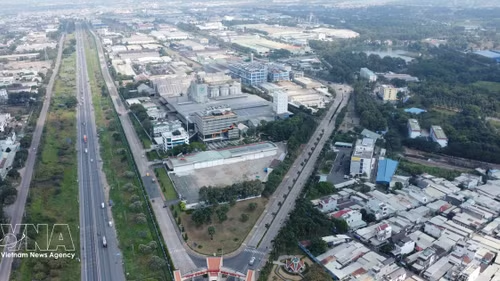
Vietnam's GDP expands by more than 8% in 2025. (Photo: VNA)

International financial institutions and economic organisations have expressed optimism about Vietnam’s growth prospects in 2026, citing the country’s strong economic performance in 2025 and continued reform momentum despite global uncertainties.

Vietnam recorded a breakthrough year in economic growth in 2025, defying global trade volatility and the prolonged impact of geopolitical tensions.

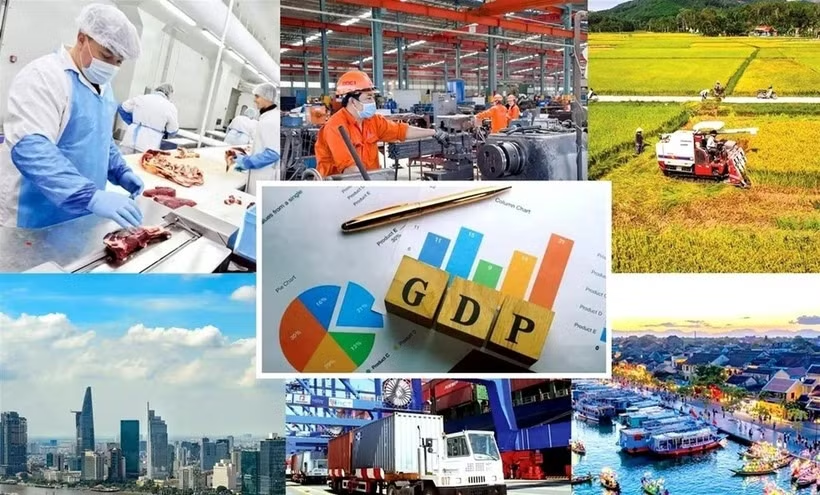
Official statistics show that the country’s gross domestic product (GDP) expanded by more than 8% last year, well above initial expectations, placing Vietnam among Southeast Asia’s fastest-growing economies and one of the region’s most dynamic performers.

Shantanu Chakraborty, Country Director of the Asian Development Bank (ADB) in Vietnam, described the above-8% growth as evidence of an effective combination of domestic institutional reforms and Vietnam’s ability to capitalise on the global supply chain realignment. He noted that the Government has demonstrated consistent policy management, from accelerating public investment disbursement to gradually refining the legal framework to create more room for private-sector development and the digital economy.

Sharing a similar view, Suan Teck Kin, Executive Director of Executive Director in Global Economics and Markets Research at UOB, said Vietnam has emerged as one of ASEAN’s growth engines.

According to UOB’s analysis, industrial production continues to play a pivotal role, helping Vietnam strengthen its position in global value chains. Meanwhile, the clear recovery of domestic consumption and the strong rebound of tourism in 2025 provided additional support to aggregate demand, alongside the leading role of public investment.

Another notable highlight in 2025 was the resilience of Vietnam’s exports amid changes in US trade policy. The country’s total import-export turnover surpassed the 900 billion USD mark for the first time - a historic high and a significant milestone in Vietnam’s international economic integration.

International observers have described this performance as growth amid adversity, reflecting tangible improvements in the competitiveness of Vietnamese goods. Rather than relying solely on low-cost advantages, many Vietnamese enterprises have increasingly met stringent requirements related to green standards, traceability and rules of origin. This has helped mitigate pressure from new technical barriers and tariffs while maintaining access to major and demanding markets.

However, international organisations have also warned of external risks that could affect Vietnam’s growth outlook in 2026. In its Article IV Consultation report released in late 2025, the International Monetary Fund (IMF) noted that part of Vietnam’s recent growth was supported by businesses accelerating exports ahead of the implementation of new tariff measures. As a result, the full impact of rising trade protectionism may become more evident in 2026, posing certain constraints on growth.

From a financial and monetary perspective, Jung Hyo Chang, Director of FX and Derivatives Trading at Shinhan Bank Vietnam, cautioned that external shocks could exert pressure on the exchange rate and short-term capital flows. If foreign exchange reserves are not managed with sufficient flexibility and prudence, Vietnam could face sharp currency fluctuations that may affect investor confidence.

UOB’s Suan Teck Kin also highlighted Vietnam’s high degree of economic openness as a double-edged sword. With exports accounting for around 83% of GDP, the economy benefits greatly when global trade is buoyant, but remains vulnerable to demand slowdowns in key markets such as the US and Europe amid prolonged inflation or tighter monetary policies.

In this context, most international experts agree that sustaining double-digit growth in 2026 and beyond will be challenging, though not unattainable, provided existing growth drivers continue to be strengthened and upgraded.

According to the ADB Country Director, three key pillars could underpin higher growth: structural reforms to improve the business environment and market efficiency; accelerating digital transformation alongside the development of high-quality human resources to harness the advantages of a young, tech-savvy workforce; and attracting high-quality foreign direct investment, particularly in technology, advanced manufacturing and green industries.

These drivers, experts say, will not only support short-term growth but also lay a more solid foundation for sustainable development over the medium and long term.

As Vietnam enters 2026 - the first year of the 2026–2030 socio-economic development plan, international organisations stress that maintaining macroeconomic stability, improving growth quality and staying the course on fundamental reforms will be crucial in turning positive assessments into tangible outcomes and shaping a more sustainable development cycle ahead.
VNA

Other News

Vietnam accelerates innovation to boost growth, competitiveness

Vietnam accelerates innovation to boost growth, competitiveness

By 2030, Vietnam aims to rank among the world’s top 40 in the GII; raise total social investment in R&D to at least 2% of GDP, with non-State funding accounting for over 60%; increase international scientific publications by an average of 10% annually; and raise the number of patent applications and granted patents by an average of 16-18% annually.

Vietnam sees high growth prospects

Vietnam sees high growth prospects

Experts from the Institute of Vietnam and World Economy under the Vietnam Academy of Social Sciences noted the quality of recent growth as the high growth rate has been recorded against an increasingly higher comparative base.

Vietnam seeks bigger share of global Halal market

Vietnam seeks bigger share of global Halal market

Vietnam's Halal exports remain modest at around 900 million USD a year, accounting for less than 1% of the global market. Most exports are still raw agricultural and seafood products. Only around 1,000–1,300 Vietnamese businesses obtained or maintained Halal certification during 2024–2026.

Hanoi sets up inter-agency mechanism to operate carbon market

Hanoi sets up inter-agency mechanism to operate carbon market

Under a decision of the municipal People’s Committee on establishing an inter-agency working group, departments and agencies are responsible for identifying facilities subject to greenhouse gas inventories, developing emissions-reduction plans and studying projects capable of generating carbon credits.

Shrimp exports reach 3.3 billion USD in eight months

Shrimp exports reach 3.3 billion USD in eight months

According to data from the Vietnam Customs cited by the Vietnam Association of Seafood Exporters and Producers (VASEP), shrimp exports reached 478.5 million USD in August, up 4.2% from the same month last year. The eight-month total stood at 3.3 billion USD, representing a year-on-year increase of 12%.

Russian investors explore opportunities in Vietnam's real estate market

Russian investors explore opportunities in Vietnam's real estate market

Vietnam is seen as a potential market, with considerable room for growth in real estate, particularly commercial property, compared with some regional markets. Strong Vietnam-Russia ties and opportunities to establish foreign-invested enterprises are also considered favourable for Russian investors.

Phu Quoc airport planning adjusted to serve APEC 2027

Phu Quoc airport planning adjusted to serve APEC 2027

For 2021-2030, the Civil Aviation Authority of Vietnam proposed bringing forward the investment in a parallel taxiway system and a connecting taxiway north of Runway No. 2 at Phu Quoc International Airport, in order to connect with the aircraft maintenance and repair facility (hangar) planned for the northern area of ​​the airport.

Policy, infrastructure emerge as new advantages in FDI attraction

Policy, infrastructure emerge as new advantages in FDI attraction

From policy and infrastructure to industrial real estate, Vietnam’s FDI advantages are broadening towards a more integrated production ecosystem, offering investors a stronger combination of conditions for high-value, technology-intensive and long-term projects.

Logistics upgrade vital to 1-trillion-USD trade target: experts

Logistics upgrade vital to 1-trillion-USD trade target: experts

As trade expands, systemic bottlenecks across transport networks, warehousing, ports, border gates, and industrial zones are becoming more apparent. Experts emphasise the need to shift from a fragmented, project-by-project approach toward strategic management structured around trade corridors and integrated supply chains.

Ample room for Vietnam, US to deepen cooperation

Ample room for Vietnam, US to deepen cooperation

Do Ngoc Hung, Trade Counsellor and head of the Vietnam Trade Office in the US, said what stands out is not only the growth in trade volume but also the increasingly deep economic ties between the two countries.

Flexible fiscal policy helps drive economic growth

Flexible fiscal policy helps drive economic growth

According to the Ministry of Finance, State budget revenue in the first eight months of 2026 was estimated at 2.02 quadrillion VND (77.7 billion USD), equivalent to 80% of the annual estimate and up 16% year-on-year. Domestic revenue reached 1.75 quadrillion VND, accounting for 86.6% of total revenue and rising 16.6%.

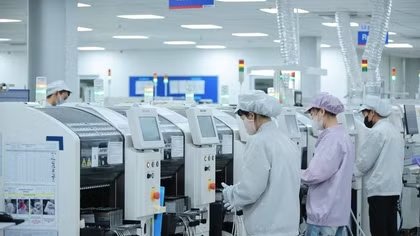
Electronic components are produced at a factory in Hanoi. (Photo: VNA)

Hanoi's imports surge 41% in first eight months of 2026

Hanoi aims to achieve average annual export growth of at least 12% during 2026-30, with the city seeking to diversify export markets, boost high-tech and value-added products and reduce reliance on traditional markets.