Washington D.C., (VNA) - Vietnam has emerged one of the most attractive destinations for leading US semiconductor companies, thanks to its competitive labour costs, political stability, favourable geographic location and extensive network of free trade agreements (FTAs), according to Dr. Tran Doan Huan, Senior Research Scientist at Georgia Institute of Technology in Atlanta.
Speaking to Vietnam News Agency correspondents in the US, Huan, who is also Head of Research Innovation at Matmerize, Inc., noted several factors behind the US decision to include Vietnam in the International Technology Security and Innovation (ITSI) programme under the 2022 CHIPS and Science Act.
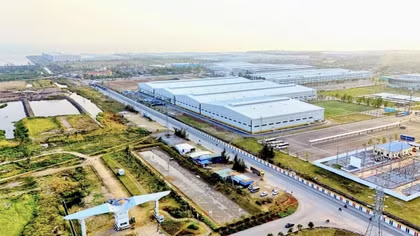
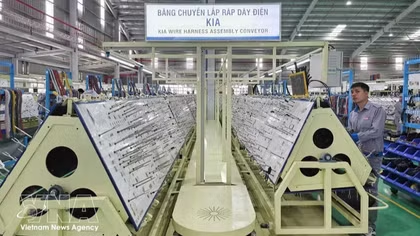
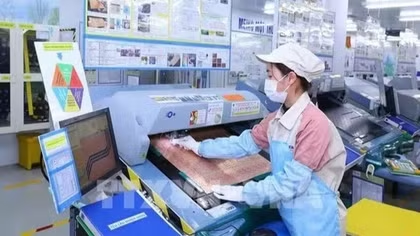
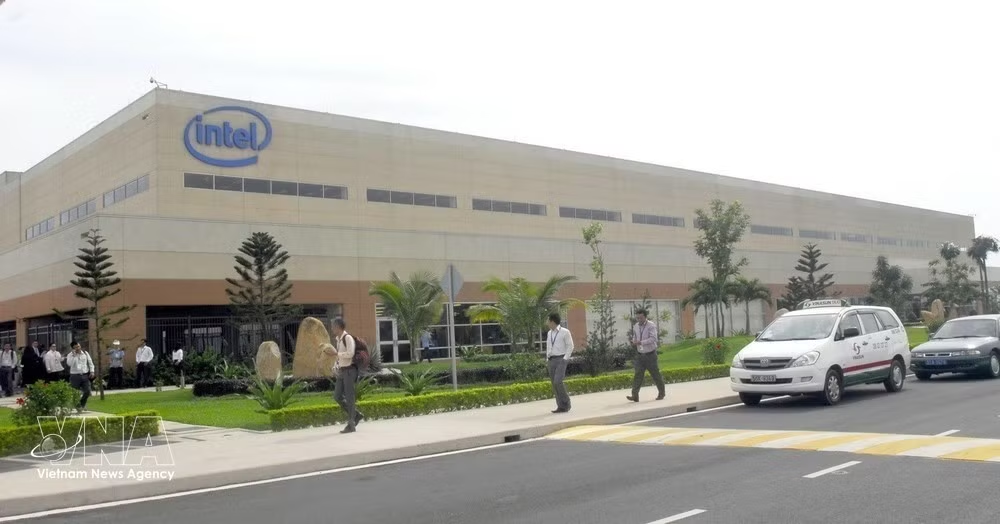
According to him, Vietnam has built a solid semiconductor and electronics industry before joining ITSI, attracting major US semiconductor companies. Intel Products Vietnam is one of Intel's largest assembly and testing facilities worldwide, while chip design companies such as Synopsys, Cadence, Marvell and Qualcomm have established engineering and research centres in the Southeast Asian country, providing a foundation for Vietnam to gradually move into higher value-added segments of the semiconductor value chain.
Vietnam's participation supports the US goal of diversifying and strengthening the resilience of semiconductor supply chains. Following the COVID-19 pandemic and amid geopolitical tensions, the US has sought to reduce excessive dependence on a small number of countries. Rather than bringing all semiconductor production back to the US, the country aims to build a network of trustworthy partners that share commitments to transparency, supply-chain security and technological cooperation.
In this context, Vietnam is well positioned to develop semiconductor assembly, testing, packaging and chip design activities, helping reduce concentration in global supply chains.
Huan also highlighted Vietnam's large electronics manufacturing ecosystem, with major companies such as Samsung, Foxconn and LG operating in the country. The ecosystem, together with a young workforce, strong mathematics and software skills and competitive labour costs, provides favourable conditions for semiconductor development.
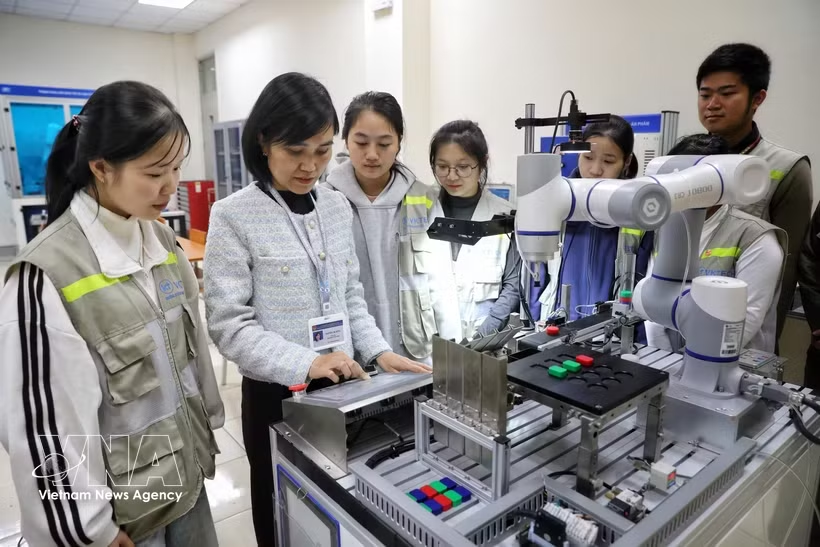
Human resources remain a key strength, he said, noting that Vietnam trains tens of thousands of engineers in electronics, information technology and engineering every year. Although the number of specialised semiconductor engineers remains limited, ITSI can help support training engineers, developing curricula, establishing laboratories, and strengthening university - business collaboration.
Geopolitically, Vietnam's strategic location and its independent and balanced foreign policy also make the country an important partner for the US in building more secure technology supply chains. The elevation of Vietnam-US relations to a Comprehensive Strategic Partnership in 2023 reflects Vietnam's growing importance in the US’s regional strategy, with semiconductor cooperation among the key areas.
Huan noted that the Vietnamese Government's strong commitment to developing semiconductors is another important factor. Vietnam has identified semiconductors as a strategic technology sector, with plans to train tens of thousands of engineers, develop chip design centres, attract foreign investment and build domestic semiconductor companies.
ITSI is designed to support countries with strong political commitment and a willingness to improve their investment environment and technological capabilities. Vietnam meets these criteria well, creating favourable conditions for US support programmes to deliver long-term results, he said.
According to the expert, besides Vietnam, many other countries have also been selected to participate in the ITSI programme. However, very few of them possess all the conditions that Vietnam currently has: a large-scale electronics industry, the presence of major US semiconductor companies, an abundant pool of skilled technical workers, a stable political environment, strong government commitment, and the ability to integrate deeply into global supply chains.
The combination of these factors makes Vietnam one of the most important strategic partners for the US in the ITSI programme, he said, adding the US decision to include Vietnam in the ITSI programme reflects a long-term cooperation strategy based on the complementary interests of the two countries.
For the US, cooperation with Vietnam can help diversify semiconductor supply chains, reduce geopolitical risks and expand its network of trustworthy technology partners. For Vietnam, ITSI offers opportunities to access resources, knowledge, technology and global business networks, laying the groundwork for a stronger position in the global semiconductor value chain.
The 2022 CHIPS and Science Act represents a major shift in US semiconductor policy. It seeks not only to restore domestic chip manufacturing but also to build a comprehensive ecosystem capable of maintaining US technological leadership.
International cooperation is a key pillar of the strategy. Through ITSI, the US works with strategic partners including Vietnam, Costa Rica, Mexico, the Philippines and Indonesia, to develop human resources, strengthen assembly, testing and packaging capacity, and build more diversified and secure semiconductor supply chains./.