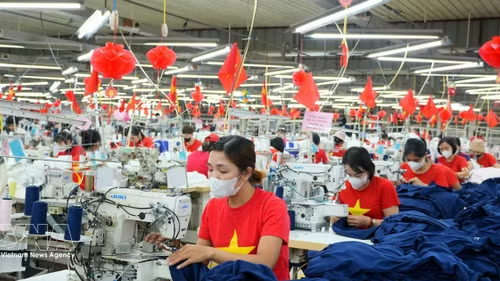
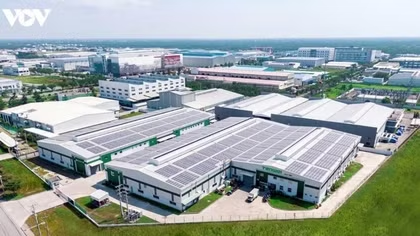
Vietnam's exports gain fresh momentum from orders and production

The positive outlook has raised expectations that key export sectors, including electronics, textiles and garments, wood products and agricultural goods, will continue to expand and help sustain double-digit export growth in 2026.

Hanoi (VNA) – Vietnam's exports are gaining fresh momentum from a recovery in production, rising year-end orders and relatively strong international demand, with total trade exceeding 712 billion USD after more than seven months.
2.jpg
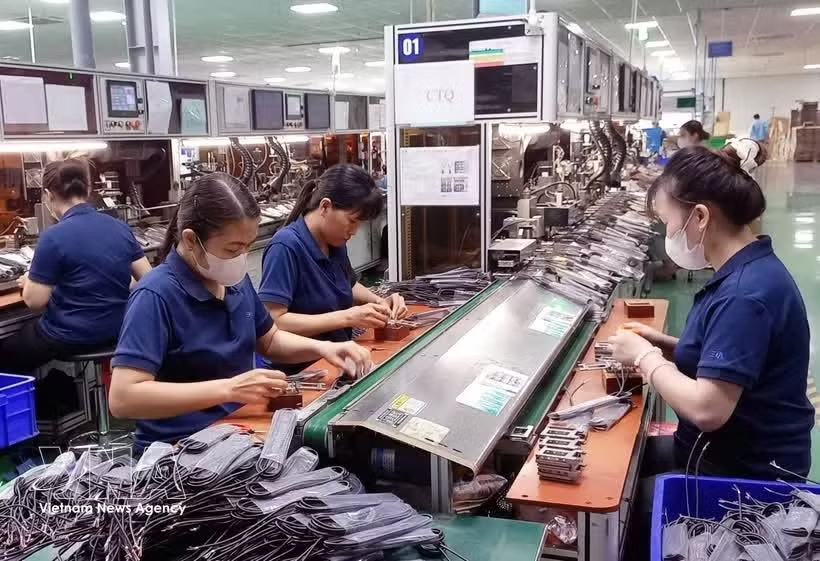
In the first half of August, computers, electronic products and components generate 7.32 billion USD in export revenue. (Photo: VNA)

The positive outlook has raised expectations that key export sectors, including electronics, textiles and garments, wood products and agricultural goods, will continue to expand and help sustain double-digit export growth in 2026.

According to the Customs Department, Vietnam's total trade in the first 15 days of August reached 52.33 billion USD, including 25.41 billion USD in exports and 26.91 billion USD in imports.

Cumulatively, from the beginning of the year through August 15, total trade surpassed 712 billion USD. Exports stood at around 345.4 billion USD, while imports reached 367.3 billion USD, resulting in a trade deficit of nearly 22 billion USD.

Previously, the Ministry of Industry and Trade reported that total trade in the first seven months reached about 659 billion USD, up 28.1% year-on-year, with exports rising 21.7% to 319.7 billion USD.

The rapid increase in imports does not necessarily signal a deterioration in trade performance. It also reflects rising demand for raw materials, components, machinery and equipment for production. For an open economy with a strong export-oriented manufacturing sector, increased imports of production inputs could help expand manufacturing capacity and support deliveries in the final months of the year.

Processed and manufactured products continue to dominate the export structure. In the first half of August, computers, electronic products and components generated 7.32 billion USD in export revenue, followed by phones and components at 3.65 billion USD and machinery, equipment, tools and spare parts at 3.11 billion USD. Textile and garment exports reached 1.84 billion USD, while footwear earned 975 million USD.

Year-end orders provide fresh boost

Improving orders, particularly in manufacturing, are expected to be a major driver of exports in the remaining months of the year. The electronics industry, in particular, has grounds to expect double-digit growth for the full year.

Businesses report that many orders have already been mapped out through the end of the year. The industry's production cycle also favours stronger exports in the final months, as companies typically prepare components, machinery and materials in advance, then accelerate production in September and October for delivery in November and December, when consumer demand in the US and Europe rises.

Global AI investment is also boosting demand for chips, prompting some companies to stockpile components, whose prices have increased by around 5-20%.

The electronics industry is also gradually moving into higher-value activities such as research, design and supply, rather than relying mainly on processing and assembly.

Textiles and garments, wood products and agricultural goods are likewise seeking growth through higher product quality rather than simply expanding output.
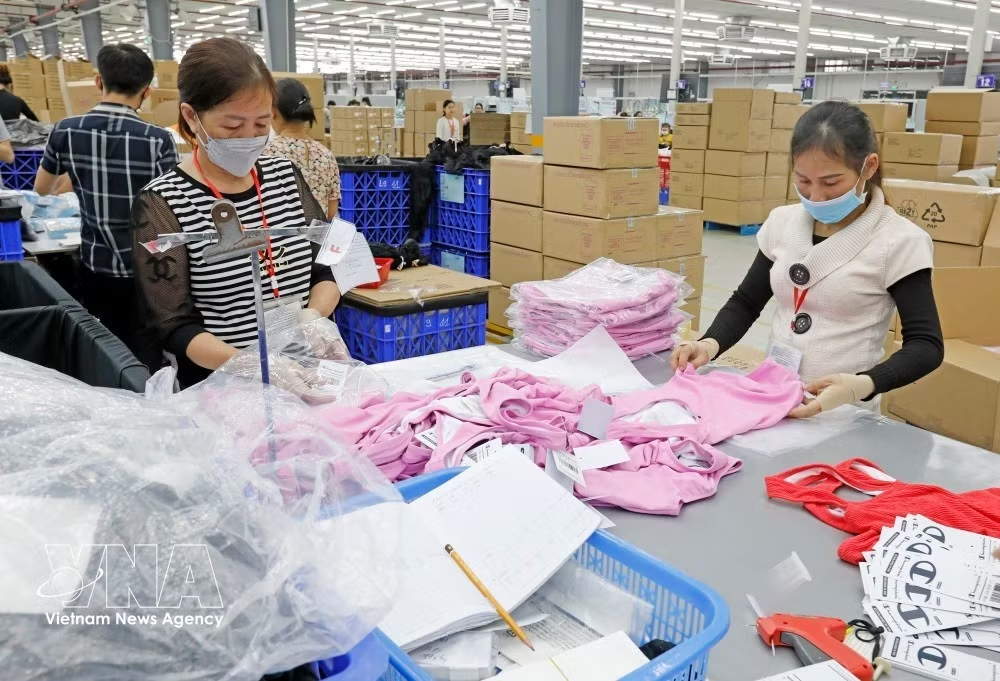
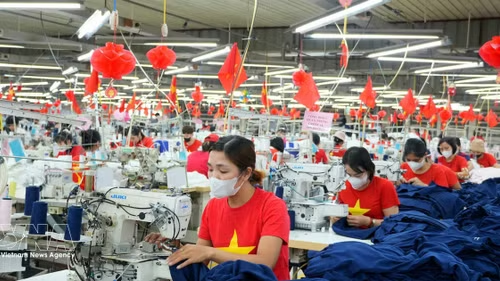
Textile and garment exports are estimated at about 27 billion USD in the first seven months, up 2.67%. (Photo: VNA)

Textile and garment exports were estimated at about 27 billion USD in the first seven months, up 2.67%. The sector is focusing on consolidating existing markets, expanding into new ones and increasing domestic sourcing of materials and accessories. Developing domestic fabric and supporting-material production would raise localisation rates, help meet rules of origin and enable businesses to make better use of free trade agreements.

Vietnam's wood industry is also shifting from processing and contract manufacturing towards greater initiative in product design and development. Vietnamese wood products are currently exported to 167 countries and territories, with the US remaining the largest market.

In agriculture, deeper processing, technology and digital transformation are creating further room for growth. Standardising growing-area codes, improving traceability, applying production standards and developing a circular agricultural model can help meet market requirements while creating higher-value products.

With exports up 21.7% in the first seven months, experts expect Vietnam to maintain double-digit export growth for the full year. The Market Analysis and Research Division of MB Securities estimated annual export growth at 17.5-19.8%, while the Ministry of Industry and Trade forecast growth of around 15-16% if there are no major adverse developments./.

en.vietnamplus.vn

Other News

Prime Minister backs PETRONAS' further investment expansion in Vietnam

Prime Minister backs PETRONAS' further investment expansion in Vietnam

Prime Minister Le Minh Hung praised PETRONAS and the Vietnam National Industry-Energy Group (Petrovietnam) for maintaining a strong partnership for more than 30 years, with joint efforts supporting Vietnam’s energy security, sustainable development and economic growth, as well as those of the Asian region.

Vietnam ties FDI incentives to local supplier commitments

Vietnam ties FDI incentives to local supplier commitments

Incentives will increasingly hinge on investors’ performance and commitments, not just on landing projects. Key commitments include transferring technology to Vietnamese firms, training workers, providing technical support and opening FDI supply chains to domestic companies.

Vietnamese businesses, entrepreneurs make growing contributions to national development

Vietnamese businesses, entrepreneurs make growing contributions to national development

Viet Nam Entrepreneurs’ Day is an opportunity to recognise the business community’s contributions to the nation, and promote the entrepreneurial spirit, the pursuit of legitimate prosperity and national responsibility. With stronger policies and greater innovation, Vietnamese enterprises are expected to play an increasingly important role in developing economic growth and realizing the country’s ambition to become a strong, prosperous nation.

Tax policy stability now key to keeping foreign investors: Officials

Tax policy stability now key to keeping foreign investors: Officials

Companies must ensure records and data truthfully reflect the substance of transactions and engage in dialogue early when complex issues arise. Tax authorities, in turn, need to publish policies, give clear guidance, enforce rules consistently and deliver information in a timely manner.

Vietnam – a potential regional supply hub for Jatropha seed oil

Vietnam – a potential regional supply hub for Jatropha seed oil

Japan’s research on non-edible oil feedstocks showed that Jatropha is highly drought-tolerant and could grow well on wasteland, eroded sandy land and infertile soil. Given this, areas in central Vietnam, including Ninh Thuan, Binh Thuan and the Central Highlands, have climatic, sunlight and soil conditions suitable for achieving high seed yields and oil content.

Vietnam enters investment grade credit rating category for first time

Vietnam enters investment grade credit rating category for first time

Vietnam has maintained robust growth, outperforming other Southeast Asian economies. Its ongoing government reforms aimed at streamlining the state apparatus, promoting the private sector, improving the institutional framework and developing capital markets will strengthen the country’s growth potential and economic resilience.

Vietnam, Laos seek to expand room for trade, investment cooperation

Vietnam, Laos seek to expand room for trade, investment cooperation

Vietnam and Laos aim to boost bilateral trade in 2026 towards the milestone of 10 billion USD by 2030, a target said to be challenging but feasible as both Governments work to remove trade barriers, improve border-trade mechanisms, and strengthen transport and logistics connectivity.

Vietnam's national brand value jumps 45% to over 462 bln USD

Vietnam's national brand value jumps 45% to over 462 bln USD

Deputy Minister of Industry and Trade Luong Hoang Thai outlined Vietnam's National Brand Programme 's achievements, the role of business community and plans for brand development in a press interview ahead of the 10th Vietnam National Brand Product recognition ceremony on October 16.

Vietnam revises scheme to improve sovereign credit rating by 2030

Vietnam revises scheme to improve sovereign credit rating by 2030

Under the decision, Vietnam aims to become a developing country with modern industry and upper-middle income by 2030, while building a competitive and effective governance system and a dynamic economy driven by science, technology, innovation and digital transformation.

Vietnam posts GDP growth of 9.95% in Q3

Vietnam posts GDP growth of 9.95% in Q3

In the first nine months, Vietnam's GDP was estimated to increase 9.01% from the same period last year. Agriculture, forestry and fisheries grew 4.02%, contributing 5.35% to overall gross value added growth; industry and construction rose 11.21%, contributing 49.62%; and services expanded 8.69%, contributing 45.03%.

Vietnam sees 149,700 new businesses in nine months

Vietnam sees 149,700 new businesses in nine months

Vietnam recorded nearly 149,700 newly established enterprises in the first nine months of 2026, up 3.2% year-on-year, with total registered capital rising 32.7% to over 1.88 quadrillion VND (71.6 billion USD).

Vietnam accelerates innovation to boost growth, competitiveness

Vietnam accelerates innovation to boost growth, competitiveness

By 2030, Vietnam aims to rank among the world’s top 40 in the GII; raise total social investment in R&D to at least 2% of GDP, with non-State funding accounting for over 60%; increase international scientific publications by an average of 10% annually; and raise the number of patent applications and granted patents by an average of 16-18% annually.