Vietnam urged to shift mindset in attracting foreign direct investment in new period

He stressed that domestic firms must proactively improve corporate governance, technological capabilities and workforce quality in order to participate more deeply in global supply chains. “Vietnamese enterprises cannot enter the supply chains of multinational corporations unless they meet required standards,” Cuong said.

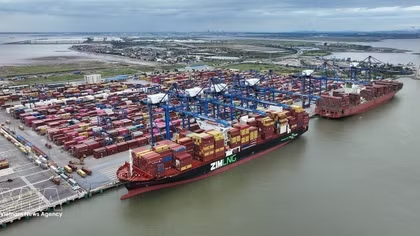
Hanoi (VNA) - It’s time for Vietnam to shift from its long-standing approach of attracting foreign direct investment (FDI) at all costs towards a more selective strategy focused on technology, innovation, green development, value creation and stronger linkages with domestic enterprises, experts have said.
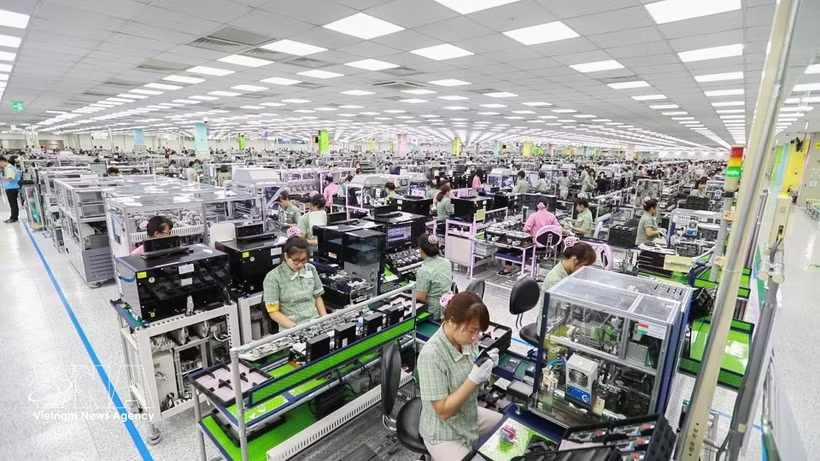
download-5.png
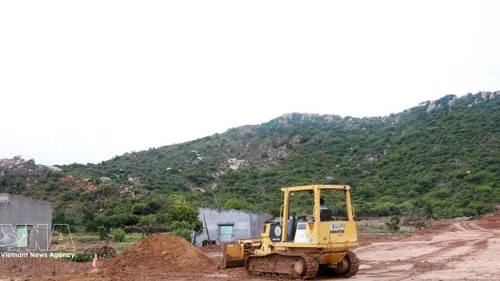
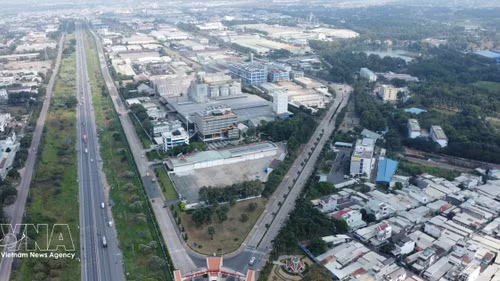
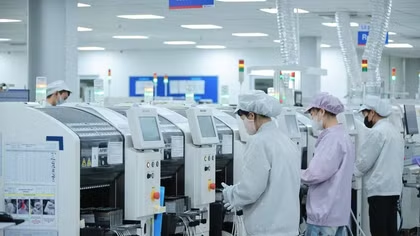
Illustrative photo (Photo: VNA)

According to Associate Prof. Dr Hoang Van Cuong, Vice Chairman of the Vietnam Association of Economic Science, Vietnamese enterprises themselves cannot remain outside the process if the country wants to build stronger and more substantive connections with the FDI sector.

He stressed that domestic firms must proactively improve corporate governance, technological capabilities and workforce quality in order to participate more deeply in global supply chains. “Vietnamese enterprises cannot enter the supply chains of multinational corporations unless they meet required standards,” Cuong said.

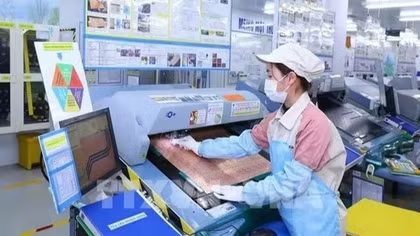
In reality, weak internal capacity remains a major bottleneck for domestic businesses. Surveys showed that around 60-70% of Vietnamese enterprises are still using outdated technologies, operating on a small scale and lacking sufficient resources to upgrade production systems.

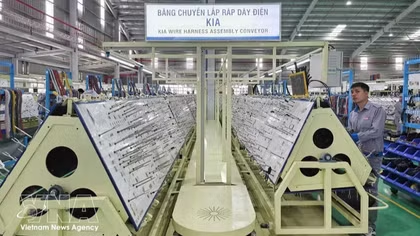
Former Deputy Director of the Banking Strategy Institute Pham Xuan Hoe cited Samsung’s supplier requirements as an example. To qualify for the conglomerate’s supply chain, firms often need to invest hundreds of VND in technological production lines, while many domestic businesses struggle to secure counterpart capital or collateral for bank loans.

The situation highlights the important role of the State in supporting enterprises through easier access to capital, science and technology, innovation and high-quality human resources training.

Experts said Vietnam should identify sectors where domestic enterprises possess competitive advantages and concentrate investment resources there instead of spreading support too broadly.

At the same time, the country needs to prepare a highly skilled workforce capable of undertaking higher value-added jobs and gradually replacing foreign workers in specialised positions.

From a long-term growth perspective, economists also recommended stronger efforts to attract FDI into sectors serving the domestic market.

Currently, foreign investment inflows into these sectors remain relatively modest compared to export-oriented manufacturing.

Improving this imbalance would help Vietnam make better use of foreign capital while reducing excessive dependence on exports and enhancing economic resilience.

Alongside policy changes, many foreign-invested enterprises are also shifting from purely investment-focused models towards long-term cooperation with Vietnamese businesses.

According to Shin JuBack, General Director of LOTTE MART Vietnam, building trust and shared development goals is the prerequisite for creating synergy between FDI enterprises and the domestic private sector.

In his view, FDI should not be seen merely as a source of capital, but also as a bridge for technology transfer, governance standards, operational expertise and international market connections. Meanwhile, Vietnamese enterprises hold major advantages in market understanding, adaptability and entrepreneurial spirit.

To turn such cooperation into a real growth driver, substantive integration within value chains is essential. LOTTE MART Vietnam has prioritised cooperation with local suppliers, especially small- and medium-sized enterprises in essential sectors such as agricultural products, fresh food and fast-moving consumer goods.

Beyond sourcing products, the retailer has also supported Vietnamese firms in improving product quality, food safety standards, traceability systems, packaging, logistics and operational capacity in order to meet the increasingly strict requirements of modern retail systems.

Notably, as green transition becomes an inevitable global trend, the company is also prioritising partners that meet environmental standards. This includes encouraging emissions reductions in logistics, cutting single-use plastics, promoting sustainable consumption and gradually building greener and more transparent supply chains.

Such cooperation models demonstrate that, if designed properly, FDI can become an important driving force helping Vietnamese enterprises mature and move beyond low-cost outsourcing roles.

Experts said Vietnam would struggle to achieve breakthroughs in productivity and value-added growth if it continues relying on the traditional FDI attraction model based on cheap labour and broad investment incentives.

However, by shifting towards high-quality investment flows centred on technology, innovation, green transition and stronger domestic business linkages, the FDI sector could become not only a growth engine but also a launchpad for strengthening the economy’s endogenous capacity.

In that context, the opening door would no longer simply welcome new investment capital, but also knowledge, advanced technologies and greater national competitiveness in a rapidly changing global economy./.
VNA
en.vietnamplus.vn

Other News

Government urges vigilance as inflation pressures mount in H2

Government urges vigilance as inflation pressures mount in H2

The Government's inflation target remains within reach despite mounting headwinds. Several forecasts suggest inflation can stay below 4.5% this year if international oil prices continue to retreat. Extending domestic fuel tax incentives through year-end, along with stable electricity prices, healthcare fees and exchange rates, would offer additional relief.

Plan issued to develop agricultural logistics system

Plan issued to develop agricultural logistics system

A key target is that by 2030, all concentrated agricultural, forestry and fisheries production areas will have access to essential services, including product traceability, quarantine, testing, quality certification, processing and market development. The move reflects growing international demand for stricter food safety, quality and traceability standards, which have become increasingly important for agricultural exports.

Vietnam seeks stronger export growth in H2

Vietnam seeks stronger export growth in H2

Despite the encouraging performance, Vietnam's exports remain heavily dependent on a limited number of major markets and product groups, while the domestic value added of many export products remains relatively low because of their reliance on imported raw materials and components.

RoK picks Vietnam as K-Food logistics hub for ASEAN expansion

RoK picks Vietnam as K-Food logistics hub for ASEAN expansion

Demand for Korean food in Vietnam has continued to grow rapidly alongside the popularity of the Korean Wave, or Hallyu, making the country a strategic market in the RoK's plan to expand agricultural and food exports to ASEAN, the RoK's Ministry of Agriculture, Food and Rural Affairs said.

Nearly 68,000 smuggling, trade fraud, counterfeit cases uncovered in H1

Nearly 68,000 smuggling, trade fraud, counterfeit cases uncovered in H1

Authorities detected and handled 67,937 violations in the first half of the year, up 36.66% year-on-year. Budget revenue from enforcement reached nearly 9.65 trillion VND (nearly 367 million USD), an increase of 49.36%, while investigation was launched into 1,676 criminal cases involving 2,789 suspects.

Vietnam joins global push for energy efficiency

Vietnam joins global push for energy efficiency

Participation in the Montreal Declaration also provides a foundation for Vietnam to explore deeper engagement with the IEA's multilateral energy efficiency initiatives, offering opportunities to access data, policy experience, technical tools and public-private partnership models in energy conservation.

Vietnam's Q2 GDP rises 8.39% amid broad-based economic growth

Vietnam's Q2 GDP rises 8.39% amid broad-based economic growth

Releasing the country's socio-economic data for the second quarter and the first half of the year on July 3, NSO Director Nguyen Thi Huong said Vietnam sustained positive growth across most industries and sectors despite a challenging international economic environment.

Public-private partnerships drive low-emission rice farming

Public-private partnerships drive low-emission rice farming

Experts agreed that integrating nutrient management, biotechnology, mechanisation and digital technologies will enhance productivity, reduce greenhouse gas emissions and accelerate the transition towards greener, more sustainable rice production.

Vietnam's tilapia exports maintain strong growth

Vietnam's tilapia exports maintain strong growth

Vietnam's tilapia export revenue in the first five months of 2026 hit 62 million USD, more than doubling that in the same period last year, reflecting a strong recovery in international demand

Vietnam's domestic carbon exchange launched

Vietnam's domestic carbon exchange launched

The carbon exchange creates a mechanism that enables businesses to optimise emission-reduction costs through trading emission quotas and carbon credits, encourages technological innovation, and supports sustainable development while maintaining the principle of not sacrificing the environment for economic growth.

SBV raises short-term capital lending cap to 40%

SBV raises short-term capital lending cap to 40%

The new circular will help credit institutions have more room to provide capital to businesses and investment projects to support high economic growth in the next few years, while increasing flexibility in the SBV’s monetary policy management.

Business confidence in Vietnam rebounds strongly: UOB

Business confidence in Vietnam rebounds strongly: UOB

The study found that 85% of Vietnamese enterprises reported positive business sentiment, a sharp increase from 48% in 2025, when business confidence was weighed down by uncertainties surrounding US tariff policies and related trade developments.