Modern logistics hubs expected to drive Vietnam's supply chain ambitions

Rather than expanding logistics infrastructure indiscriminately, the MoIT plans to establish a tiered network comprising national, regional and local logistics centres, specialised logistics hubs and cargo consolidation points.

Hanoi (VNA) – As Vietnam moves to integrate more deeply into regional and global supply chains, the development of modern, green and smart logistics hubs is expected to become a new growth driver by reducing logistics costs, improving supply chain efficiency and enhancing the country's competitiveness, said insiders.
download-12.png
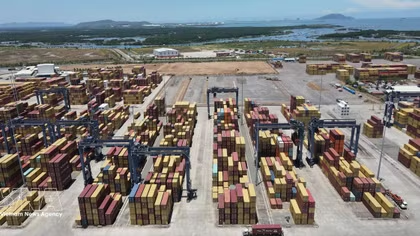
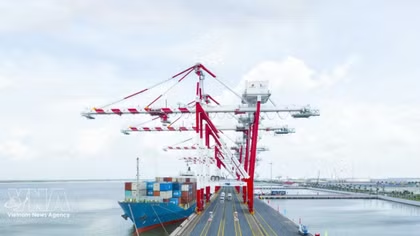
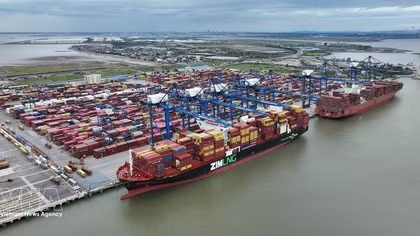
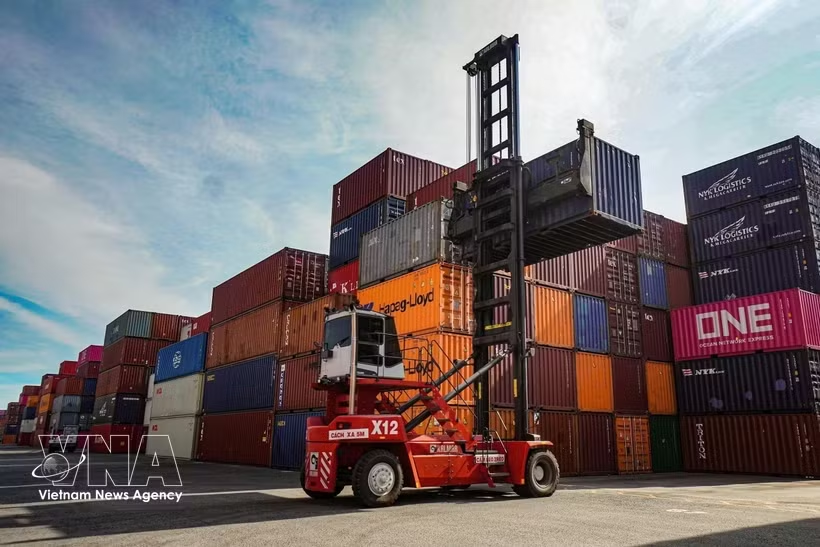
Containers are loaded at the Cai Mep – Thi Vai port complex in Ho Chi Minh City. (Photo: VNA)

Vietnam's Logistics Services Development Strategy to 2035, with a vision to 2050, aims to build a sustainable, efficient and high-value-added logistics industry with stronger competitiveness. A central pillar of the strategy is forming large-scale and modern logistics hubs linked to seaports, cross-border railways, border gates and multimodal transport networks to optimise supply chains and lower logistics costs, thus increasing the competitiveness of Vietnamese goods.

Vital link in supply chains

With total import – export turnover exceeding 930 billion USD in 2025 and an extensive network of free trade agreements (FTAs), Vietnam holds an opportunity to evolve from a transit point for goods into a supply chain organiser.

Dr. Bui Ba Nghiem, a senior specialist from the Ministry of Industry and Trade (MoIT)'s Agency of Foreign Trade, said the strategy marks a new development phase in which logistics is no longer merely a supporting service but a strategic component of national competitiveness. If implemented comprehensively across institutional reforms, infrastructure investment, business competitiveness enhancement and the development of green, smart logistics hubs and free trade zones, Vietnam could become an important logistics link in ASEAN and integrate more deeply into global logistics networks.

However, logistics activities in Vietnam remain fragmented, said Bui Nguyen Anh Tuan, Deputy Director of the MoIT’s Agency for Domestic Market Surveillance and Development. He stressed the need to reorganise logistics services into a more integrated, professional and cost-efficient system.

A breakthrough solution, he said, is developing regional and inter-regional logistics hubs connected to seaports, cross-border railways, border gates and multimodal transport infrastructure. Northern hubs could be centred in Hai Phong and Quang Ninh, leveraging deep-water ports and major international border crossings. Meanwhile, southern hubs could be developed around Ho Chi Minh City, linked with the Cai Mep – Thi Vai port complex, Long Thanh International Airport and the southeastern industrial region.

Tuan said rather than expanding logistics infrastructure indiscriminately, the MoIT plans to establish a tiered network comprising national, regional and local logistics centres, specialised logistics hubs and cargo consolidation points. Such an approach will avoid overlapping investment, improve efficiency and create logistics hubs capable of connecting Vietnam to regional and global supply chains.

At this stage, logistics hubs are evolving into strategic infrastructure for manufacturing and international trade, rather than being viewed merely as warehouses or cargo transshipment facilities, he noted.

Opportunities from green, smart logistics

Tuan noted that a network of modern, green, smart and interconnected logistics hubs will help significantly strengthen Vietnam's national competitiveness.

Lower logistics costs will reduce production, distribution and export expenses, an important factor as Vietnam pursues ambitious growth targets for 2026–2030. Faster and more efficient logistics will also improve product quality management, traceability and compliance with stringent export market standards.

Improved logistics infrastructure is expected to attract more investment to industry, retail, e-commerce and agricultural processing, while enhancing inter-regional connectivity by linking production zones, processing centres, consumer markets, border gates and seaports into an integrated network. Meanwhilee, green and smart logistics are expected to strengthen Vietnam's position in global supply chains.

Nguyen Le Hang, external affairs director at SLP Vietnam, said developing logistics hubs and green logistics represents an inevitable trend and offers Vietnamese companies significant opportunities.

By investing in modern and environmentally friendly logistics infrastructure and digital technologies, businesses can move beyond price competition to compete by service quality, delivery speed and compliance with international standards, she said.

They can also expand into fast-growing sectors such as e-commerce, cold storage and express delivery. Besides, green investment strategies are expected to improve access to financing by making firms more attractive to investors and financial institutions, Hang noted./.
VNA
en.vietnamplus.vn

Other News

Plan issued to develop agricultural logistics system

Plan issued to develop agricultural logistics system

A key target is that by 2030, all concentrated agricultural, forestry and fisheries production areas will have access to essential services, including product traceability, quarantine, testing, quality certification, processing and market development. The move reflects growing international demand for stricter food safety, quality and traceability standards, which have become increasingly important for agricultural exports.

Vietnam seeks stronger export growth in H2

Vietnam seeks stronger export growth in H2

Despite the encouraging performance, Vietnam's exports remain heavily dependent on a limited number of major markets and product groups, while the domestic value added of many export products remains relatively low because of their reliance on imported raw materials and components.

RoK picks Vietnam as K-Food logistics hub for ASEAN expansion

RoK picks Vietnam as K-Food logistics hub for ASEAN expansion

Demand for Korean food in Vietnam has continued to grow rapidly alongside the popularity of the Korean Wave, or Hallyu, making the country a strategic market in the RoK's plan to expand agricultural and food exports to ASEAN, the RoK's Ministry of Agriculture, Food and Rural Affairs said.

Nearly 68,000 smuggling, trade fraud, counterfeit cases uncovered in H1

Nearly 68,000 smuggling, trade fraud, counterfeit cases uncovered in H1

Authorities detected and handled 67,937 violations in the first half of the year, up 36.66% year-on-year. Budget revenue from enforcement reached nearly 9.65 trillion VND (nearly 367 million USD), an increase of 49.36%, while investigation was launched into 1,676 criminal cases involving 2,789 suspects.

Vietnam joins global push for energy efficiency

Vietnam joins global push for energy efficiency

Participation in the Montreal Declaration also provides a foundation for Vietnam to explore deeper engagement with the IEA's multilateral energy efficiency initiatives, offering opportunities to access data, policy experience, technical tools and public-private partnership models in energy conservation.

Vietnam's Q2 GDP rises 8.39% amid broad-based economic growth

Vietnam's Q2 GDP rises 8.39% amid broad-based economic growth

Releasing the country's socio-economic data for the second quarter and the first half of the year on July 3, NSO Director Nguyen Thi Huong said Vietnam sustained positive growth across most industries and sectors despite a challenging international economic environment.

Public-private partnerships drive low-emission rice farming

Public-private partnerships drive low-emission rice farming

Experts agreed that integrating nutrient management, biotechnology, mechanisation and digital technologies will enhance productivity, reduce greenhouse gas emissions and accelerate the transition towards greener, more sustainable rice production.

Vietnam's tilapia exports maintain strong growth

Vietnam's tilapia exports maintain strong growth

Vietnam's tilapia export revenue in the first five months of 2026 hit 62 million USD, more than doubling that in the same period last year, reflecting a strong recovery in international demand

Vietnam's domestic carbon exchange launched

Vietnam's domestic carbon exchange launched

The carbon exchange creates a mechanism that enables businesses to optimise emission-reduction costs through trading emission quotas and carbon credits, encourages technological innovation, and supports sustainable development while maintaining the principle of not sacrificing the environment for economic growth.

SBV raises short-term capital lending cap to 40%

SBV raises short-term capital lending cap to 40%

The new circular will help credit institutions have more room to provide capital to businesses and investment projects to support high economic growth in the next few years, while increasing flexibility in the SBV’s monetary policy management.

Business confidence in Vietnam rebounds strongly: UOB

Business confidence in Vietnam rebounds strongly: UOB

The study found that 85% of Vietnamese enterprises reported positive business sentiment, a sharp increase from 48% in 2025, when business confidence was weighed down by uncertainties surrounding US tariff policies and related trade developments.

Bac Ninh seeks high-quality foreign investment for sustainable growth

Bac Ninh seeks high-quality foreign investment for sustainable growth

According to Vice Chairman of the provincial People’s Committee Pham Van Thinh, the province aims to maintain stable and sustainable growth, improve the competitiveness of both the economy and local businesses, and make better use of free trade agreements (FTAs) to expand and diversify export markets.