Vietnamese enterprises renew growth model to move up global value chains

The resolution identifies enterprises as the centre of the renewal process, urging them to shift from cost-based competition to productivity, technology, quality and market responsiveness; from operating independently to joining industrial ecosystems; and from participating in value chains to mastering and eventually leading them.

Hanoi (VNA) - After four decades of Doi Moi (renewal), Vietnam is seeking to shift its growth model from reliance on capital, natural resources and low-cost labour towards productivity, technology, innovation and higher value-added activities, as businesses face growing pressure to strengthen competitiveness and move up global value chains.

This is a key requirement of Resolution No. 19-NQ/TW on renewing the national development model, which aims to modernise traditional growth drivers and gradually build a self-reliant, innovative, humane, sustainable and internationally integrated development model.
download-8.png
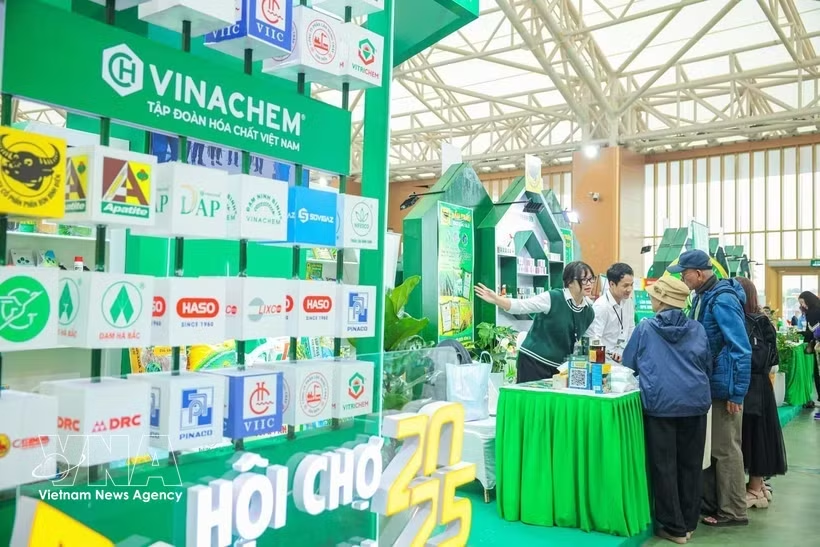
Vinachem affirms its position as a leading chemical enterprise at the Autumn Fair 2025 (Photo: VNA)

From participation to mastery of value chains

The resolution identifies enterprises as the centre of the renewal process, urging them to shift from cost-based competition to productivity, technology, quality and market responsiveness; from operating independently to joining industrial ecosystems; and from participating in value chains to mastering and eventually leading them.

Few enterprises can meet these requirements alone, however, making cooperation and the sharing of technology, capital, markets and management experience essential to building complete value chains.

Cao Huu Hieu, General Director of the Vietnam National Textile and Garment Group (Vinatex), said the group is promoting cooperation, gradually mastering technologies and securing higher-value links in the chain. It is also helping small enterprises improve productivity and develop their own products, aiming to complete the chain from design and material supply to finished products.

This approach is expected to raise enterprise value, strengthen the textile and garment industry's competitiveness and build an ecosystem capable of meeting partners' requirements.

The Vietnam National Chemical Group (Vinachem), meanwhile, is focusing on technology mastery and investment in science, technology and human resources.

Vinachem Chairman Phung Quang Hiep said the group is investing about 1.5 trillion VND (57.3 million USD) in a 3ha research, development, science, technology and innovation centre at Hoa Lac Hi-Tech Park in Hanoi. The centre will connect businesses with research institutes, universities and technology partners, helping commercialise research results and improve self-reliance in materials and core technologies.

This is expected to provide a foundation for Vinachem to strengthen its self-sufficiency in raw materials, master core technologies, boost productivity, and gradually cement its role as a key player in Vietnam’s chemicals and fertiliser industries.

The renewal of the development model also requires changes among enterprises providing essential infrastructure and services.
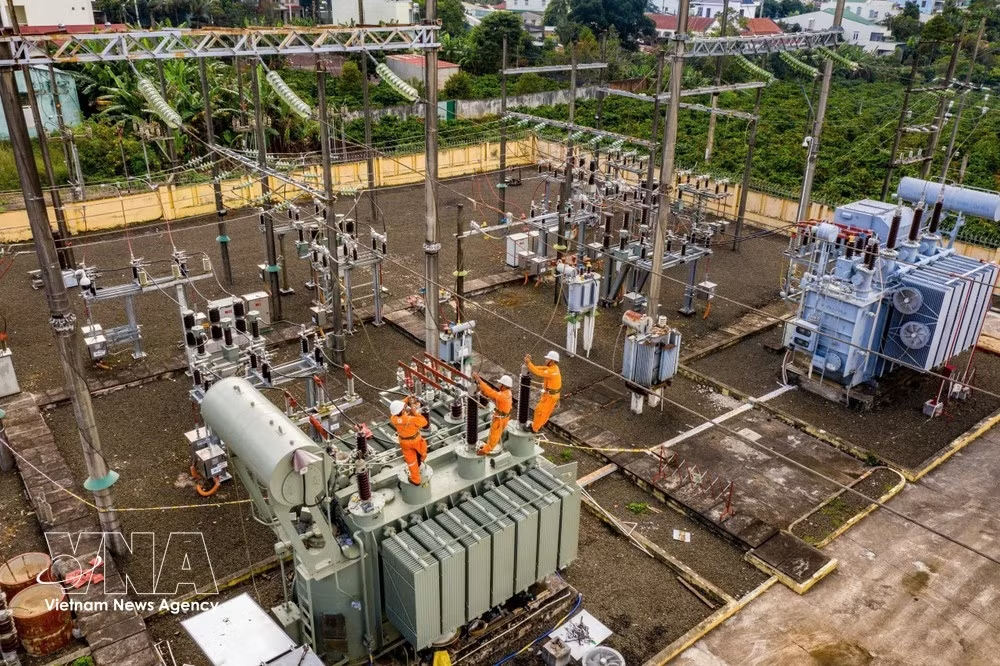
The Central Power Corporation (EVNCPC) has rolled out solutions to ensure a safe, stable, and reliable power supply across the provinces and cities of the central region (Photo: VNA)

Nguyen Anh Tuan, President and CEO of Vietnam Electricity (EVN), said the group has invested in power generation and grids, strengthened transmission capacity and prepared infrastructure for high-tech industries, semiconductors, artificial intelligence, data centres and electric transport.

EVN is also shifting towards data-driven management, accelerating automation and applying AI, the Internet of Things and Big Data to grid operation, load forecasting and smart energy management. It is promoting green transformation, applying environmental, social and governance (ESG) criteria, improving efficiency, reducing losses and increasing renewable-energy integration.

Leveraging for enterprises

The experiences of Vinatex, Vinachem and EVN show that enterprises are not merely beneficiaries but direct actors in implementing Resolution No. 19-NQ/TW.

Enterprises need to master high-value links in supply chains, core technologies and branding, while small and medium-sized enterprises should view research and development, intellectual property, data, technology, human resources and digital transformation as long-term investments in competitiveness.

Effective cooperation among businesses, research institutes and universities can unlock the potential of industrial ecosystems.

Deputy Secretary General of the Vietnam Chamber of Commerce and Industry (VCCI) Dau Anh Tuan said the State should remove institutional and business-environment bottlenecks and improve policies supporting technology, capital, innovation and business linkages.

For major projects, incentives should be tied to developing domestic suppliers and achieving substantive localisation, backed by mechanisms to verify results.

Supply-chain financing should also help small suppliers access capital based on contracts and receivables from lead firms, turning the strength and credibility of major enterprises into leverage for smaller businesses.

Only by strengthening individual enterprises, tightening links and building effective ecosystems can new growth drivers become real economic capabilities rather than expectations./.
VNA
en.vietnamplus.vn

Other News

Vietnam accelerates innovation to boost growth, competitiveness

Vietnam accelerates innovation to boost growth, competitiveness

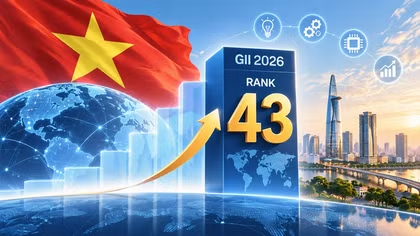
By 2030, Vietnam aims to rank among the world’s top 40 in the GII; raise total social investment in R&D to at least 2% of GDP, with non-State funding accounting for over 60%; increase international scientific publications by an average of 10% annually; and raise the number of patent applications and granted patents by an average of 16-18% annually.

Vietnam sees high growth prospects

Vietnam sees high growth prospects

Experts from the Institute of Vietnam and World Economy under the Vietnam Academy of Social Sciences noted the quality of recent growth as the high growth rate has been recorded against an increasingly higher comparative base.

Vietnam seeks bigger share of global Halal market

Vietnam seeks bigger share of global Halal market

Vietnam's Halal exports remain modest at around 900 million USD a year, accounting for less than 1% of the global market. Most exports are still raw agricultural and seafood products. Only around 1,000–1,300 Vietnamese businesses obtained or maintained Halal certification during 2024–2026.

Hanoi sets up inter-agency mechanism to operate carbon market

Hanoi sets up inter-agency mechanism to operate carbon market

Under a decision of the municipal People’s Committee on establishing an inter-agency working group, departments and agencies are responsible for identifying facilities subject to greenhouse gas inventories, developing emissions-reduction plans and studying projects capable of generating carbon credits.

Shrimp exports reach 3.3 billion USD in eight months

Shrimp exports reach 3.3 billion USD in eight months

According to data from the Vietnam Customs cited by the Vietnam Association of Seafood Exporters and Producers (VASEP), shrimp exports reached 478.5 million USD in August, up 4.2% from the same month last year. The eight-month total stood at 3.3 billion USD, representing a year-on-year increase of 12%.

Russian investors explore opportunities in Vietnam's real estate market

Russian investors explore opportunities in Vietnam's real estate market

Vietnam is seen as a potential market, with considerable room for growth in real estate, particularly commercial property, compared with some regional markets. Strong Vietnam-Russia ties and opportunities to establish foreign-invested enterprises are also considered favourable for Russian investors.

Phu Quoc airport planning adjusted to serve APEC 2027

Phu Quoc airport planning adjusted to serve APEC 2027

For 2021-2030, the Civil Aviation Authority of Vietnam proposed bringing forward the investment in a parallel taxiway system and a connecting taxiway north of Runway No. 2 at Phu Quoc International Airport, in order to connect with the aircraft maintenance and repair facility (hangar) planned for the northern area of ​​the airport.

Policy, infrastructure emerge as new advantages in FDI attraction

Policy, infrastructure emerge as new advantages in FDI attraction

From policy and infrastructure to industrial real estate, Vietnam’s FDI advantages are broadening towards a more integrated production ecosystem, offering investors a stronger combination of conditions for high-value, technology-intensive and long-term projects.

Logistics upgrade vital to 1-trillion-USD trade target: experts

Logistics upgrade vital to 1-trillion-USD trade target: experts

As trade expands, systemic bottlenecks across transport networks, warehousing, ports, border gates, and industrial zones are becoming more apparent. Experts emphasise the need to shift from a fragmented, project-by-project approach toward strategic management structured around trade corridors and integrated supply chains.

Ample room for Vietnam, US to deepen cooperation

Ample room for Vietnam, US to deepen cooperation

Do Ngoc Hung, Trade Counsellor and head of the Vietnam Trade Office in the US, said what stands out is not only the growth in trade volume but also the increasingly deep economic ties between the two countries.

Flexible fiscal policy helps drive economic growth

Flexible fiscal policy helps drive economic growth

According to the Ministry of Finance, State budget revenue in the first eight months of 2026 was estimated at 2.02 quadrillion VND (77.7 billion USD), equivalent to 80% of the annual estimate and up 16% year-on-year. Domestic revenue reached 1.75 quadrillion VND, accounting for 86.6% of total revenue and rising 16.6%.

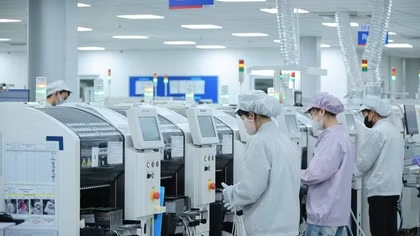
Electronic components are produced at a factory in Hanoi. (Photo: VNA)

Hanoi's imports surge 41% in first eight months of 2026

Hanoi aims to achieve average annual export growth of at least 12% during 2026-30, with the city seeking to diversify export markets, boost high-tech and value-added products and reduce reliance on traditional markets.