Eco-industrial parks seen as catalyst for higher-quality FDI

The eco-industrial park model will help Vietnam meet international environmental standards while creating opportunities to improve growth quality and economic competitiveness. Many multinational corporations now view green standards, emissions reduction and energy efficiency as key conditions when selecting investment destinations.

Hanoi (VNA) – Vietnam is accelerating the shift toward green and eco-industrial parks as part of efforts to improve the quality of foreign direct investment (FDI), enhance competitiveness and strengthen its position in global supply chains.

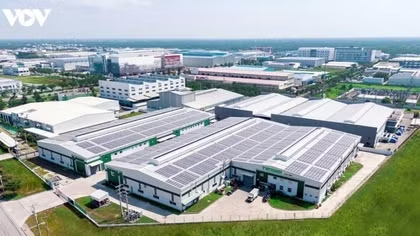
According to the Ministry of Finance (MoF), the country currently has 478 industrial parks, including 324 already operational and 153 under development. Vietnam has also attracted more than 45,000 FDI projects with combined registered capital surpassing 530 billion USD.

download-6.png
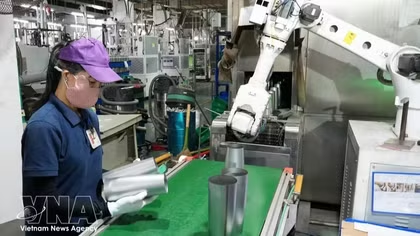
A production line for camera modules and export-oriented electronic components at the factory of MCNEX VINA Co., Ltd. in Phuc Son Industrial Park, Ninh Binh province. (Photo: VNA)

Do Van Su, Director General of the MoF’s Foreign Investment Agency, said FDI inflows into industrial and export processing zones have remained on a positive trajectory, contributing significantly to industrial growth, exports and economic restructuring.

He noted that Vietnam is increasingly prioritising quality over quantity in attracting FDI, with rising additional investment flowing into existing projects, reflecting investors’ long-term confidence. Investment trends are also shifting toward high-tech industries, advanced manufacturing and smart production.

Despite these gains, Su said challenges remain, including uneven project quality, limited spillover effects and weak linkages between foreign-invested enterprises and domestic firms. Infrastructure constraints, shortages of high-quality labour and imbalanced industrial park planning also continue to hinder development.

Against the backdrop of global supply chain restructuring, Vietnam faces mounting pressure to improve investment quality. Investors are paying greater attention to innovation, technology, workforce skills and the business environment, while ESG standards, green transition, energy efficiency and digital transformation are becoming increasingly important in investment decisions.

In this context, industrial parks are being redefined not only as manufacturing hubs but also as integrated ecosystems capable of generating higher added value and strengthening supply chain connectivity. Developing green, smart and eco-industrial parks is therefore becoming essential for Vietnam to integrate more deeply into next-generation global supply chains.

However, awareness of eco-industrial park models remains relatively low. A survey conducted by the Vietnam Chamber of Commerce and Industry (VCCI) across 118 industrial parks found that nearly half of businesses had little or no understanding of sustainable industrial park concepts. Only around 30% were familiar with eco-industrial parks, while just 20% fully understood the need to balance economic, environmental, social and governance objectives.

To support the transition, Decree No. 35/2022/ND-CP dated May 28, 2022 established a legal framework for eco-industrial parks, followed by Circular No. 05/2025/TT-BKHDT issued in early 2025 by the former Ministry of Planning and Investment (now the MoF), providing further implementation guidelines.

As more countries tighten carbon reduction commitments and strengthen environmental standards on imports, the transition from traditional industrial parks to eco-industrial models is becoming increasingly urgent.

Hanoi currently operates nine industrial parks covering approximately 1,348 ha, most of which were established around 20 years ago, including three converted from smaller industrial clusters.

Many of these parks are now facing ageing infrastructure, deteriorating facilities and shortcomings in meeting updated fire safety and environmental standards, highlighting the need for comprehensive transformation.

Le Thanh Son, deputy head of the Hanoi High-Tech and Industrial Parks, warned that without timely reform, industrial land risks becoming locked into outdated growth models or serving as a destination for obsolete technologies, weakening the capital’s competitiveness and attractiveness to investors.

The authority is drafting a roadmap to transform existing industrial parks into green, smart and eco-industrial zones, alongside a comprehensive evaluation framework covering planning, digital and technical infrastructure, environment, energy, industrial structure, circular economy, social infrastructure and governance.

According to Son, the criteria are intended not only to assess industrial parks but also to screen investment projects, improve land-use efficiency, raise production value and promote sustainable growth.

Economic experts said the eco-industrial park model would help Vietnam meet international environmental standards while creating opportunities to improve growth quality and economic competitiveness. Many multinational corporations now view green standards, emissions reduction and energy efficiency as key conditions when selecting investment destinations.

For Vietnam, eco-industrial parks could also enhance resource efficiency, reduce production costs through circular economy models and improve working conditions for employees. The transition is aligned with the country’s net-zero emissions commitment by 2050 announced at COP26./.

VNA
en.vietnamplus.vn

Other News

RoK picks Vietnam as K-Food logistics hub for ASEAN expansion

RoK picks Vietnam as K-Food logistics hub for ASEAN expansion

Demand for Korean food in Vietnam has continued to grow rapidly alongside the popularity of the Korean Wave, or Hallyu, making the country a strategic market in the RoK's plan to expand agricultural and food exports to ASEAN, the RoK's Ministry of Agriculture, Food and Rural Affairs said.

Nearly 68,000 smuggling, trade fraud, counterfeit cases uncovered in H1

Nearly 68,000 smuggling, trade fraud, counterfeit cases uncovered in H1

Authorities detected and handled 67,937 violations in the first half of the year, up 36.66% year-on-year. Budget revenue from enforcement reached nearly 9.65 trillion VND (nearly 367 million USD), an increase of 49.36%, while investigation was launched into 1,676 criminal cases involving 2,789 suspects.

Vietnam joins global push for energy efficiency

Vietnam joins global push for energy efficiency

Participation in the Montreal Declaration also provides a foundation for Vietnam to explore deeper engagement with the IEA's multilateral energy efficiency initiatives, offering opportunities to access data, policy experience, technical tools and public-private partnership models in energy conservation.

Vietnam's Q2 GDP rises 8.39% amid broad-based economic growth

Vietnam's Q2 GDP rises 8.39% amid broad-based economic growth

Releasing the country's socio-economic data for the second quarter and the first half of the year on July 3, NSO Director Nguyen Thi Huong said Vietnam sustained positive growth across most industries and sectors despite a challenging international economic environment.

Public-private partnerships drive low-emission rice farming

Public-private partnerships drive low-emission rice farming

Experts agreed that integrating nutrient management, biotechnology, mechanisation and digital technologies will enhance productivity, reduce greenhouse gas emissions and accelerate the transition towards greener, more sustainable rice production.

Vietnam's tilapia exports maintain strong growth

Vietnam's tilapia exports maintain strong growth

Vietnam's tilapia export revenue in the first five months of 2026 hit 62 million USD, more than doubling that in the same period last year, reflecting a strong recovery in international demand

Vietnam's domestic carbon exchange launched

Vietnam's domestic carbon exchange launched

The carbon exchange creates a mechanism that enables businesses to optimise emission-reduction costs through trading emission quotas and carbon credits, encourages technological innovation, and supports sustainable development while maintaining the principle of not sacrificing the environment for economic growth.

SBV raises short-term capital lending cap to 40%

SBV raises short-term capital lending cap to 40%

The new circular will help credit institutions have more room to provide capital to businesses and investment projects to support high economic growth in the next few years, while increasing flexibility in the SBV’s monetary policy management.

Business confidence in Vietnam rebounds strongly: UOB

Business confidence in Vietnam rebounds strongly: UOB

The study found that 85% of Vietnamese enterprises reported positive business sentiment, a sharp increase from 48% in 2025, when business confidence was weighed down by uncertainties surrounding US tariff policies and related trade developments.

Bac Ninh seeks high-quality foreign investment for sustainable growth

Bac Ninh seeks high-quality foreign investment for sustainable growth

According to Vice Chairman of the provincial People’s Committee Pham Van Thinh, the province aims to maintain stable and sustainable growth, improve the competitiveness of both the economy and local businesses, and make better use of free trade agreements (FTAs) to expand and diversify export markets.

Green building trend flourishes in Ho Chi Minh City's real estate landscape

Green building trend flourishes in Ho Chi Minh City's real estate landscape

The International Finance Corporation (IFC) highlighted the city's dominance in green-certified building floor space in Vietnam, reflecting the rapid expansion of the green building market with 780 completed green buildings encompassing over 18.69 million sq.m by 2025, predominantly certified by EDGE and LEED.

UK supports Vietnam in wind power and green finance development

UK supports Vietnam in wind power and green finance development

The United Kingdom officially announced two new climate cooperation initiatives to support Vietnam in its energy transition and green growth journey. These programs focus on offshore wind power development and the creation of a sustainable green financial ecosystem.