Business confidence in Vietnam rebounds strongly: UOB

The study found that 85% of Vietnamese enterprises reported positive business sentiment, a sharp increase from 48% in 2025, when business confidence was weighed down by uncertainties surrounding US tariff policies and related trade developments.

Ho Chi Minh City (VNA) – Business sentiment in Vietnam is rebounding strongly despite a challenging operating environment marked by rising costs and growing global uncertainties, including prolonged geopolitical tensions and trade-related pressures, according to the recently released Business Outlook Study 2026 by the United Overseas Bank (UOB).
4-3071.jpg
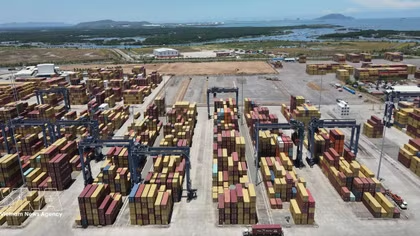
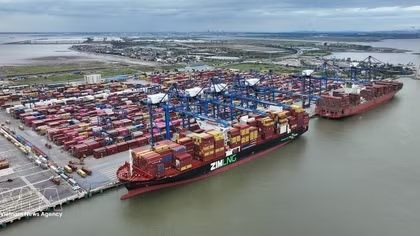
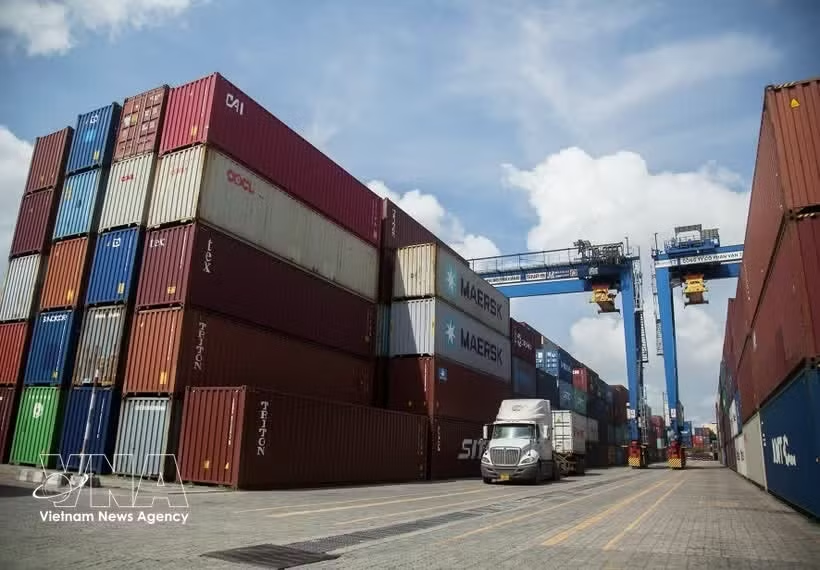
Containers at Cat Lai Port in Ho Chi Minh City. (Photo: VNA)

The study found that 85% of Vietnamese enterprises reported positive business sentiment, a sharp increase from 48% in 2025, when business confidence was weighed down by uncertainties surrounding US tariff policies and related trade developments.

Energy management becomes strategic priority

The outlook remains highly optimistic, with nine out of 10 businesses expecting improved performance in 2026 and forecasting stronger revenue growth in 2027–2028.

However, macroeconomic challenges continue to exert pressure on business operations. Nearly half of the surveyed firms reported higher costs linked to tariff measures and geopolitical tensions, underscoring the urgent need for solutions that enhance operational efficiency, strengthen cost management, and support sustainable business transformation in an increasingly complex operating environment.

In addition to persistent concerns over trade and geopolitical uncertainties, energy management is emerging as a top strategic priority for Vietnamese businesses. Even before the recent escalation of tensions in the Middle East, the study found that 96% of enterprises in Vietnam considered efficient energy management and use important, significantly higher than the regional average of 87%.

More than half of the surveyed firms (55%) identified ensuring a stable and sustainable energy supply for their operations as a key priority, while 53% focused on optimising energy use and 47% sought to reduce energy consumption and improve energy efficiency.

To achieve these goals, companies are increasing investments in energy-saving equipment (43%) and solar power solutions (42%), aiming to strike a balance between cost management and long-term operational sustainability.

At the same time, Vietnamese firms are accelerating their digital transformation efforts, with artificial intelligence (AI) gradually emerging as a key driver of growth. Although adoption remains at an early stage, eight in ten enterprises have begun implementing AI solutions. However, only around 25% have reached an advanced level of AI utilisation.

AI is already delivering tangible benefits for businesses, with 49% of the surveyed firms reporting improved productivity, 47% achieving cost savings, and 46% posting revenue growth. Reflecting growing confidence in the technology’s potential, two-thirds of businesses plan to increase their AI investment budgets by more than 25% in 2026.

However, AI adoption continues to face several challenges. The main obstacles cited by businesses include high costs and limited financial resources (49%), constraints related to AI solutions and partner ecosystems (48%), as well as limitations in data availability and system readiness (47%).

Strong focus on supply chain diversification

Supply chain management continues to be a top priority, with 97% of Vietnamese businesses identifying it as critical. While disruptions have eased compared with previous years, challenges persist, particularly from geopolitical risks and procurement complexity. Regulatory ambiguity also remains a concern, affecting 88% of businesses.

To strengthen resilience, Vietnamese companies are actively diversifying their supply chains. Four in five businesses plan to expand their supplier networks in 2026, with more than half looking to increase suppliers within ASEAN and 23% focusing on domestic sourcing.

Nearshoring strategies are also gaining momentum. About one in three intend to establish or expand operations in Vietnam, while many are also considering broader ASEAN expansion (43%), reinforcing the region’s role as a key manufacturing and supply chain hub.

This shift is strongly driving a wave of international expansion. Seven in ten Vietnamese businesses expanded their operations overseas in 2025, while nine in ten plan to further expand internationally over the next three years. Likewise, 80% of Vietnamese enterprises intend to invest abroad within the next two years, with the average planned investment exceeding 28 million USD.

ASEAN remains the preferred destination for expansion, with 65% of Vietnamese firms identifying the region as their top choice. Among ASEAN markets, Thailand, Singapore and Indonesia are the most attractive destinations. However, companies continue to face a number of challenges, particularly in meeting legal, regulatory, compliance and tax requirements (36%), finding suitable local partners (36%), and gaining access to partnership opportunities with large corporations or government-linked organisations.

Pham Nhu Anh, head of Wholesale Banking at UOB Vietnam, said that Vietnamese businesses are demonstrating remarkable resilience and adaptability in an increasingly volatile global environment./.
en.vietnamplus.vn

Other News

Green building trend flourishes in Ho Chi Minh City's real estate landscape

Green building trend flourishes in Ho Chi Minh City's real estate landscape

The International Finance Corporation (IFC) highlighted the city's dominance in green-certified building floor space in Vietnam, reflecting the rapid expansion of the green building market with 780 completed green buildings encompassing over 18.69 million sq.m by 2025, predominantly certified by EDGE and LEED.

UK supports Vietnam in wind power and green finance development

UK supports Vietnam in wind power and green finance development

The United Kingdom officially announced two new climate cooperation initiatives to support Vietnam in its energy transition and green growth journey. These programs focus on offshore wind power development and the creation of a sustainable green financial ecosystem.

Ample room remains for Vietnam–India logistics cooperation

Ample room remains for Vietnam–India logistics cooperation

The GTTCI expert noted that alongside logistics and integrated warehousing, e-commerce is expected to be a particularly high-growth sector in the coming years. He described it as a multi-billion-dollar market with significant untapped opportunities for cooperation between Vietnam and India.

Exports gain momentum from high-tech growth drivers

Exports gain momentum from high-tech growth drivers

According to the Ministry of Industry and Trade, Vietnam’s exports reached 215.66 billion USD in the first five months of 2026, up 19.5% year-on-year. Twenty-six export items generated more than 1 billion USD in revenue each, including seven with turnover exceeding 10 billion USD.

Vietnam–China crossings see spike in ASEAN fresh produce

Vietnam–China crossings see spike in ASEAN fresh produce

Since the start of the summer harvest season, China's two major border gates with Vietnam, Youyi Guan in Pingxiang and Beilun 2 Bridge in Dongxing, have entered their peak period for handling imports of fresh agricultural and seafood products from member states of the Association of Southeast Asian Nations (ASEAN).

Cargo handling operations at Berths 3 and 4 of the Hai Phong International Gateway Port. (Photo: VNA)

AI reshapes logistics, raising bar for workforce skills

According to the Vietnam Logistics Business Association (VLA), the logistics sector will require around 2.2 million workers by 2030, including 1.6 million employees for logistics service providers and nearly 600,000 personnel supporting logistics operations in manufacturing and trading enterprises.

Robust dispute resolution framework key to Vietnam's IFC ambitions

Robust dispute resolution framework key to Vietnam's IFC ambitions

The development strategy for VIFC-HCMC envisions a comprehensive financial ecosystem encompassing green finance, carbon credits, financial technology (fintech), blockchain technology, digital assets, digital banking and other innovative business models. These highly internationalised sectors involve complex cross-border transactions and sophisticated legal structures.

North – South Expressway expands EV charging infrastructure

North – South Expressway expands EV charging infrastructure

According to the Department for Roads of Vietnam, the Vietnam National Petroleum Group (Petrolimex) is investing in nine rest stops. At the Mai Son–National Highway 45 rest area, 10 charging points have been installed on each side of the expressway. Each point has two charging ports, providing 20 EV charging spaces on each side.

A view of a container port in Singapore. (File photo: Xinhua/VNA)

Vietnam-Singapore trade cooperation gains fresh momentum

Analysts noted that Vietnam-Singapore ties are increasingly moving beyond traditional goods trade towards green growth, innovation and high-quality supply chains, laying a stronger foundation for more substantive and sustainable cooperation in the years ahead.

Vietnamese products make strong impression at Foodservice Australia 2026

Vietnamese products make strong impression at Foodservice Australia 2026

International visitors expressed positive impressions of Vietnamese products displayed at the fair. Nelma Sanjines, senior supervisor at ESP Catering in Sydney, praised the flavour of Vietnamese chilli sauce and soy sauce as well as the attractive packaging of confectionery products.

Digital technology helps standardise supply chains, sustain export competitiveness

Digital technology helps standardise supply chains, sustain export competitiveness

Experts noted that supply chain optimisation and risk management are no longer isolated tasks for individual companies but a requirement for the entire export ecosystem. With guidance from regulators, support from industry experts and their own efforts, Vietnamese exporters are expected to enhance their competitiveness and turn technical barriers and market volatility into opportunities for sustainable growth in global markets.