The milestone reflects years of economic reforms, deeper global integration and an improving business environment, although experts say productivity, innovation and technology adoption are key challenges.
Vietnam ranks 27th in its IMD debut

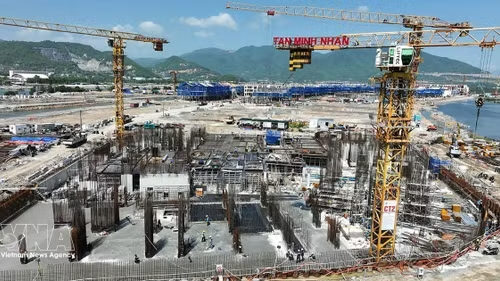
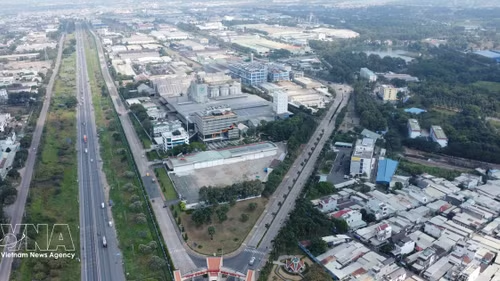
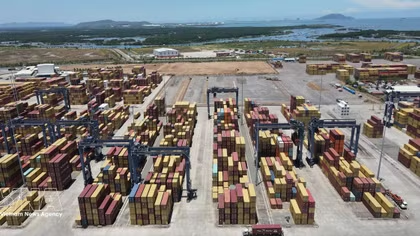
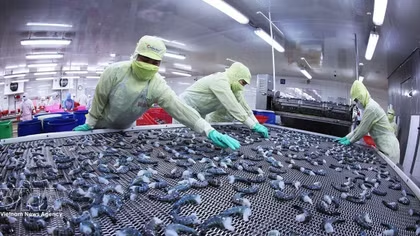
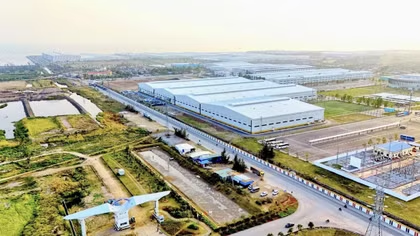
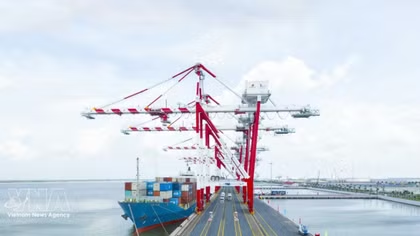
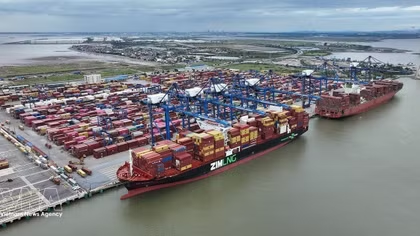
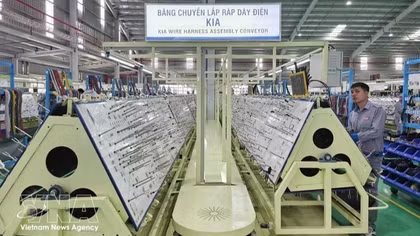
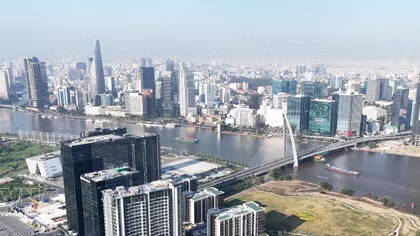
Vietnam breaks into global Top 30 for competitiveness, but challenges remain. (Illustrative image)
According to IMD's 2026 World Competitiveness Ranking, Vietnam placed 27th among 70 economies assessed worldwide.
The Swiss-based institute evaluates economies using 264 indicators that combine statistical data with business surveys across four pillars - economic performance, government efficiency, business efficiency and infrastructure.
Despite making its debut in the ranking, Vietnam posted strong performances in several categories. It ranked 19th for economic performance and business efficiency, 16th for domestic economy, sixth for international trade and 11th for employment.
The result follows Vietnam's consistent performance in other global innovation benchmarks. In the 2025 Global Innovation Index published by the World Intellectual Property Organization (WIPO), Vietnam ranked 44th among 139 economies and was one of the countries that have consistently outperformed their level of development in innovation over the past 15 years.
Together, these international rankings suggest that Vietnam's competitiveness is improving on a structural basis rather than through short-term gains.
Factors behind stronger competitiveness
Economists said the improvement reflects years of accumulated reforms. According to Dr. Nguyen Van Dien, head of the Faculty of Political Economy at the Ho Chi Minh National Academy of Politics – Region II, macroeconomic stability and a stable political and social environment are Vietnam's greatest competitive advantages. These conditions provide businesses with greater confidence to invest while enhancing Vietnam's appeal to international investors.
Another important factor is the country’s expanding network of 17 free trade agreements (FTAs), which has significantly broadened market access for Vietnamese exporters. With total trade reaching approximately US$930 billion, equivalent to nearly 200% of GDP, Vietnam is now among the world's most open economies.
Institutional reforms have also contributed substantially. In recent years, the government has continued simplifying administrative procedures, reducing business conditions, expanding digital public services and improving the legal framework to support economic development.
With regard to business performance, small and medium-sized enterprises (SMEs) and household businesses have demonstrated considerable resilience in adapting to global economic uncertainties, helping sustain the economy through periods of geopolitical volatility.
Better rankings could strengthen investment appeal
Vietnam's strong performance in international trade will further enhance its attractiveness to foreign investors, Dr. Dien told thanhnien.vn.
Global competitiveness rankings serve not only as indicators of business conditions but also as important references for multinational corporations when selecting investment destinations. Higher rankings help strengthen a country's reputation, reinforce investor confidence and improve its position within global supply chains.
However, he noted that Vietnam continues to rank relatively low in international investment indicators, suggesting that its capacity to absorb high-quality foreign direct investment (FDI), particularly technology-intensive projects, is limited.
To maximise future opportunities, he suggested Vietnam further develop its high-skilled workforce by expanding education and training in STEM disciplines, semiconductors, artificial intelligence and software engineering, while encouraging foreign investors to transfer technology and invest in research and development (R&D).
Structural bottlenecks remain
Despite its progress, the IMD report also highlights several structural weaknesses. Labour productivity, technological capability and innovation capacity continue to lag behind Vietnam's economic potential. Energy infrastructure is also facing mounting pressure as demand from manufacturing and consumption continues to grow.
Dr. Dien attributed these challenges largely to the structure of Vietnam's business sector, where most enterprises are small or micro-sized with limited financial resources, making it difficult to invest in research, technological upgrading and workforce development.
He said stronger policies supporting innovation, technology transfer and science and technology development could help businesses improve productivity and competitiveness.
Sharing a similar view, Dinh Tuan Minh of the Market Solutions Research Centre for Socio-Economic Issues (MASSEI) told thanhnien.vn Vietnam has made notable progress in institutional reform, trade liberalisation and improving the investment climate. The next priority, he said, is to translate policies on innovation, digital transformation and science and technology into tangible results.
In his view, Vietnam should provide greater space for universities, research institutes and businesses to undertake breakthrough research projects while creating regulatory frameworks that encourage innovation without compromising effective risk management.
Beyond rankings
Vietnam’s entry into IMD's global top 30 marks an important milestone after years of reform and international integration. However, experts stressed that rankings alone are not the ultimate goal. Their real value lies in translating stronger competitiveness into higher productivity, greater innovation and increased capacity to attract high-quality investment.
As global competition intensifies, continued institutional reforms, investment in human capital, technological advancement and stronger innovation capabilities will be essential for Vietnam not only to maintain its current position but also to climb higher in future international competitiveness rankings.