Customs force tightens crackdown on intellectual property-infringing goods

As offenders adopt increasingly sophisticated tactics, customs authorities are tightening controls at border gates, stepping up the use of technologies and refining enforcement measures to intercept illicit goods at the import and transit stages.

vnanet-an-giang.jpg
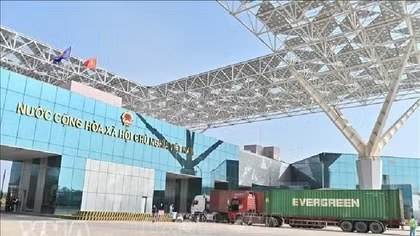
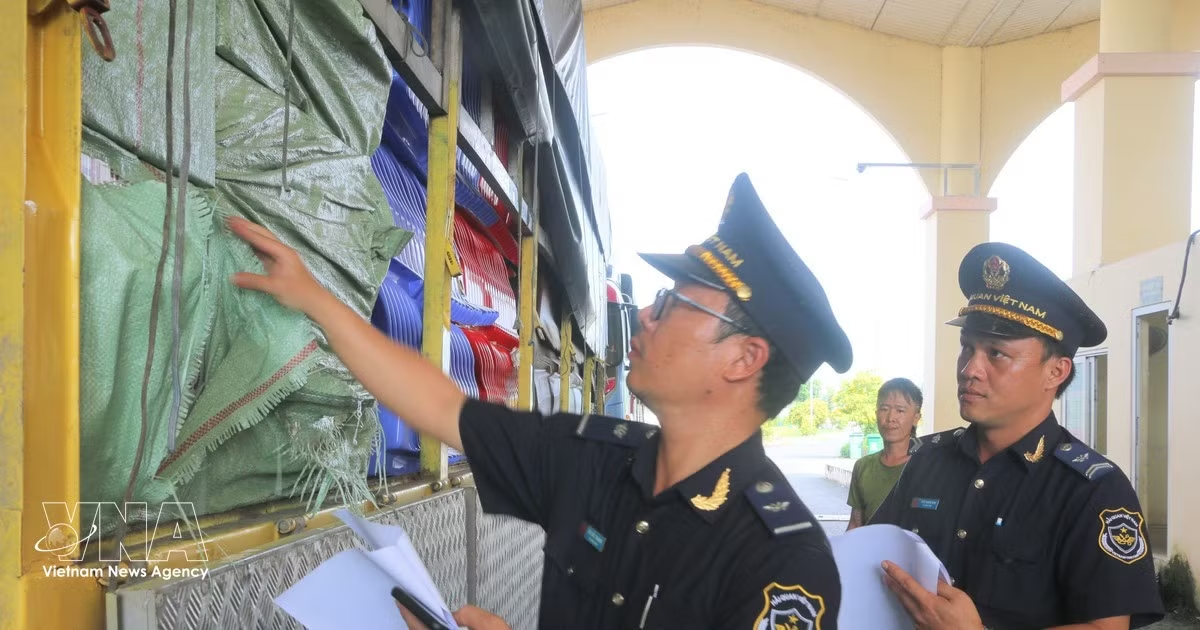
Customs officers check goods transported via Tinh Bien international border gate in An Giang province. (Photo: VNA)

The rapid expansion of cross-border e-commerce is creating major opportunities for international trade, but it is also increasing the risk of counterfeit, imitation and intellectual property (IP)-infringing goods entering markets.

As offenders adopt increasingly sophisticated tactics, customs authorities are tightening controls at border gates, stepping up the use of technologies and refining enforcement measures to intercept illicit goods at the import and transit stages.

Cross-border e-commerce has significantly altered the way goods are transported and distributed. Whereas infringing products were previously moved in large volumes through formal import channels, there is now a growing trend of splitting shipments into smaller consignments and sending them via express delivery services, international post or under the guise of transit operations. The range of infringing products has also widened, spanning fashion, cosmetics, electronics, technology accessories and children’s toys.

According to the Department of Customs, during a recent nationwide campaign implementing the Prime Minister’s Official Dispatch No. 38/CD-TTg on combating counterfeit goods and intellectual property violations, the customs force detected and seized thousands of suspected counterfeit products, trademark-infringing goods and imports failing to meet regulatory requirements. The results underscore both the complexity of the issue and customs authorities’ determination to tighten oversight across borders and ports of entry.

Violations are no longer concentrated solely along the northern border, where trade flows with China are highest. Cases have also emerged along transit transport routes and at major southern seaports.

A series of recent cases indicates that IP-infringing goods are appearing across multiple trade routes and import-export categories. Of particular concern is the growing exploitation of cross-border e-commerce platforms to channel counterfeit and imitation products into the domestic market through small-scale orders, complicating inspection and monitoring efforts.

To respond to these challenges, the customs sector is accelerating the adoption of information technology, digital transformation, and risk-based management. Databases on intellectual property rights, protected trademarks and alerts issued by rights holders are being continuously updated to help customs officers identify suspect goods more effectively.

Alongside tighter inspections at border checkpoints, customs authorities are also improving the legal framework to strengthen enforcement against counterfeit and IP-infringing products. Recently, the Department of Customs issued a document to standardise appraisal procedures for exported, imported and transit goods suspected of infringement.

Under the new guidance, where a rights holder or authorised representative has already confirmed an infringement in writing, customs authorities may proceed directly with enforcement without requiring an expert assessment. In cases where evidence remains insufficient, customs officers will collect samples for appraisal or coordinate with relevant agencies for further verification.

The measure is expected to shorten investigation timelines, speed up case handling and strengthen prevention efforts directly at points of entry.

The customs sector is also enhancing cooperation with trademark owners, industry associations and international organisations to exchange information, support authentication of genuine products and strengthen enforcement capacity. This is seen as an essential response as intellectual property violations become increasingly sophisticated, cross-border in nature and closely linked to the growth of e-commerce./.


VNA
en.vietnamplus.vn

Other News

Vietnam–China crossings see spike in ASEAN fresh produce

Vietnam–China crossings see spike in ASEAN fresh produce

Since the start of the summer harvest season, China's two major border gates with Vietnam, Youyi Guan in Pingxiang and Beilun 2 Bridge in Dongxing, have entered their peak period for handling imports of fresh agricultural and seafood products from member states of the Association of Southeast Asian Nations (ASEAN).

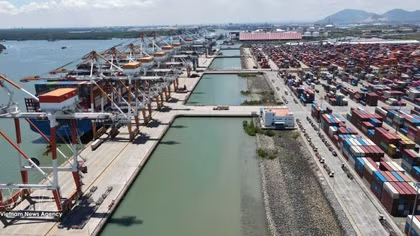
Cargo handling operations at Berths 3 and 4 of the Hai Phong International Gateway Port. (Photo: VNA)

AI reshapes logistics, raising bar for workforce skills

According to the Vietnam Logistics Business Association (VLA), the logistics sector will require around 2.2 million workers by 2030, including 1.6 million employees for logistics service providers and nearly 600,000 personnel supporting logistics operations in manufacturing and trading enterprises.

Robust dispute resolution framework key to Vietnam's IFC ambitions

Robust dispute resolution framework key to Vietnam's IFC ambitions

The development strategy for VIFC-HCMC envisions a comprehensive financial ecosystem encompassing green finance, carbon credits, financial technology (fintech), blockchain technology, digital assets, digital banking and other innovative business models. These highly internationalised sectors involve complex cross-border transactions and sophisticated legal structures.

North – South Expressway expands EV charging infrastructure

North – South Expressway expands EV charging infrastructure

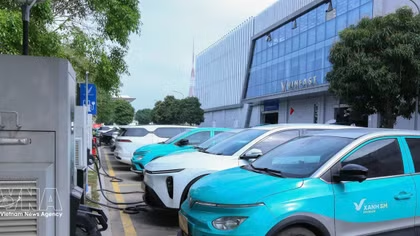
According to the Department for Roads of Vietnam, the Vietnam National Petroleum Group (Petrolimex) is investing in nine rest stops. At the Mai Son–National Highway 45 rest area, 10 charging points have been installed on each side of the expressway. Each point has two charging ports, providing 20 EV charging spaces on each side.

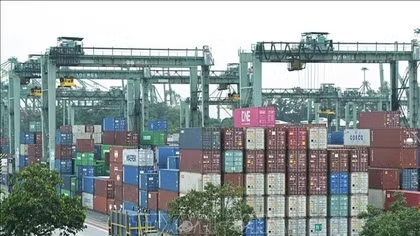
A view of a container port in Singapore. (File photo: Xinhua/VNA)

Vietnam-Singapore trade cooperation gains fresh momentum

Analysts noted that Vietnam-Singapore ties are increasingly moving beyond traditional goods trade towards green growth, innovation and high-quality supply chains, laying a stronger foundation for more substantive and sustainable cooperation in the years ahead.

Vietnamese products make strong impression at Foodservice Australia 2026

Vietnamese products make strong impression at Foodservice Australia 2026

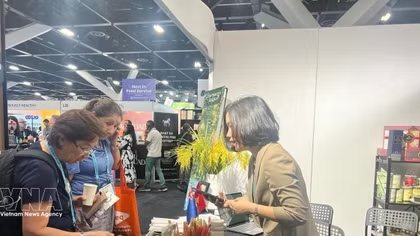
International visitors expressed positive impressions of Vietnamese products displayed at the fair. Nelma Sanjines, senior supervisor at ESP Catering in Sydney, praised the flavour of Vietnamese chilli sauce and soy sauce as well as the attractive packaging of confectionery products.

Digital technology helps standardise supply chains, sustain export competitiveness

Digital technology helps standardise supply chains, sustain export competitiveness

Experts noted that supply chain optimisation and risk management are no longer isolated tasks for individual companies but a requirement for the entire export ecosystem. With guidance from regulators, support from industry experts and their own efforts, Vietnamese exporters are expected to enhance their competitiveness and turn technical barriers and market volatility into opportunities for sustainable growth in global markets.