Fishermen's associations help drive efforts to lift EC's IUU 'yellow card'

To date, over 100 fisheries unions, solidarity groups and teams protecting national sovereignty and security at sea in Da Nang have signed commitments not to engage in IUU fishing.

Alongside maritime law enforcement forces, more than 100 fisheries associations and fishermen’s self-management groups in Da Nang city have become key players in combating illegal, unreported and unregulated (IUU) fishing, contributing to Vietnam’s efforts to secure the removal of the European Commission (EC)'s “yellow card” warning.

Colonel Tran Tien Hien, Commander of the Da Nang Border Guard Command, said the central city has a long coastline, vast fishing grounds and more than 4,200 fishing vessels, including thousands operating in deep-sea areas. Beyond their role in economic development, local fishermen also contribute to safeguarding national sovereignty, maintaining maritime security and complying with fisheries regulations.
iuu.jpg
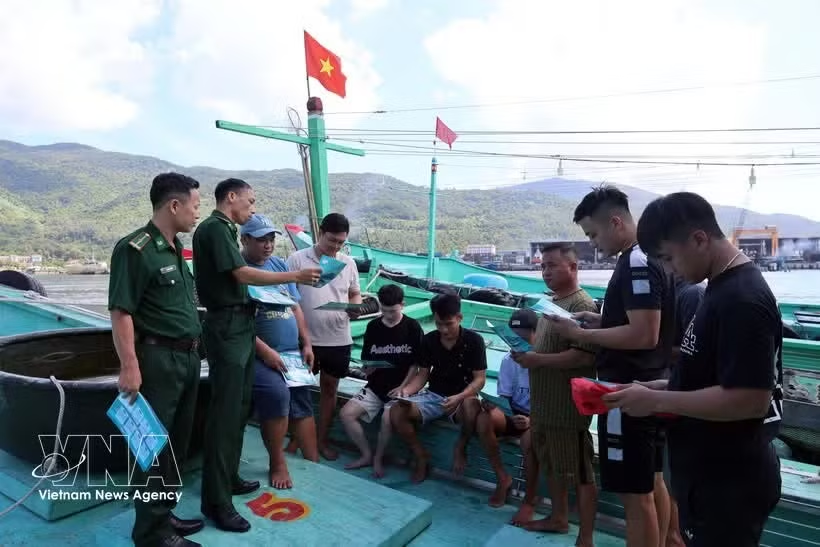
Officers and soldiers of Son Tra Border Guard Station under Da Nang City Border Guard Command tell local fishermen about anti-IUU fishing. (Photo: VNA)

To date, over 100 fisheries unions, solidarity groups and teams protecting national sovereignty and security at sea have signed commitments not to engage in IUU fishing.

Nguyen Cong Thanh, captain of a fishing vessel from Duy Hai commune, said fishermen are increasingly aware of the importance of complying with anti-IUU regulations during every fishing trip.

If all fishermen strictly observe regulations against illegal fishing, the goal of having the "yellow card" lifted is within reach, he said.

Similarly, Tran Dinh Len, captain of squid-fishing vessel QNa 91702 TS, said he recently invested more than 400 million VND (15,200 USD) to upgrade his vessel and equipment, and also signed the commitment to fully comply with anti-IUU fishing rules.

To support these efforts, border guard stations have strengthened monitoring systems to supervise fishing activities and detect potential violations while organising training and awareness raising campaigns for fishermen.

Lieutenant Colonel Le Anh Tuy, head of the Ky Ha Port Border Guard Station, said extensive communications activities have helped fishermen better understand and comply with fisheries regulations, significantly reducing violations in areas under the station’s management.

Local authorities are also investing in infrastructure to improve fisheries management and traceability.

Hoang Chau Son, Chairman of the Nui Thanh commune People’s Committee, said local authorities have created favourable conditions for fishermen to access loans for repairing and upgrading boats, purchasing fishing gear, and installing modern maritime equipment.

In addition, it has implemented projects to upgrade the Tam Quang fishing port and the An Hoa storm shelter anchorage. The facilities will provide secure shelter for fishing vessels and enable authorities to better monitor seafood landings and catches, helping ensure compliance with international regulations, he added.

With active participation from fishermen’s organisations and strict implementation of the rules on vessel registration, inspection, vessel monitoring systems, catch reporting and foreign waters infringement prevention, Da Nang’s fishing community is making a significant contribution to Vietnam’s efforts to have the EC’s IUU fishing yellow card lifted.
en.vietnamplus.vn

Other News

Major works at Long Thanh International Airport gather pace towards completion

Major works at Long Thanh International Airport gather pace towards completion

The ACV said on July 20 that contractors are deploying additional workers and equipment to speed up construction under Component Project 3, which covers the airport's essential aviation infrastructure. Major facilities, including the first and second runways, taxiways, aircraft aprons, the passenger terminal apron and the aircraft fuel supply system, are approaching completion.

GDP expands 8.18%, with new growth drivers taking shape

GDP expands 8.18%, with new growth drivers taking shape

According to the National Statistics Office under the Ministry of Finance, GDP expanded by 8.39% in the second quarter, up from 8.14% a year earlier. Growth for the first six months reached 8.18%, exceeding the 7.63% recorded in the same period of 2025. The performance reflected broad-based contributions from both the supply and demand sides of the economy.

Vietnamese economy sustains momentum on strong industrial production

Vietnamese economy sustains momentum on strong industrial production

The National Statistics Office (NSO) under the Ministry of Finance reported that the manufacturing and processing sector remained the principal driver of economic growth, accounting for 33.07% of the economy's total value-added growth during the first six months of the year.

Government urges vigilance as inflation pressures mount in H2

Government urges vigilance as inflation pressures mount in H2

The Government's inflation target remains within reach despite mounting headwinds. Several forecasts suggest inflation can stay below 4.5% this year if international oil prices continue to retreat. Extending domestic fuel tax incentives through year-end, along with stable electricity prices, healthcare fees and exchange rates, would offer additional relief.

Plan issued to develop agricultural logistics system

Plan issued to develop agricultural logistics system

A key target is that by 2030, all concentrated agricultural, forestry and fisheries production areas will have access to essential services, including product traceability, quarantine, testing, quality certification, processing and market development. The move reflects growing international demand for stricter food safety, quality and traceability standards, which have become increasingly important for agricultural exports.

Vietnam seeks stronger export growth in H2

Vietnam seeks stronger export growth in H2

Despite the encouraging performance, Vietnam's exports remain heavily dependent on a limited number of major markets and product groups, while the domestic value added of many export products remains relatively low because of their reliance on imported raw materials and components.

RoK picks Vietnam as K-Food logistics hub for ASEAN expansion

RoK picks Vietnam as K-Food logistics hub for ASEAN expansion

Demand for Korean food in Vietnam has continued to grow rapidly alongside the popularity of the Korean Wave, or Hallyu, making the country a strategic market in the RoK's plan to expand agricultural and food exports to ASEAN, the RoK's Ministry of Agriculture, Food and Rural Affairs said.

Nearly 68,000 smuggling, trade fraud, counterfeit cases uncovered in H1

Nearly 68,000 smuggling, trade fraud, counterfeit cases uncovered in H1

Authorities detected and handled 67,937 violations in the first half of the year, up 36.66% year-on-year. Budget revenue from enforcement reached nearly 9.65 trillion VND (nearly 367 million USD), an increase of 49.36%, while investigation was launched into 1,676 criminal cases involving 2,789 suspects.

Vietnam joins global push for energy efficiency

Vietnam joins global push for energy efficiency

Participation in the Montreal Declaration also provides a foundation for Vietnam to explore deeper engagement with the IEA's multilateral energy efficiency initiatives, offering opportunities to access data, policy experience, technical tools and public-private partnership models in energy conservation.

Vietnam's Q2 GDP rises 8.39% amid broad-based economic growth

Vietnam's Q2 GDP rises 8.39% amid broad-based economic growth

Releasing the country's socio-economic data for the second quarter and the first half of the year on July 3, NSO Director Nguyen Thi Huong said Vietnam sustained positive growth across most industries and sectors despite a challenging international economic environment.

Public-private partnerships drive low-emission rice farming

Public-private partnerships drive low-emission rice farming

Experts agreed that integrating nutrient management, biotechnology, mechanisation and digital technologies will enhance productivity, reduce greenhouse gas emissions and accelerate the transition towards greener, more sustainable rice production.