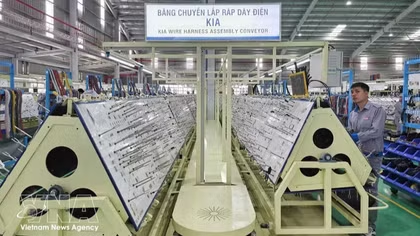
The northern province of Bac Ninh is stepping up international economic integration efforts and seeking to attract more high-quality foreign direct investment (FDI) through the end of 2026 as part of its strategy for sustainable economic growth and stronger global competitiveness.
According to Vice Chairman of the provincial People’s Committee Pham Van Thinh, the province aims to maintain stable and sustainable growth, improve the competitiveness of both the economy and local businesses, and make better use of free trade agreements (FTAs) to expand and diversify export markets.
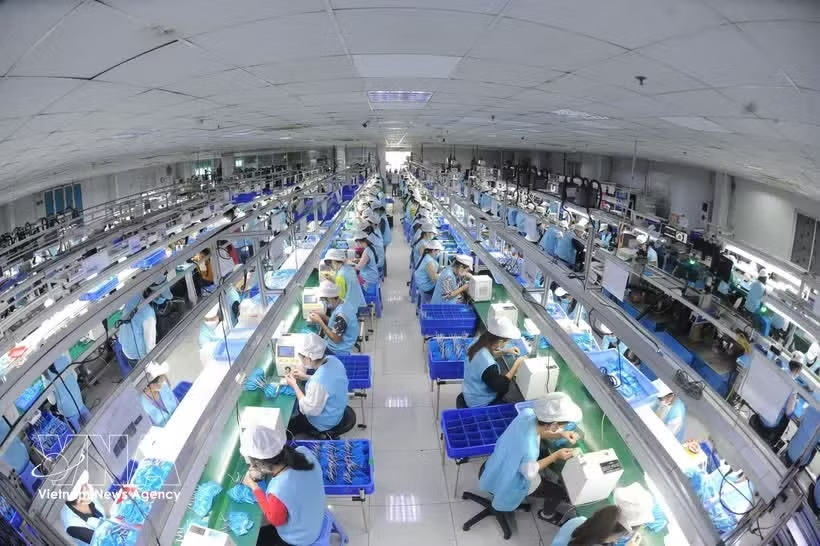
The province is focusing on attracting foreign investment selectively, prioritising projects that bring advanced technologies, support the development of supporting industries, and help local firms participate more deeply in regional and global value chains.
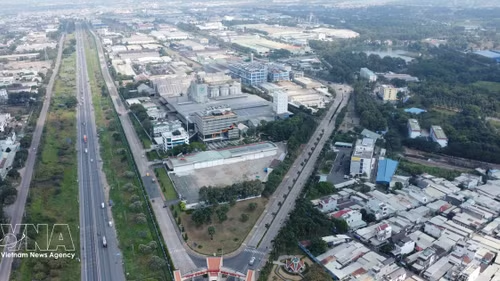
Bac Ninh has so far attracted more than 3,500 FDI projects from 46 countries and territories, with total registered capital reaching about 50 billion USD. Major international investors operating in the province include Samsung, Foxconn, Amkor and Goertek.
In May alone, the province secured more than 1 billion USD in newly registered and adjusted investment capital.
During the first five months of 2026, total investment attracted by the province exceeded 7.18 billion USD. The figure included 98 newly licensed domestic projects with combined registered capital of more than 138 trillion VND (5.24 billion USD) and 38 adjusted domestic projects with additional capital exceeding 6.1 trillion VND.
In the foreign-invested sector, it licensed 142 new FDI projects with total registered capital of over 466 million USD and approved capital increases for 114 existing projects worth more than 992 million USD.
This year, the province is continuing to fully implement commitments under international economic integration frameworks and FTAs. It is also promoting stable and sustainable export growth while increasing the share of high-value manufacturing and high-tech products in its export structure.
Local authorities are helping businesses improve their use of tariff preferences under FTAs and expand and diversify export markets.
Bac Ninh is also reviewing and improving its regulatory framework to create a more favourable environment for economic integration during the 2026–2030 period. The review covers policies and regulations related to investment, trade, import-export activities, logistics, environmental protection and market management.
The province plans to propose amendments to regulations that are no longer suitable and address policy bottlenecks that may affect business operations and international integration.
Thinh said supporting enterprises remains a key priority. Authorities are providing businesses with information on overseas markets, FTA commitments, rules of origin, technical standards, and environmental and labour requirements. Companies are also receiving guidance on adjusting production and business activities to meet international standards.
At the same time, Bac Ninh is implementing programmes to strengthen corporate governance, technical capabilities and brand development. Local enterprises are encouraged to join regional and global production, value and supply chains while improving their ability to prevent and handle risks and disputes in international trade and investment, particularly trade remedy cases.
The province is also expanding cooperation with international partners and localities that have strong potential in investment, trade and technology. Economic diplomacy activities are being promoted to support socio-economic development.
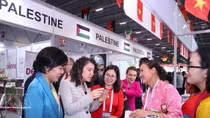
Efforts are underway to strengthen links between domestic businesses and multinational corporations as well as FDI enterprises operating in the province, helping build a stronger local supplier network. Bac Ninh is also organising regional and international trade fairs and exhibitions and encouraging local firms to participate in overseas events to promote products and explore new markets.
A notable event scheduled for late June is a conference between provincial leaders and Japanese businesses and investors. The event is expected to draw nearly 130 representatives from Japanese enterprises, investors and the Japan External Trade Organisation (JETRO).
The conference is expected to provide an opportunity for provincial authorities to listen to feedback from Japanese investors and promptly address difficulties encountered during project implementation and business operations. It will also help promote Bac Ninh’s investment environment and attract additional Japanese investment.