Hanoi (VNA) – As digital transformation reshapes every aspect of society, religious life is evolving alongside it, creating new opportunities to preserve and spread faith traditions while raising unprecedented challenges in safeguarding their sacred values, cultural identity and the right to freedom of belief in the digital age.
When sacred spaces move online
Digital transformation is changing not only how people work and communicate but also how they practice their faith. A Buddhist sermon can now attract tens of thousands of online viewers. A Protestant believer in a remote area can join a Bible study class via smartphone. Religious activities once closely tied to places of worship are increasingly taking place in cyberspace.
According to Do Huong, an expert from the Ho Chi Minh National Academy of Politics, when the Law on Belief and Religion was enacted in 2016, religious activities in Vietnam were largely limited to "religion on the internet," with online platforms serving mainly as channels for sharing information, announcing worship schedules and disseminating religious content.
The COVID-19 pandemic, however, became a catalyst for a rapid shift from "religion on the internet" to "online religion," and is now giving way to comprehensive digital transformation across the religious field.
This shifting is not merely about adopting new communication tools but is fundamentally changing the way faith is practised. Whereas religious activities were once closely associated with physical spaces, fixed schedules and direct participation by believers, many can now be conducted flexibly through digital platforms, transcending the limits of time and place.
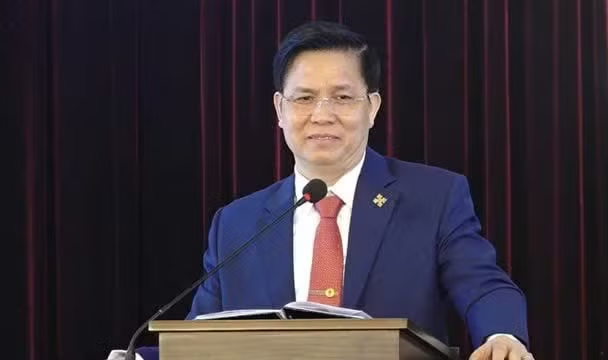
Pastor Nguyen Huu Mac, Head of the Evangelical Church of Vietnam (North), said digital technology has enabled pastoral work and support for believers to continue uninterrupted, especially during difficult periods such as the pandemic. Livestreaming, online learning and social media have allowed the Church to connect with believers more quickly, more broadly and more conveniently.
"Many believers living far away, as well as elderly or sick members, can still take part in worship services, prayer meetings and Bible study. However, technology is only a supporting tool; what matters most is genuine faith and meaningful human connection," he stressed.
Technology becomes "memory" of religious heritage
Beyond changing religious practice, digital transformation is creating new opportunities to preserve cultural, spiritual and religious values.

According to UNESCO Representative to Vietnam Jonathan Wallace Baker, digital technology has become an important tool for documenting, preserving and transmitting cultural expressions, knowledge systems and traditions associated with communities' spiritual life.
Traditions once passed down mainly through oral transmission and direct intergenerational practice can now be preserved through digital archives, audiovisual records and digitised collections, making them more accessible to young people, researchers and communities with limited access to cultural heritage, Baker said.
However, UNESCO emphasised that digitisation is not an end in itself. A ritual, belief or cultural space remains meaningful only when it continues to be practised and passed on by the community.
Because intangible cultural heritage constantly evolves, digital archives must be regularly updated to reflect its living nature rather than becoming outdated versions detached from reality, Baker noted. He also underlined the importance of establishing mechanisms to monitor digital data repositories.
Filling legal gaps with Law on Belief and Religion 2026
The rapid expansion of religious activities in cyberspace has also posed new demands on state management.
Huong noted that the 2016 Law on Belief and Religion contained no provisions specifically governing religious activities on the internet, social media or digital platforms, leaving authorities to rely largely on the Cybersecurity Law and general internet regulations, while religious activities in the digital environment continue to expand rapidly.
A major step forward came with the adoption of the 2026 Law on Belief and Religion, which will take effect on January 1, 2027.
For the first time, religious and belief-related activities in cyberspace are formally recognised in sector-specific legislation. The law clearly defines the responsibilities of agencies, organisations and individuals participating in religious activities online; specifies prohibited acts; and requires religious organisations to stipulate responsibilities for online activities in their charters.
Beyond regulating online religious activities, the law also mandates the development of a national database on belief and religion while promoting digital transformation in state management.
Experts said that codifying religious activities in cyberspace not only fills a legal gap but also reflects a more forward-looking governance approach suited to an increasingly digital society.
Preserving sacred values in AI era
While digital technologies offer significant opportunities, they also present growing risks.

According to Huong, when anyone can interpret religious teachings on social media, religious authority no longer rests solely with formally trained clergy. This creates risks of doctrinal distortion, the commercialisation of spirituality and the exploitation of religion for other purposes.
Cyberspace has also become a channel for spreading superstition, fraudulent religious organisations and misleading content that exploits religious beliefs to sow division and misinformation.
Most Venerable Thich Duc Thien, Vice President and General Secretary of the Executive Council of the Vietnam Buddhist Sangha (VBS), said the rapid development of the internet, artificial intelligence and digital platforms is fundamentally changing religious behaviour and expressions of faith.
He cited experiments in several countries where AI-powered robots have been used to explain religious doctrines or answer faith-related questions, saying such developments call for further legal research on the application of AI in religious activities.
Experts agree that the greatest challenge is not technology itself, but how it is governed to protect the right to freedom of belief while preventing the misuse of religion to undermine social order and traditional cultural values.
Ensuring technology serves humanity
Baker emphasised that digital transformation in cultural heritage is ultimately about people, governance and cultural responsibility rather than technology alone.
Countries should develop secure and sustainable cultural data ecosystems, protect communities' cultural rights and ownership, and ensure equal access to digital cultural resources, he said.
Drawing on practical experience in Vietnam, Pastor Nguyen Huu Mac said the most important task in the digital era is to use technology with responsibility, honesty and humanity.
"Technology may change rapidly, but moral values, compassion and love remain enduring," he said.
The Pastor urged believers to use digital platforms responsibly, promote kindness instead of division, respect the law, contribute positively to their communities and demonstrate their faith through ethical conduct in everyday life.
"When each acts with kindness and responsibility, the digital society will become a positive, safe and hopeful environment for future generations," he noted./.