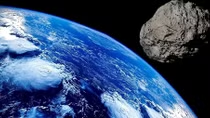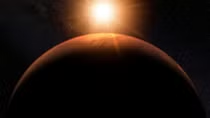
The two celestial bodies will be closest to Earth late Friday and early Saturday, in US Eastern Daylight Time, the US space agency revealed.
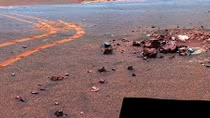
Because of the proximity and likeness of Mars to Earth, scientists have long speculated about the possibility of life on Mars, with more recent probes focusing on whether there was once water on the Red Planet, with findings by Mars rovers substantially adding weight to these claims.
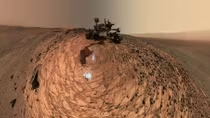
Previously, NASA’s Curiosity rover detected traces of methane on Mars, confirmed by the European Space Agency (ESA) Mars Express mission. The recently arrived to Mars Trace Gas Orbiter findings, however, showed no signs of the gas, puzzling scientists. This week, Curiosity again found methane at much higher levels then previously measured.
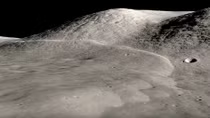
An unexpectedly massive patch of metal under the surface of the moon's South Pole-Aitken basin could be as big as the Hawaii Island, new research suggested.
Money moves are underway for NASA as the agency announced plans to open the International Space Station to more commercial interests and ditch its long-time ban on tourists in an effort to fund further missions.
NASA's Spitzer space telescope has enabled astronomers to gaze back to the early universe, 13 billion years in the past, and find some of the very first galaxies.
The section where the incident took place was designed to test experimental technologies related to refuelling spacecraft with methane using special techniques allowing for the preservation of fuel in tanks for lengthy periods of time.
The space agency previously announced that Christina Koch and Anne McClain would participate in a mission, completely carried out and led by women, on 29 March.
Only a handful of days after NASA gave up on the Mars rover Opportunity, sister rover Curiosity did something strange by suddenly placing herself into standby mode, alarming technicians on Earth.
NASA's Johnson Space Center has invited Russian scientists to jointly develop a system of forecasting radiation hazards during solar flares to protect crew of NASA' s prospective lunar-orbit space station Gateway, Mikhail Panasyuk, the head of the Skobeltsyn Institute of Nuclear Physics at Lomonosov Moscow State University, said.
Russia's Roscosmos, NASA, the European Space Agency, and China's National Space Administration have all made plans to send manned missions to the Red Planet sometime in the next few decades. However, important details about such missions, including the radiation astronauts will face as they travel through the solar system, remain to be calculated.