Spitzer Telescope Finds STRANGE BRIGHT Galaxies In Early Universe

NASA's Spitzer space telescope has enabled astronomers to gaze back to the early universe, 13 billion years in the past, and find some of the very first galaxies.

New observations from NASA's Spitzer infrared space telescope have offered a significant clue towards unlocking the mystery of how starlight initially appeared.

The Universe as we know it today, glittering with light, was something completely different at its outset: dark and murky.  We don’t yet know what started exciting the hydrogen with radiation and ionising it – but that is ultimately what caused the first ultraviolet light to shine.
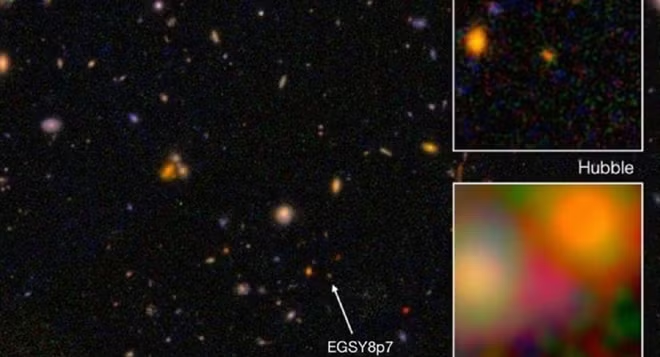
Photo: NASA.
Photo: NASA. 

The observations from NASA's Spitzer telescope have just provided a pretty significant clue about one of the most important cosmic events in history: the "Epoch of Reionization," as it spied unusually luminous galaxies, like tiny glowing dots in a sea of darkness.

To begin with, in the wake of the Big Bang, the Universe was a dark, 'primordial soup' on a cosmic scale, which was expanding rapidly, and as this happened, it cooled, causing protons and neutrons to start to combine into ionised hydrogen atoms. Around 240,000-300,000 years after the Big Bang, these hydrogen atoms attracted electrons, coalescing into neutral hydrogen.

Only after gravity started to pull together the first stars and galaxies did starlight appear.

One billion years after the Big Bang, the Universe was glittering with starlight.

The open question remained: how? With the neutral hydrogen in the Universe, it would have taken a huge amount of radiation to make light, and it's unclear just what might have produced such radiation, whether newborn stars could have been enough, or luminous galaxies…

Astronomer Stephane De Barros of the University of Geneva says the new findings could be a very significant clue, providing a possible answer to one of the biggest open questions in observational cosmology.

The research has been published in the Monthly Notices of the Royal Astronomical Society.

Spitzer spent hundreds of hours in a special observation run, perusing two regions of the night sky, tasked with attempting to find clues. Over 13 billion light-years away, it observed 135 galaxies that were very different from those nearer to us.

The galaxies in the early Universe are poor in heavy elements, which are forged in explosive processes and therefore weren't around in huge amounts until a few generations of stars had run their life cycle and died.

Instead, these galaxies are dominated by young, hot stars mostly made of hydrogen and helium, and are particularly bright in two infrared wavelengths that are produced through the interaction of ionising radiation and hydrogen and oxygen gases.

It was these galaxies that could likely have contributed to the Epoch of Reionisation.

"Our latest Spitzer result reveals how different these early galaxies are to those at later times and pinpoints our sample as a key set for providing insights into how galaxies so efficiently reionised the Universe,"  said astronomer Garth Illingworth of UC Santa Cruz.
Sputnik News

Other News

SK Group partners to build AI ecosystem in Vietnam

SK Group partners to build AI ecosystem in Vietnam

SK Innovation and SK Telecom signed MoUs with Nghe An province and the National Innovation Centre of Vietnam to advance AI ecosystem development and support the country’s long-term growth strategy.

Vietnam Research Excellence Fellowship for 2026-2030 approved

Vietnam Research Excellence Fellowship for 2026-2030 approved

Under the Vietnam Research Excellence Fellowship (VREF) for the 2026–2030 period, PhD students are identified as a core research force directly contributing to breakthroughs in sci-tech and innovation. Investing in top-tier doctoral candidates is more than workforce development, but a high-stakes strategic bet to forge a cohort of world-class scientists and technologists who can power Vietnam’s long-term economic ambitions.

Strategic tech must address practical challenges: PM

Strategic tech must address practical challenges: PM

Prime Minister Pham Minh Chinh on March 28 said strategic technologies must tackle Vietnam’s practical challenges, while chairing a meeting of the Government’s Steering Committee for science and technology, innovation, digital transformation, and Project 06.

Ho Chi Minh City sets sights on becoming semiconductor hub

Ho Chi Minh City sets sights on becoming semiconductor hub

Ho Chi Minh City is stepping up efforts to attract investment from global leading groups and companies in the fields of electronic components, semiconductors and chip manufacturing as it seeks to position itself as a leading semiconductor industry hub in both the region and the world. 

Ho Chi Minh City launches upgraded technology exchange platform

Ho Chi Minh City launches upgraded technology exchange platform

The upgraded platform represents a comprehensive shift from a simple information-sharing model to a managed online technology trading system, enabling monitoring and measurement of real transaction outcomes. It is built on three pillars, namely new tradable technology products, a modern digital platform, and an improved operational model.

AI – unmissable opportunity for Vietnam: Experts

AI – unmissable opportunity for Vietnam: Experts

AI also emerges as a key enabler for Vietnam's ambition to build financial and technology hubs. Applications can boost efficiency, automate workflows, cut costs, and sharpen data analytics, which are essential pillars of a modern financial system.

PM calls for accelerated space technology development in Vietnam

PM calls for accelerated space technology development in Vietnam

Vietnam aims by 2030 to achieve a mid-level position in space science and technology development within Southeast Asia, and after 2030 to build national capabilities to independently develop satellite technologies and apply space data to address global challenges and national security needs.

High-level forum advances Vietnam–US technological cooperation

High-level forum advances Vietnam–US technological cooperation

A high-level executive leadership forum focusing on strengthening Vietnam - US relations through technology cooperation was jointly held in Washington D.C. on March 11 by the Embassy of Vietnam in the US, the Weatherhead East Asian Institute of Columbia University, and the US -ASEAN Business Council (USABC). 

AI Law takes effect, anchors national governance framework

AI Law takes effect, anchors national governance framework

While many countries are still drafting policy blueprints or issuing non-binding guidance, Vietnam has moved ahead with a standalone Law on Artificial Intelligence (AI), effective from March 1, placing it among a select group of nations to adopt dedicated AI legislation at the parliamentary level. 

Vietnam International Defence Expo 2026 preparations move into high gear

Vietnam International Defence Expo 2026 preparations move into high gear

Vietnam International Defence Expo 2026, themed “Peace, Friendship, Cooperation and Development,” will be organised on a larger scale, featuring a wide array of weapons and technical equipment alongside product exhibitions, seminars and panel discussions, drills, live field demonstrations, and business networking activities.

Ministry requests urgent measures to counter UAVs threatening aviation safety

Ministry requests urgent measures to counter UAVs threatening aviation safety

Ministry of Construction requested the Ministry of National Defence, the Ministry of Public Security and provincial and municipal steering committees for counter-terrorism to strengthen the management, inspection and supervision of UAVs and other aerial devices, ensuring strict compliance with Decree No. 288/2025/ND-CP and relevant legal regulations.