Vietnam becomes vital player in global semiconductor value chain: Deputy PM

Vietnam is emerging as an important link in the global semiconductor value chain, particularly in chip packaging and testing, as the country continues to lay key foundations for developing its semiconductor industry, Deputy Prime Minister Nguyen Chi Dung has stated.

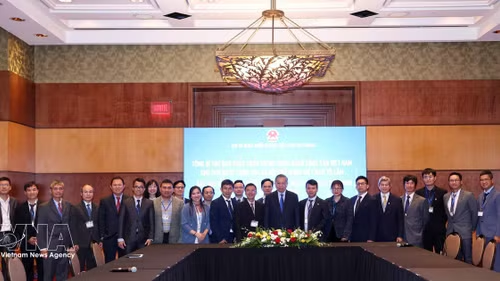
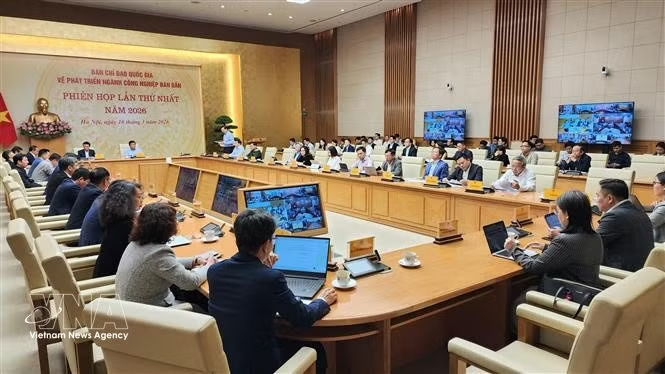
Deputy PM Dung, who is head of the National Steering Committee on Semiconductor Industry Development, made the remark while chairing the committee’s first meeting in 2026 in Hanoi on March 10.

He noted that ministries and sectors have actively implemented tasks under the national strategy for developing semiconductor industry and the programme on developing human resources for the industry, focusing on removing institutional bottlenecks, improving the legal framework and creating favourable conditions to attract investment.

According to the Deputy PM, Vietnam has consistently pursued a balanced approach to developing its semiconductor industry, ensuring harmonious interests and balancing relations with major partners while selectively attracting foreign investment and strengthening the capacity of domestic enterprises.
Vietnam becomes vital player in global semiconductor value chain: Deputy PM -0
Participants at the first meeting of the National Steering Committee on Semiconductor Industry Development in 2026 (Photo: VNA)

To date, many global technology giants have invested in and expanded their operations in the country, mainly in semiconductor assembly, packaging and testing.

Vietnamese companies have also gradually joined the global value chain by improving their capabilities in chip design, production and related services. Notably, a semiconductor chip manufacturing plant project developed by the Viettel Military Industry and Telecoms Group (Viettel) has already commenced.

However, the Deputy PM pointed out that the industry still faces significant challenges, including shortages of high-quality human resources, limited research and development capacity, infrastructure constraints and the relatively modest participation of domestic enterprises in the global value chain.

At the meeting, members of the Steering Committee reviewed the implementation of assigned tasks and discussed solutions to accelerate the effective and strong development of semiconductor ecosystem in Vietnam.

According to Permanent Deputy Minister of Science and Technology Vu Hai Quan, the national strategy for semiconductor development to 2030 with a vision to 2050 assigns 38 tasks and projects to ministries, sectors and localities. So far, 13 tasks have been completed while the remaining 25 are being implemented on schedule. The tasks are being performed in a coordinated manner with the participation of ministries, sectors, localities, organisations, businesses and research institutions.

Regarding the programme on developing human resources for semiconductor industry to 2030 with a vision to 2050, initial progress has been made. Currently, 166 universities in Vietnam provide training in disciplines related to semiconductor technology. The country now has around 7,000 chip design engineers, more than 6,000 engineers and over 10,000 technicians working in semiconductor packaging, testing and related industries.

Alongside improving the legal framework, the Ministry of Science and Technology is promoting domestic semiconductor production by supporting the implementation of a Vietnamese chip manufacturing plant, the establishment of a national semiconductor manufacturing centre, and chip production activities at companies such as Viettel and FPT. Meanwhile, cooperation with global technology firms such as Samsung, NVIDIA and Qualcomm, as well as investment promotion organisations in Japan, the Republic of Korea and Taiwan (China), has been strengthened.

Minister of Science and Technology Nguyen Manh Hung noted that the ministry will develop a policy communication plan to better promote the development of the industry.

Meanwhile, Deputy Minister of Finance Nguyen Duc Tam said that by March, foreign direct investment in the semiconductor sector had reached nearly 16 billion USD across 228 projects. Investors from the RoK accounted for the largest share at 45.3%, followed by the Netherlands with 25.8% and Singapore with 12%. Ho Chi Minh City leads the country with 53 projects.

In his concluding remarks, Deputy PM Dung said Vietnam is moving in the right direction and has started to establish essential foundations for developing its semiconductor industry.

He stressed the need to further develop a complete semiconductor ecosystem, expand high-quality human resources and boost research and development.

He requested ministries, localities, research institutions and enterprises to strengthen coordination, improve infrastructure and expand international cooperation to enable the country to participate more deeply in the global semiconductor value chain.
VNA

Other News

SK Group partners to build AI ecosystem in Vietnam

SK Group partners to build AI ecosystem in Vietnam

SK Innovation and SK Telecom signed MoUs with Nghe An province and the National Innovation Centre of Vietnam to advance AI ecosystem development and support the country’s long-term growth strategy.

Vietnam Research Excellence Fellowship for 2026-2030 approved

Vietnam Research Excellence Fellowship for 2026-2030 approved

Under the Vietnam Research Excellence Fellowship (VREF) for the 2026–2030 period, PhD students are identified as a core research force directly contributing to breakthroughs in sci-tech and innovation. Investing in top-tier doctoral candidates is more than workforce development, but a high-stakes strategic bet to forge a cohort of world-class scientists and technologists who can power Vietnam’s long-term economic ambitions.

Strategic tech must address practical challenges: PM

Strategic tech must address practical challenges: PM

Prime Minister Pham Minh Chinh on March 28 said strategic technologies must tackle Vietnam’s practical challenges, while chairing a meeting of the Government’s Steering Committee for science and technology, innovation, digital transformation, and Project 06.

Ho Chi Minh City sets sights on becoming semiconductor hub

Ho Chi Minh City sets sights on becoming semiconductor hub

Ho Chi Minh City is stepping up efforts to attract investment from global leading groups and companies in the fields of electronic components, semiconductors and chip manufacturing as it seeks to position itself as a leading semiconductor industry hub in both the region and the world. 

Ho Chi Minh City launches upgraded technology exchange platform

Ho Chi Minh City launches upgraded technology exchange platform

The upgraded platform represents a comprehensive shift from a simple information-sharing model to a managed online technology trading system, enabling monitoring and measurement of real transaction outcomes. It is built on three pillars, namely new tradable technology products, a modern digital platform, and an improved operational model.

AI – unmissable opportunity for Vietnam: Experts

AI – unmissable opportunity for Vietnam: Experts

AI also emerges as a key enabler for Vietnam's ambition to build financial and technology hubs. Applications can boost efficiency, automate workflows, cut costs, and sharpen data analytics, which are essential pillars of a modern financial system.

PM calls for accelerated space technology development in Vietnam

PM calls for accelerated space technology development in Vietnam

Vietnam aims by 2030 to achieve a mid-level position in space science and technology development within Southeast Asia, and after 2030 to build national capabilities to independently develop satellite technologies and apply space data to address global challenges and national security needs.

High-level forum advances Vietnam–US technological cooperation

High-level forum advances Vietnam–US technological cooperation

A high-level executive leadership forum focusing on strengthening Vietnam - US relations through technology cooperation was jointly held in Washington D.C. on March 11 by the Embassy of Vietnam in the US, the Weatherhead East Asian Institute of Columbia University, and the US -ASEAN Business Council (USABC). 

AI Law takes effect, anchors national governance framework

AI Law takes effect, anchors national governance framework

While many countries are still drafting policy blueprints or issuing non-binding guidance, Vietnam has moved ahead with a standalone Law on Artificial Intelligence (AI), effective from March 1, placing it among a select group of nations to adopt dedicated AI legislation at the parliamentary level. 

Vietnam International Defence Expo 2026 preparations move into high gear

Vietnam International Defence Expo 2026 preparations move into high gear

Vietnam International Defence Expo 2026, themed “Peace, Friendship, Cooperation and Development,” will be organised on a larger scale, featuring a wide array of weapons and technical equipment alongside product exhibitions, seminars and panel discussions, drills, live field demonstrations, and business networking activities.

Ministry requests urgent measures to counter UAVs threatening aviation safety

Ministry requests urgent measures to counter UAVs threatening aviation safety

Ministry of Construction requested the Ministry of National Defence, the Ministry of Public Security and provincial and municipal steering committees for counter-terrorism to strengthen the management, inspection and supervision of UAVs and other aerial devices, ensuring strict compliance with Decree No. 288/2025/ND-CP and relevant legal regulations.

International conference spotlights advanced microscopy in life sciences, materials

International conference spotlights advanced microscopy in life sciences, materials

The microscopy user community in Vietnam remains fragmented, lacking a common platform for sharing technical expertise, research experience and collaboration opportunities. This limited connectivity has, to some extent, curtailed the full potential of microscopy technologies in advancing scientific progress and industrial applications at home and abroad.