Politburo's Resolution 57 sets course for new development paradigm

As the digital economy and knowledge-based sectors expand, institutions must evolve accordingly, regulating not only traditional economic relationships but also new resources such as data and intellectual capital.

Politburo's Resolution 57 sets course for new development paradigm -0
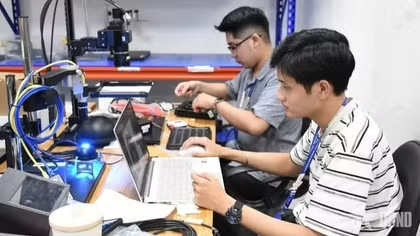
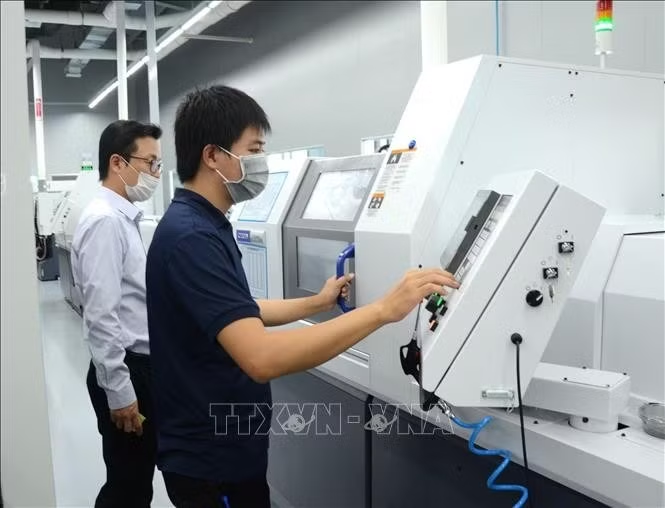
Operation of a modern machine learning system at Da Nang Hi-Tech Park. (Illustrative photo: VNA)

After a period of implementation, Resolution No. 57-NQ/TW of the Politburo is increasingly seen as a catalyst for reshaping Vietnam’s development model, exposing pressing requirements to strengthen implementation capacity, upgrade governance mechanisms and reposition social sciences as a pillar of evidence-based policymaking in a new growth cycle.

Mounting pressure for transformation

Reviewing the current growth model, Assoc. Prof. Dr. Tran Dinh Thien, former Director of the Vietnam Institute of Economics, said sustaining high growth over the long term is an ambitious objective that cannot be achieved through incremental adjustments to conventional policy tools. Instead, it requires a fundamental shift in development mindset.

He noted that today’s economic landscape bears little resemblance to the past. Rapid technological advances and digital transformation are restructuring production, governance and social organisation at an unprecedented pace. In this context, clinging to established trajectories will not generate sufficient momentum to meet future targets.

Resolution 57, therefore, positions digital transformation and innovation not as supporting measures, but as core components of the development model itself. Realising this vision, however, requires a comprehensive reassessment of the capacity of all actors, from state agencies and enterprises to research institutions, to determine priority areas for concentrated investment.

Yet, translating ambition into reality remains complex. Dr Thien underscored that implementation capacity and organisational effectiveness are the decisive factors. Without clearly defined priorities and disciplined resource allocation to key sectors, the transition risks losing speed and coherence.

Against this backdrop, he argued, the social sciences must move beyond commentary to play a more strategic role. By analysing emerging challenges, anticipating risks and offering policy options, they can help lay the intellectual groundwork for a renewed development strategy suited to a rapidly evolving environment.

Institutions as the critical enabler

Prof. Vo Khanh Vinh, former Vice President of the Vietnam Academy of Social Sciences (VASS), stressed that the success of Resolution 57 hinges not only on technology or funding, but fundamentally on institutional reform.

As the digital economy and knowledge-based sectors expand, institutions must evolve accordingly, regulating not only traditional economic relationships but also new resources such as data and intellectual capital.

At VASS, implementation has included organisational restructuring, revisions to internal governance regulations, improvements in policy advisory procedures and the development of scientific management mechanisms to strengthen research performance. These measures are intended to align institutional capacity with the Resolution’s higher standards.

Nonetheless, bottlenecks persist. Some assigned tasks have progressed more slowly than planned, certain research outputs and policy advisory reports have yet to meet rising expectations, digital transformation efforts remain uneven, and research infrastructure continues to show disparities.

Prof. Vinh emphasised the need to shift from an administrative management mindset to a development-oriented governance approach, with the State serving as an enabler that cultivates a supportive ecosystem for science, technology and innovation.

He also called for stronger forecasting capabilities and more robust policy design, alongside expanded programmes to review practical experience, conduct large-scale surveys and build comprehensive social science databases. These steps are essential to ensure that strategic decisions are grounded in reliable evidence and aligned with on-the-ground realities.

Initial outcomes suggest that Resolution 57 is gradually being embedded into practice. However, the experience to date underscores the necessity of continued institutional refinement, capacity enhancement and fresh thinking to secure sustained growth in the years ahead.

Ultimately, the Resolution represents more than a technical recalibration. It signals a deeper transformation in development philosophy and methodology – one in which the social sciences assume a central role in shaping the policy architecture for Vietnam’s next phase of growth.
VNA

Other News

SK Group partners to build AI ecosystem in Vietnam

SK Group partners to build AI ecosystem in Vietnam

SK Innovation and SK Telecom signed MoUs with Nghe An province and the National Innovation Centre of Vietnam to advance AI ecosystem development and support the country’s long-term growth strategy.

Vietnam Research Excellence Fellowship for 2026-2030 approved

Vietnam Research Excellence Fellowship for 2026-2030 approved

Under the Vietnam Research Excellence Fellowship (VREF) for the 2026–2030 period, PhD students are identified as a core research force directly contributing to breakthroughs in sci-tech and innovation. Investing in top-tier doctoral candidates is more than workforce development, but a high-stakes strategic bet to forge a cohort of world-class scientists and technologists who can power Vietnam’s long-term economic ambitions.

Strategic tech must address practical challenges: PM

Strategic tech must address practical challenges: PM

Prime Minister Pham Minh Chinh on March 28 said strategic technologies must tackle Vietnam’s practical challenges, while chairing a meeting of the Government’s Steering Committee for science and technology, innovation, digital transformation, and Project 06.

Ho Chi Minh City sets sights on becoming semiconductor hub

Ho Chi Minh City sets sights on becoming semiconductor hub

Ho Chi Minh City is stepping up efforts to attract investment from global leading groups and companies in the fields of electronic components, semiconductors and chip manufacturing as it seeks to position itself as a leading semiconductor industry hub in both the region and the world. 

Ho Chi Minh City launches upgraded technology exchange platform

Ho Chi Minh City launches upgraded technology exchange platform

The upgraded platform represents a comprehensive shift from a simple information-sharing model to a managed online technology trading system, enabling monitoring and measurement of real transaction outcomes. It is built on three pillars, namely new tradable technology products, a modern digital platform, and an improved operational model.

AI – unmissable opportunity for Vietnam: Experts

AI – unmissable opportunity for Vietnam: Experts

AI also emerges as a key enabler for Vietnam's ambition to build financial and technology hubs. Applications can boost efficiency, automate workflows, cut costs, and sharpen data analytics, which are essential pillars of a modern financial system.

PM calls for accelerated space technology development in Vietnam

PM calls for accelerated space technology development in Vietnam

Vietnam aims by 2030 to achieve a mid-level position in space science and technology development within Southeast Asia, and after 2030 to build national capabilities to independently develop satellite technologies and apply space data to address global challenges and national security needs.

High-level forum advances Vietnam–US technological cooperation

High-level forum advances Vietnam–US technological cooperation

A high-level executive leadership forum focusing on strengthening Vietnam - US relations through technology cooperation was jointly held in Washington D.C. on March 11 by the Embassy of Vietnam in the US, the Weatherhead East Asian Institute of Columbia University, and the US -ASEAN Business Council (USABC). 

AI Law takes effect, anchors national governance framework

AI Law takes effect, anchors national governance framework

While many countries are still drafting policy blueprints or issuing non-binding guidance, Vietnam has moved ahead with a standalone Law on Artificial Intelligence (AI), effective from March 1, placing it among a select group of nations to adopt dedicated AI legislation at the parliamentary level. 

Vietnam International Defence Expo 2026 preparations move into high gear

Vietnam International Defence Expo 2026 preparations move into high gear

Vietnam International Defence Expo 2026, themed “Peace, Friendship, Cooperation and Development,” will be organised on a larger scale, featuring a wide array of weapons and technical equipment alongside product exhibitions, seminars and panel discussions, drills, live field demonstrations, and business networking activities.

Ministry requests urgent measures to counter UAVs threatening aviation safety

Ministry requests urgent measures to counter UAVs threatening aviation safety

Ministry of Construction requested the Ministry of National Defence, the Ministry of Public Security and provincial and municipal steering committees for counter-terrorism to strengthen the management, inspection and supervision of UAVs and other aerial devices, ensuring strict compliance with Decree No. 288/2025/ND-CP and relevant legal regulations.

International conference spotlights advanced microscopy in life sciences, materials

International conference spotlights advanced microscopy in life sciences, materials

The microscopy user community in Vietnam remains fragmented, lacking a common platform for sharing technical expertise, research experience and collaboration opportunities. This limited connectivity has, to some extent, curtailed the full potential of microscopy technologies in advancing scientific progress and industrial applications at home and abroad.