AI Law takes effect, anchors national governance framework

While many countries are still drafting policy blueprints or issuing non-binding guidance, Vietnam has moved ahead with a standalone Law on Artificial Intelligence (AI), effective from March 1, placing it among a select group of nations to adopt dedicated AI legislation at the parliamentary level. 

Risk-based, human-centred governance

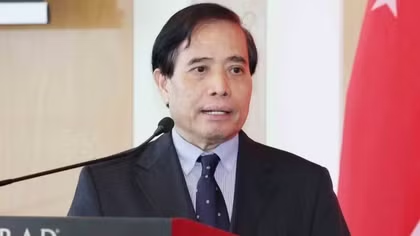
Minister of Science and Technology Nguyen Manh Hung emphasised that the law is grounded in a clear principle: AI serves as a support tool, and ultimate responsibility in critical social matters must remain with humans. This human-in-command approach shaped the legislative process. 

The law introduces a three-tier risk classification system for AI applications – high, medium and low. Providers must assess and categorise their systems before deployment, in line with forthcoming technical guidance. 

High-risk systems are subject to stricter safeguards. Developers must incorporate mechanisms enabling human oversight and intervention, while maintaining comprehensive technical documentation and operational logs for compliance reviews and post-market inspections. Users are required to adhere strictly to operational protocols and safety measures, and are barred from unauthorised modifications. Oversight and inspection mechanisms will be proportionate to the risk level. 

To support enforcement, the Ministry of Science and Technology (MoST) is preparing a Prime Ministerial decision to issue an official list of high-risk AI systems. 

Five criteria will guide the identification of such systems: impact on human rights and legitimate interests; implications for safety, security and public welfare; sector and usage context; degree of automation and extent of human control; and scale of application and potential impact. The draft list groups high-risk systems into four broad categories, covering those affecting human rights, public safety and security, essential public-interest sectors, and systems with wide-reaching or difficult-to-remedy consequences. 

AI Law takes effect, anchors national governance framework -0
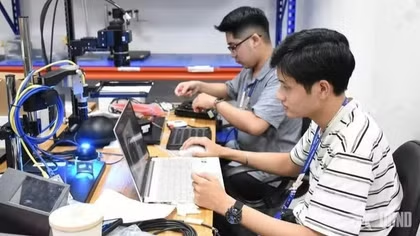
Illustrative image.


Transparency and safeguards for AI-generated content

The legislation also tightens transparency requirements. AI systems that interact directly with users must be clearly identifiable as such, except where otherwise stipulated by law. 

Providers are required to embed machine-readable markers in AI-generated audio, images and videos in accordance with Government regulations. Content that replicates a real person’s voice or appearance, or simulates real-world events, must carry clear and visible labels distinguishing it from authentic material. 

A dedicated chapter focuses on infrastructure development and safeguarding national AI sovereignty. Organisations and individuals engaged in research and mastery of core AI technologies will be eligible for preferential policies and targeted support. 

AI enterprises are entitled to the highest level of incentives under current regulations, including improved access to infrastructure, datasets and regulatory sandbox environments to facilitate research, production and commercialisation. Small and medium-sized enterprises will receive assistance in funding, training and market access. Domestically developed AI products and services will be prioritised in public procurement under existing bidding laws. 

The law further mandates the development of AI talent through integrated education pathways. Foundational AI knowledge, computational thinking, digital skills and technology ethics will be embedded in compulsory curricula, while vocational and higher education institutions are encouraged to expand AI and data science programmes and deepen partnerships with businesses, research bodies and international organisations. 

Decision No. 367/QD-TTg, dated March 3, 2026 approves the implementation plan for the law, setting out detailed tasks, timelines and responsibilities to ensure timely, coordinated and effective enforcement, while raising awareness and strengthening accountability across ministries and local authorities. 

Seven key task groups are outlined, including communications and training on the law and its guiding documents from 2026 onward; a review of implementing provisions under the Law on Digital Technology Industry; and a comprehensive audit of related legal instruments, with findings to be consolidated by the MoST and reported to the Prime Minister. 

In the 2026–2027 period, MoST will establish a national AI development fund and build AI innovation clusters that combine concentrated physical hubs with interconnected digital networks. 

Taken together, the new AI Law and its implementation roadmap not only complete Vietnam’s legal architecture for AI, but also lay a structured foundation for risk management, innovation and ecosystem development, aiming to ensure coherent and effective enforcement in the years ahead.

VNA

Other News

SK Group partners to build AI ecosystem in Vietnam

SK Group partners to build AI ecosystem in Vietnam

SK Innovation and SK Telecom signed MoUs with Nghe An province and the National Innovation Centre of Vietnam to advance AI ecosystem development and support the country’s long-term growth strategy.

Vietnam Research Excellence Fellowship for 2026-2030 approved

Vietnam Research Excellence Fellowship for 2026-2030 approved

Under the Vietnam Research Excellence Fellowship (VREF) for the 2026–2030 period, PhD students are identified as a core research force directly contributing to breakthroughs in sci-tech and innovation. Investing in top-tier doctoral candidates is more than workforce development, but a high-stakes strategic bet to forge a cohort of world-class scientists and technologists who can power Vietnam’s long-term economic ambitions.

Strategic tech must address practical challenges: PM

Strategic tech must address practical challenges: PM

Prime Minister Pham Minh Chinh on March 28 said strategic technologies must tackle Vietnam’s practical challenges, while chairing a meeting of the Government’s Steering Committee for science and technology, innovation, digital transformation, and Project 06.

Ho Chi Minh City sets sights on becoming semiconductor hub

Ho Chi Minh City sets sights on becoming semiconductor hub

Ho Chi Minh City is stepping up efforts to attract investment from global leading groups and companies in the fields of electronic components, semiconductors and chip manufacturing as it seeks to position itself as a leading semiconductor industry hub in both the region and the world. 

Ho Chi Minh City launches upgraded technology exchange platform

Ho Chi Minh City launches upgraded technology exchange platform

The upgraded platform represents a comprehensive shift from a simple information-sharing model to a managed online technology trading system, enabling monitoring and measurement of real transaction outcomes. It is built on three pillars, namely new tradable technology products, a modern digital platform, and an improved operational model.

AI – unmissable opportunity for Vietnam: Experts

AI – unmissable opportunity for Vietnam: Experts

AI also emerges as a key enabler for Vietnam's ambition to build financial and technology hubs. Applications can boost efficiency, automate workflows, cut costs, and sharpen data analytics, which are essential pillars of a modern financial system.

PM calls for accelerated space technology development in Vietnam

PM calls for accelerated space technology development in Vietnam

Vietnam aims by 2030 to achieve a mid-level position in space science and technology development within Southeast Asia, and after 2030 to build national capabilities to independently develop satellite technologies and apply space data to address global challenges and national security needs.

High-level forum advances Vietnam–US technological cooperation

High-level forum advances Vietnam–US technological cooperation

A high-level executive leadership forum focusing on strengthening Vietnam - US relations through technology cooperation was jointly held in Washington D.C. on March 11 by the Embassy of Vietnam in the US, the Weatherhead East Asian Institute of Columbia University, and the US -ASEAN Business Council (USABC). 

Vietnam International Defence Expo 2026 preparations move into high gear

Vietnam International Defence Expo 2026 preparations move into high gear

Vietnam International Defence Expo 2026, themed “Peace, Friendship, Cooperation and Development,” will be organised on a larger scale, featuring a wide array of weapons and technical equipment alongside product exhibitions, seminars and panel discussions, drills, live field demonstrations, and business networking activities.

Ministry requests urgent measures to counter UAVs threatening aviation safety

Ministry requests urgent measures to counter UAVs threatening aviation safety

Ministry of Construction requested the Ministry of National Defence, the Ministry of Public Security and provincial and municipal steering committees for counter-terrorism to strengthen the management, inspection and supervision of UAVs and other aerial devices, ensuring strict compliance with Decree No. 288/2025/ND-CP and relevant legal regulations.

International conference spotlights advanced microscopy in life sciences, materials

International conference spotlights advanced microscopy in life sciences, materials

The microscopy user community in Vietnam remains fragmented, lacking a common platform for sharing technical expertise, research experience and collaboration opportunities. This limited connectivity has, to some extent, curtailed the full potential of microscopy technologies in advancing scientific progress and industrial applications at home and abroad.