Ho Chi Minh City sets sights on becoming semiconductor hub

Ho Chi Minh City is stepping up efforts to attract investment from global leading groups and companies in the fields of electronic components, semiconductors and chip manufacturing as it seeks to position itself as a leading semiconductor industry hub in both the region and the world. 

Under Plan No. 98, issued on March 16, the city is implementing Vietnam’s semiconductor industry development strategy alongside a national workforce development programme for 2026. The initiative moves beyond investment attraction, focusing on building a fully integrated ecosystem covering research and development (R&D), human resource training, innovation and start-up incubation in microchip and semiconductor technologies. 

A central component of the plan is expanding cooperation with global technology leaders such as AMD, NVIDIA and Qualcomm. These partnerships are expected to support technology transfer, strengthen chip design capabilities and help the city move further up global semiconductor value chains. 

Ho Chi Minh City also aims to attract at least four foreign direct investment (FDI) projects in the semiconductor sector, prioritising environmentally sustainable, high value-added ventures with strong economic spillover effects. To support these ambitions, the city plans to establish an international-standard semiconductor research centre, expand university-based microchip laboratories and develop a national shared laboratory at Vietnam National University, Ho Chi Minh City. The high-performance computing centre at Quang Trung Software City will be upgraded to serve chip design and artificial intelligence applications, while Saigon Hi-Tech Park will be expanded into a high-tech urban area anchored by a large-scale semiconductor industrial complex. 
Ho Chi Minh City sets sights on becoming semiconductor hub -0
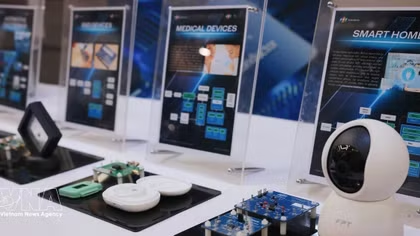
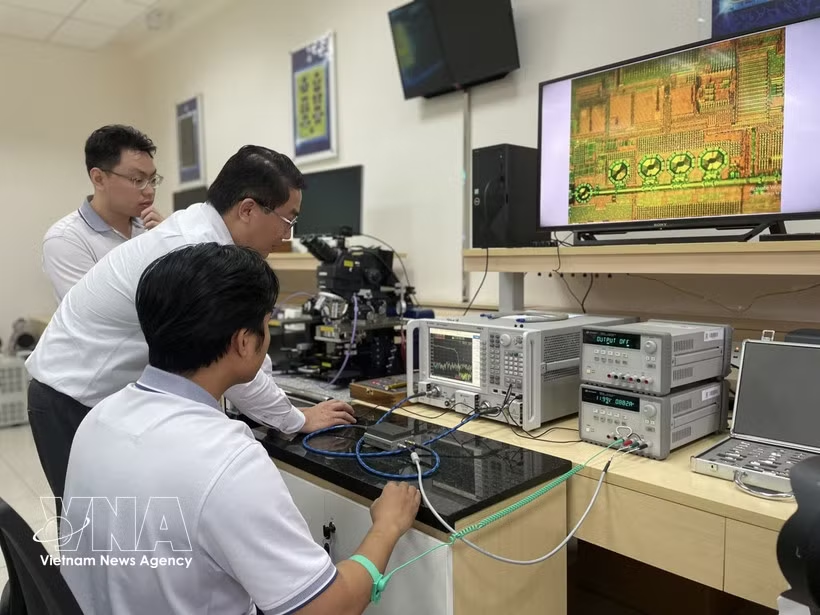
The High-Frequency Systems and Microchip Laboratory at Ho Chi Minh City University of Technology, Vietnam National University, Ho Chi Minh City. (Photo: VNA)

Meanwhile, the proposed “Science and Technology City – Northern Ho Chi Minh City”, spanning roughly 1,000 ha, is expected to provide long-term infrastructure for the development of this strategic high-tech sector. 

Recognising human resources as a decisive factor, the city plans to train 1,500 specialised semiconductor professionals in 2026 and enroll around 3,300 additional university students in related fields. At least 300 workers will benefit from reskilling and upskilling programmes to meet the industry's rising demand. A 5-million-USD microchip design human resource development fund will also be launched to finance scholarships, research activities and the attraction of domestic and international experts. 

Vice Chairman of the municipal People’s Committee Nguyen Manh Cuong said the city’s semiconductor ambitions are built on three pillars: policy, technology and human resources. 

In investment attraction, Marvell Technology has opened two new offices, making Ho Chi Minh City its third-largest global R&D hub, while Dutch firm BE Semiconductor Industries has secured approval to increase its investment by 42 million USD. 

On the domestic front, CT Group has begun phase two of its chip packaging and testing facility with a targeted annual capacity of 100 million chips, while VNChip has launched a research laboratory meeting Cadence Design Systems standards. 

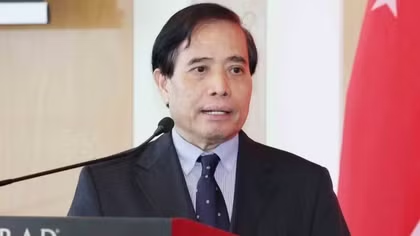
Prof. Dr Vo Xuan Vinh, Dean of the Institute of Business Research at the University of Economics Ho Chi Minh City, suggested the city could draw lessons from established global technology hubs when designing policies to attract major investors. 

He pointed to Yokneam Illit in Israel, often described as a “start-up village,” as a successful model driven by strong incentives, including tax reductions during the first decade of operation and government equity participation of at least 20%. The city’s high-tech zone now hosts hundreds of technology firms generating billions of US dollars in annual export revenue. 

In Asia, cities in the Republic of Korea such as Yongin and Pyeongtaek have established a 20-billion-USD support fund for semiconductor enterprises through tax incentives and land-rent reductions for both domestic and foreign investors. In the US, states including Kansas, Arizona and Texas allocate between 300 million USD and 400 million USD each year to support technology start-ups. 

According to Vinh, a sustainable semiconductor industry must extend beyond design, packaging and testing to include suppliers, input materials, logistics, finance and economic governance. Development strategies should therefore focus on building a fully integrated ecosystem combining technological capacity with strong economic and financial foundations. 

He added that semiconductor development should not be limited to workforce training for foreign firms or academic cooperation alone. Instead, the city needs a long-term, multi-stakeholder strategy, particularly involving financial and economic sectors, to mobilise investment capital. Strong linkages between scientific research, innovation, universities and R&D centres, supported by capable financial and business expertise, will be essential to sustaining long-term growth.

VNA

Other News

SK Group partners to build AI ecosystem in Vietnam

SK Group partners to build AI ecosystem in Vietnam

SK Innovation and SK Telecom signed MoUs with Nghe An province and the National Innovation Centre of Vietnam to advance AI ecosystem development and support the country’s long-term growth strategy.

Vietnam Research Excellence Fellowship for 2026-2030 approved

Vietnam Research Excellence Fellowship for 2026-2030 approved

Under the Vietnam Research Excellence Fellowship (VREF) for the 2026–2030 period, PhD students are identified as a core research force directly contributing to breakthroughs in sci-tech and innovation. Investing in top-tier doctoral candidates is more than workforce development, but a high-stakes strategic bet to forge a cohort of world-class scientists and technologists who can power Vietnam’s long-term economic ambitions.

Strategic tech must address practical challenges: PM

Strategic tech must address practical challenges: PM

Prime Minister Pham Minh Chinh on March 28 said strategic technologies must tackle Vietnam’s practical challenges, while chairing a meeting of the Government’s Steering Committee for science and technology, innovation, digital transformation, and Project 06.

Ho Chi Minh City launches upgraded technology exchange platform

Ho Chi Minh City launches upgraded technology exchange platform

The upgraded platform represents a comprehensive shift from a simple information-sharing model to a managed online technology trading system, enabling monitoring and measurement of real transaction outcomes. It is built on three pillars, namely new tradable technology products, a modern digital platform, and an improved operational model.

AI – unmissable opportunity for Vietnam: Experts

AI – unmissable opportunity for Vietnam: Experts

AI also emerges as a key enabler for Vietnam's ambition to build financial and technology hubs. Applications can boost efficiency, automate workflows, cut costs, and sharpen data analytics, which are essential pillars of a modern financial system.

PM calls for accelerated space technology development in Vietnam

PM calls for accelerated space technology development in Vietnam

Vietnam aims by 2030 to achieve a mid-level position in space science and technology development within Southeast Asia, and after 2030 to build national capabilities to independently develop satellite technologies and apply space data to address global challenges and national security needs.

High-level forum advances Vietnam–US technological cooperation

High-level forum advances Vietnam–US technological cooperation

A high-level executive leadership forum focusing on strengthening Vietnam - US relations through technology cooperation was jointly held in Washington D.C. on March 11 by the Embassy of Vietnam in the US, the Weatherhead East Asian Institute of Columbia University, and the US -ASEAN Business Council (USABC). 

AI Law takes effect, anchors national governance framework

AI Law takes effect, anchors national governance framework

While many countries are still drafting policy blueprints or issuing non-binding guidance, Vietnam has moved ahead with a standalone Law on Artificial Intelligence (AI), effective from March 1, placing it among a select group of nations to adopt dedicated AI legislation at the parliamentary level. 

Vietnam International Defence Expo 2026 preparations move into high gear

Vietnam International Defence Expo 2026 preparations move into high gear

Vietnam International Defence Expo 2026, themed “Peace, Friendship, Cooperation and Development,” will be organised on a larger scale, featuring a wide array of weapons and technical equipment alongside product exhibitions, seminars and panel discussions, drills, live field demonstrations, and business networking activities.

Ministry requests urgent measures to counter UAVs threatening aviation safety

Ministry requests urgent measures to counter UAVs threatening aviation safety

Ministry of Construction requested the Ministry of National Defence, the Ministry of Public Security and provincial and municipal steering committees for counter-terrorism to strengthen the management, inspection and supervision of UAVs and other aerial devices, ensuring strict compliance with Decree No. 288/2025/ND-CP and relevant legal regulations.

International conference spotlights advanced microscopy in life sciences, materials

International conference spotlights advanced microscopy in life sciences, materials

The microscopy user community in Vietnam remains fragmented, lacking a common platform for sharing technical expertise, research experience and collaboration opportunities. This limited connectivity has, to some extent, curtailed the full potential of microscopy technologies in advancing scientific progress and industrial applications at home and abroad.