Backup infrastructure keeps Vietnam’s Internet stable after undersea cable incident

Vietnam has still maintained stable Internet connectivity amid a malfunction on the AAE-1 undersea cable, thanks to its backup infrastructure and the Vietnam–Singapore Terrestrial Cable Network (VSTN), according to the Vietnam Telecommunications Authority under the Ministry of Science and Technology.

The incident occurred during the Lunar New Year (Tet) holiday. The affected capacity accounted for nearly 10% of Vietnam’s total international Internet bandwidth, equivalent to about 45,000 Gbps. However, this reduction was considered relatively minor in the overall context and insufficient to create an imbalance between international bandwidth supply and demand.

Immediately after the disruption was detected, telecom operators activated contingency plans, rerouting traffic to other undersea cables and alternative connection routes. Coordination between domestic carriers and international partners was carried out promptly, and no localised service interruptions were reported.

Backup infrastructure keeps Vietnam’s Internet stable after undersea cable incident -0
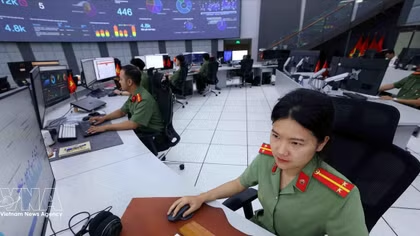
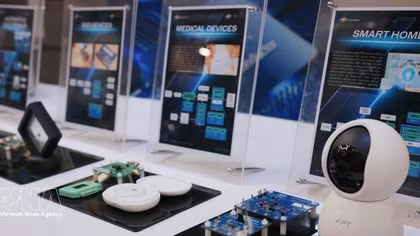
Illustrative image (Photo: VNA)

Following the incident, FPT Telecom said its total international bandwidth at peak times remained secure and within backup capacity. MobiFone reported that its average international channel load stood at 56%, rising to 64.2% when the AAE-1 cable encountered problems—still within safe limits.

Viettel and VNPT also confirmed that their international connectivity capacity has been sufficiently upgraded and backed up, making the capacity loss from AAE-1 negligible compared to the overall capacity of remaining routes.

According to the Telecommunications Authority, Vietnam has steadily expanded its international connectivity infrastructure in recent years. Internet access to the global network relies mainly on three channels —undersea fiber-optic cables, terrestrial cables and satellite Internet— with undersea systems playing a dominant role.

Vietnam currently operates six undersea cables, namely AAG, IA, AAE-1, APG, ADC and SJC2. The newly launched ADC and SJC2 have boosted outbound capacity, while AAE-1, in service since July 2017, links Vietnam to Europe and the Middle East and provides backup capacity toward Hong Kong (China) and Singapore.

To reduce reliance on undersea cables, in 2025, Vietnam, for the first time, took full control of the Vietnam–Singapore Terrestrial Cable Network (VSTN), which has a designed capacity of 4 Tbps and scalability up to 12 Tbps. The route enables end-to-end operational control, helping mitigate risks of international Internet disruptions.

Vietnam has also agreed to pilot satellite Internet services. In mid-February, after completing relevant procedures, Starlink was officially licensed, though its rollout schedule and pricing for the domestic market have yet to be announced.

VNA

Other News

AI offers both opportunities, challenges for Vietnam's growth

AI offers both opportunities, challenges for Vietnam's growth

Dr. Ho Duc Thang, a full-time member of the National Assembly’s Committee for Cultural and Educational, said productivity is the key to sustaining double-digit economic growth, and AI has greater potential to improve productivity than any previous technology.

Top leader unveils people-centred vision for new development model

Top leader unveils people-centred vision for new development model

Vietnam's growth model, long fueled by low-cost labour, resource extraction, contract manufacturing, expanded investment, and capital accumulation, has run out of road. The country now needs a sweeping reform agenda to shift from extensive growth to a model driven by productivity, knowledge, science and technology, innovation, and digital transformation.

First national semiconductor chip prototyping support centre makes debut

First national semiconductor chip prototyping support centre makes debut

Vietnam's semiconductor ecosystem now comprises around 60 chip design companies, some 7,000 chip design engineers and 166 universities offering semiconductor-related training programmes. Initial registrations from 12 organisations indicate demand for the prototyping of approximately 30,000 chips.

Vietnam targets at least 10 large strategic technology firms by 2030

Vietnam targets at least 10 large strategic technology firms by 2030

Deputy Prime Minister Ho Quoc Dung has signed a decision approving a plan to develop large domestic strategic technology enterprises in the 2026–2030 period, aimed at advancing digital infrastructure, digital human resources, digital data, strategic technologies and cybersecurity.

Protecting users crucial in building digital trust: Experts

Protecting users crucial in building digital trust: Experts

In Vietnam, digital transformation in the finance and banking sector is accelerating cashless payments, expanding access to financial services, improving market transparency and supporting economic growth and macroeconomic management.

Fostering skilled workforce for innovation era: experts

Fostering skilled workforce for innovation era: experts

Experts said close coordination among State management agencies, research institutes, universities, and businesses will improve training quality and serve the dual goals of quality education and practical research application.

Startup forum bridges Silicon Valley and local innovation ecosystem

Startup forum bridges Silicon Valley and local innovation ecosystem

The University of Economics Ho Chi Minh City (UEH), Saigon Asset Management (SAM), and Plug and Play Tech Centre co-hosted the “From Vietnam to Silicon Valley” forum, exploring AI innovation, venture capital, and pathways to integrate Vietnam’s startup ecosystem with Silicon Valley and global markets.

Experts call for stronger action against fake news online

Experts call for stronger action against fake news online

Experts have warned that fake news, misinformation and harmful online content are increasingly shaping public perceptions, particularly among young people, and stressed the need for stronger legal safeguards, technology tools and wider dissemination of credible information to tackle the problem effectively.

Protecting digital future in post-quantum, AI era

Protecting digital future in post-quantum, AI era

Participants highlighted the importance of building a proactive, synchronised and sustainable national cybersecurity ecosystem through closer cooperation among regulators, technology firms, research institutions and cybersecurity experts.