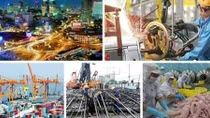
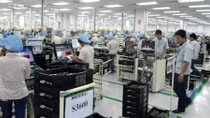
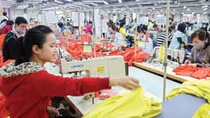
The Vietnamese economy is forecast to expand at 5.5% in the first quarter of the year as manufacturing and trade regain momentum, according to the United Overseas Bank Limited (UOB).
PSNews - Recently, the Ministry of Planning and Investment’s National Centre for Socio-Economic Information and Forecast (NCIF) in collaboration with the United Nations Development Programme (UNDP) held the second Vietnam Economic Pulse 2022 Forum, themed “Extending Economic Recovery – Drivers for Growth”.
Vietnam’s digital economy will likely reach 52 billion USD in value by 2025, according to the e-Conomy SEA 2019 report by Google, Temasek and Bain & Company.
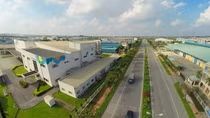
Vietnam has emerged as a popular destination for industrial property projects as increased labour costs, trade disputes and COVID-19 prompt global manufacturers to vary their supply chains throughout Asia, according to CBRE.
A conference discussing measures to fully tap into opportunities brought about by the EU-Vietnam Free Trade Agreement (EVFTA) and support Vietnamese enterprises in promoting post-pandemic development was held in Hanoi on June 29.
Developing Asia will barely grow in 2020 as containment measures to address the coronavirus disease (COVID-19) pandemic hamper economic activity and weaken external demand, according to a new set of forecasts from the Asian Development Bank (ADB).
The Vietnam Manufacturing Purchasing Managers' Index (PMI) fell sharply to 41.9 in March from 49.0 in February, a survey by IHS Markit and Nikkei released on April 1 showed.
International media outlets have highlighted Vietnam’s thriving economy which is among the fastest-growing in Southeast Asia in 2019 amid the global economic slowdown.
Viet Nam’s economy is forecast to maintain healthy growth in 2019 and 2020 at 6.8% and 6.7%, respectively, after growing robustly at 7.1% last year, the Asian Development Bank (ADB) said in an update of its flagship annual economic publication launched today.
The Ministry of Planning and Investment (MPI) proposed three large groups of solutions to boost economic development in the central region, during a conference held in Binh Dinh province on August 20.
Vietnam slipped one notch from the 68th to 69th place out of 190 economies in the World Bank Group’s Doing Business 2019: Training for Reform report, released on October 31.
The fourth industrial revolution and digital transformation are bringing sweeping changes to the manufacturing sector and every aspect of socio-economic life around the world. In this context, Vietnamese enterprises, most of which are small or medium-sized, are facing the risk of being wiped out if they are not fully aware of the challenges which are rapidly becoming a reality.
The ongoing US-China trade war will greatly impact on the structure of the world economy in the future, causing damage but also generating indirect opportunities for countries where the economy relies heavily on agricultural production like Vietnam.
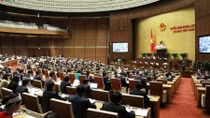
The national economy is displaying signs of stable growth, according to a government report presented by Deputy Prime Minister Truong Hoa Binh at the 14th-tenure National Assembly’s fifth session, which opened in Hanoi on May 21.
The Republic of Korea (ROK) is the largest foreign investor present in Vietnam with investment capital of US$355.6 million, accounting for 28.3% of the country’s total foreign direct investment (FDI).
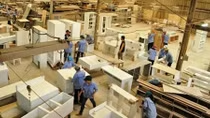
Exports of forestry products increased by 9.2 percent from 2016 to US$7.97 billion in 2017, according to the Vietnam Administration of Forestry (VNForest).
The domestic private sector in Vietnam is still relatively underdeveloped and faces major challenges, said speakers from the Ministry of Planning and Investment at a recent economic forum in Hanoi.