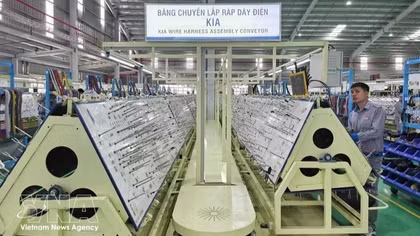
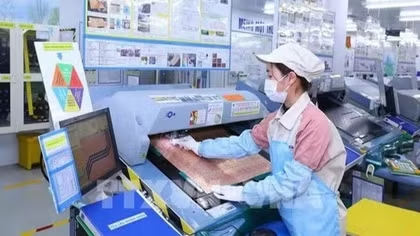
On the occasion of Vietnamese Entrepreneurs' Day (October 13), a number of entrepreneurs have given opinions on the measures to help businesses quickly adapt to the fourth industrial revolution.
Truong Gia Binh, Chairman of FPT Corporation
Digital transformation is inevitable

Under the strong impacts of the fourth industrial revolution, proactive digital transformation is now an inevitable requirement to help enterprises overcome difficulties, reduce losses and take advantage of the opportunities brought about by the revolution.
Many experts have warned that if Vietnamese enterprises fail to begin the digital transformation immediately, they could lose on their home ground, let alone conquering regional and international markets, because most business models in the digital age are common in that they are borderless.
A successful digital transformation requires those in leadership positions to change their mindset and dare to take on new challenges. Business leaders should understand that the process cannot be avoided or postponed because it doesn’t rule out any country or form of business. With that in mind, enterprises need to determine an appropriate roadmap for themselves, focusing on investment and building a digital culture in a serious and proper manner, not only internally but also between enterprises and their customers and partners.
Concerning solutions for digital transformation, conventional enterprises could make use of and build on technological solutions from digital enterprises and start-up businesses and develop their own research and development systems.
In the digital economy, digital solutions are the foundations of all innovation processes and the application of other advanced technologies in corporate operations. Many would think that these aforementioned requirements are too demanding for Vietnamese enterprises and imagine a less bright future when looking at their current state. But in the digital age, thinking and speed are the most important, not money or existing infrastructure.
Therefore, the competition is fair in terms of opportunities and challenges for both small and large enterprises. The winners could even be start-up businesses that few have ever heard of. As such, instead of hesitation, Vietnamese enterprises should begin their digital transformation as soon as possible. I believe that there are still ample opportunities if we get down to it now and with gumption.
Hoang Manh Trung, CEO of Fumee Tech
Adapt so as not to be knocked out

As one of the small and medium-sized enterprises (SMEs) in mechanical engineering, we have been feeling the clear impacts of international integration and the fourth industrial revolution. Such impacts are not only the concern of large companies but also present questions for SMEs: adapt to the new situation to turn challenges into opportunities or accept being washed out by foreign competitors.
When mentioning Vietnam’s competitive edges, people usually think of cheap labour first. This advantage has been utilised for years to offset for the limits in capital and technology. However with the influx of new technologies into Vietnam, cheap labour is no longer an advantage, especially for the mechanical sector. Let’s take robotics for example. Robots can now, not only imitate human actions with greater precision and productivity, but also possess a greater ability to make judgements, handle different situations and learn new things. Therefore, if we are slow to change our thinking and improve technologies, the mechanical sector will soon be defeated in the near future, even though it employs little advanced technology.
Le Tien Truong, General Director of Vinatex
Focusing on changing the production method

The wave of technology in the fourth industrial revolution is expected to bring about exponential changes, placing labour-intensive sectors under the greatest pressure to come up with quick, aggressive and correct solutions. But this is also a new opportunity for the garment sector to apply automation, reduce the number of direct workers and link data between production machines. Therefore, the next five years will be a key period to either achieve new development or be eliminated.
According to a recent survey, the number of enterprises approaching the standard on new technology in terms of equipment currently accounts for less than 10%. However, with technology being partly renovated in recent years, productivity has improved considerably. Ten years ago, 80,000-90,000 additional workers were needed to produce an additional US$1 billion in exports, but now only 50,000-60,000 are needed.
In the future, enterprises need to transform themselves into original design manufacturers and original brand manufacturers because with new technologies, bulk orders from abroad will fall dramatically. They also need to concentrate their finances on technological innovations, keep a close watch on and update new technologies of the world, and make plans to substitute new technologies so as not to be eliminated due to outdated equipment, high costs and the failure to meet environmental standards.
Moreover, the government needs to introduce specific policies, take bold actions to develop the supporting industries, and attract and encourage investment in producing raw materials for the garment and footwear industries.