Active member of UNCLOS
Vietnam could not attend the first and second UN conferences on the Law of the Sea in 1958 and 1960 for several reasons. After reunification in 1975 it sent delegations to sessions of the third UN Conference on the Law of the Sea held between 1973 and 1982 and absorbed the draft document of UNCLOS. During these meetings, Vietnamese representatives raised issues that were typical of a developing and coastal state which needed to be addressed, thereby contributing to the formation of the rights and obligations of the coastal state with regard to maritime issues.
On May 12, 1977, Vietnam adopted a statement on the Territorial Sea, the Contiguous Zone, the Exclusive Economic Zone, and the Continental Shelf, becoming the first Southeast Asian nation to release such a document. It then issued a declaration of the straight baselines five years later before ratifying UNCLOS in 1994 and promulgating the Vietnam Maritime Law in 2012.
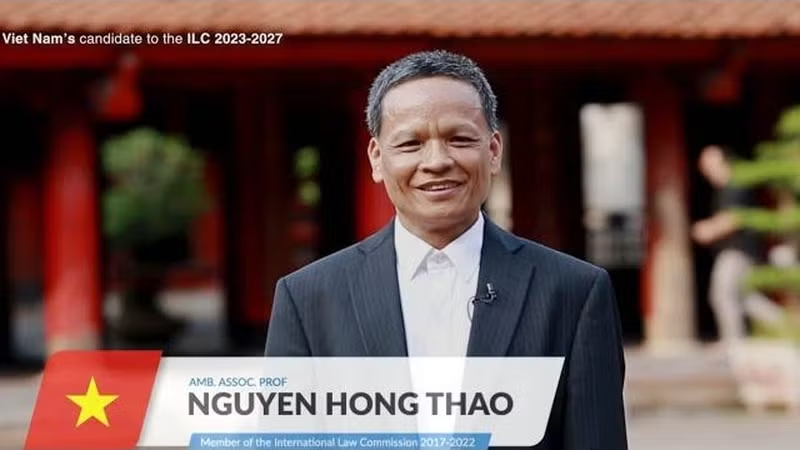
Through these timelines, Vietnam has always proved itself to be a responsible state that strictly enforces all rights and obligations of a coastal state, in line with the provisions of UNCLOS, as well as international law. It can be viewed as a leading nation that has observed UNCLOS in settling maritime disputes, especially those relating to maritime delimitation. According to Ambassador Assoc. Prof. Dr. Nguyen Hong Thao, Vietnam has so far resolved seven out of 11 disputes at sea, an effort that is highly appreciated by foreign experts.
“In 1997, Vietnam and Thailand negotiated the delimitation of the boundary in the Gulf of Thailand. This was the first maritime delimitation document in the region after UNCLOS came into force in 1994. We also negotiated with China in 2000 to divide the Gulf of Tonkin, and with Indonesia in 2003 to define their continental shelves. We also reached agreements on common historic waters between Vietnam and Cambodia in 1982, and on joint exploitation between Vietnam and Malaysia in 1992 and 1995,” recalls Ambassador Thao.
Most notably, the three-step formula applied in the maritime delimitation between Vietnam and China in the Gulf of Tonkin was recommended by the International Court of Justice for the settlement of the Snake Island dispute in the Black Sea which occurred between Ukraine and Romania in 2009.
“We have reaped success in solving problems relating to our Spratly and Paracel archipelagoes as well as maritime management. Vietnam and the Philippines co-drafted an ASEAN statement on the Code of Conduct for negotiations. Vietnam is also a signatory to the Declaration on the Conduct of Parties in the East Sea and is now also an active negotiator of the Code of Conduct of Parties in the East Sea (COC),” says the Vietnamese diplomat.
UNCLOS to be protected
UNCLOS has so far been ratified by 168 out of 193 member states of the UN. As part of efforts to encourage the remaining countries and territories to join the convention, Vietnam and Germany have put forward an initiative aimed at establishing the UNCLOS Group of Friends as an open forum to allow exchanges on issues of mutual interest.
“As a co-founder of group, Vietnam asserts that it not only adheres to UNCLOS but also helps protect the legal document from attempts to change its core value. Serving as an open forum, I think the UNCLOS Group of Friends is one of very good complementary mechanisms to UNCLOS for us to better understand and better explain the provisions of the convention. These provisions are largely international customary rules that apply to all states, no matter what they are. It is also an opportunity for the United State to participate in and express its views,” says the diplomat.
Representatives of many countries joining the UNCLOS Group of Friends highly appreciate the initiative, which they believe has served as a timely response to interests and must uphold the role and values, as well as promoting the adherence to the convention. They maintained that the initiative would contribute to helping create a co-ordination mechanism in jointly addressing challenges to UNCLOS and issues at sea such as environmental pollution, climate change, rising sea levels, and the implementation of sustainable development goals.
“Currently, many countries interpret and apply the law of the sea in their own way. Therefore, the idea of forming a group of friends to increase common awareness and build consensus in maintaining international peace and security at sea has been supported by a majority of countries. This is a good mechanism for the sake of common interest as well as national interest,” explains Ambassador Dang Dinh Quy, former head of the Permanent Representative of Vietnam Delegation to the UN.
A key tool for resolving maritime disputes in East Sea
Vietnam maintains that the observation of the universal values of UNCLOS to promote co-operation on the basis of respecting the lawful rights and obligations of coastal, as well as landlocked states, members and non-members of UNCLOS is to maintain peace, stability, safety, and freedom of navigation and overflight. In line with this, it will also help to promote the sustainable management of the East Sea.
To this end, states should strive to respect international law, including UNCLOS, enhance confidence, and exercise self-restraint from conducting activities that may further complicate the situation or escalate tensions in the East Sea. This should be done whilst simultaneously complying with UNCLOS in making maritime claims and resolving disputes through peaceful means.
According to Ambassador Thao, China’s argument in relation to the East Sea issue has changed following the Permanent Court of Arbitration’s 2016 ruling in a lawsuit lodged by the Philippines. The northern neighbour had previously claimed the ‘nine-dash line’ or ‘cow’s tongue line’ to declare its sovereignty over most of the East Sea. However, the so-called ‘nine-dash line’ was rejected by the Permanent Court of Arbitration. Though China later rejected the ruling, it still had to make a new argument called ‘Four Shas’ which covers waters even larger than the area limited to the ‘nine-dash line’.
Resolving disputes in the East Sea can be considered a long struggle in the context of all countries having needs to boost economic development and co-operation. A stable environment is therefore a matter of urgency. To this end, it is very important to create an additional legal framework to support UNCLOS as a means of maintaining peace and stability throughout the region. That is what ASEAN is looking forward to when concerned parties are prepared to sit for negotiations of the Code of Conduct in the East Sea (COC). This mechanism which is designed to benefit China, ASEAN and Vietnam, by contributing to peace, security, and stability in the East Sea.
However, the COC negotiation process has been interrupted due to the impact of the COVID-19 pandemic over the past two years. With the virus being gradually brought under control, it is hoped that parties concerned will resume negotiations in the near future.
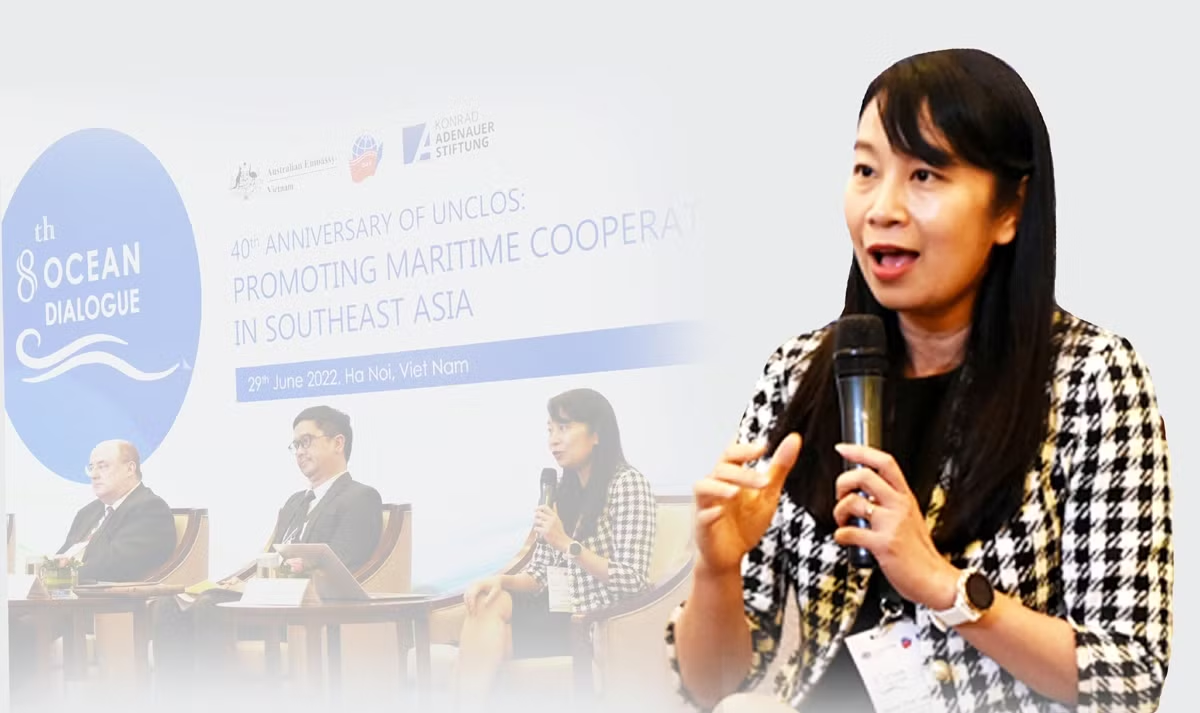
“Currently, all ASEAN countries, including Vietnam, as well as China have affirmed that UNCLOS is a universal document that regulates national activities at sea. Experts say, if a COC agreement is reached in the future, all provisions of the COC will be based on UNCLOS and will comply with the convention,” says Dr. Nguyen Thi Lan Anh, acting director of the East Sea Institute under the Diplomatic Academy of Vietnam.