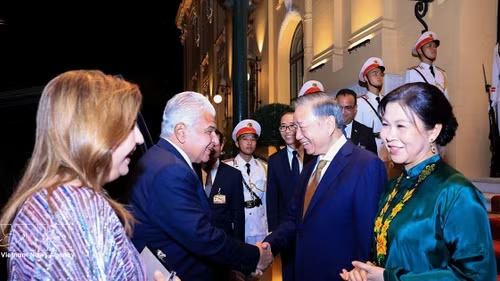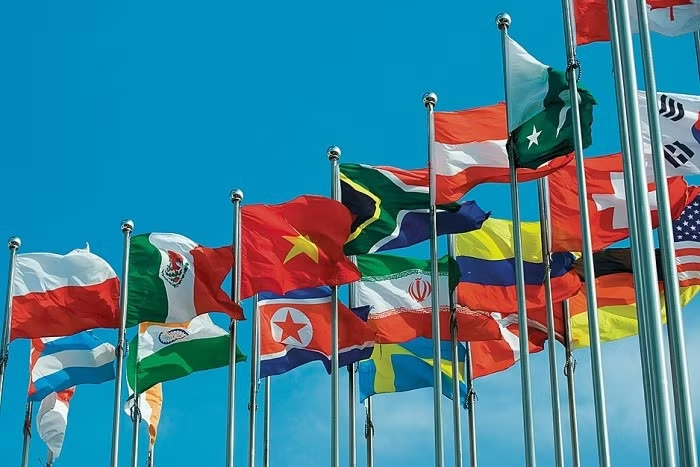
In fact, changes in the global trends, power balance and world order as well as gloomy prospects in many hot spots have made all countries to adjust and revise their policies. In that gloomy picture, Vietnam with a proactive, open, confident and friendly foreign policy emerged as a bright spot, promoting its position in the international arena.
Developments in the past decades casted doubts whether peace, stability, and international cooperation are still the mainstream of the world? As a matter of fact, populism has unleashed the use of force, causing armed conflict here and there in the world.
After the US withdrawal from the TPP and the UK's secession from the EU, nuclear threats loomed large. In 2023, Russia withdrew from the New START with the US and the Treaty on Conventional Armed Forces in Europe, and deployed tactical nuclear weapons in Belarus, while China increased the number of nuclear warheads from 350 to 410.
The role of the United Nations and multilateral arrangements were seriously challenged by the rise of isolationism, unilateralism, and hegemony.
Meanwhile, a peaceful Europe has become a battlefield, and Finland, which has quit its neutrality status. lasting for hundreds of years, chose NATO as a guarantee for its national interests.
In the end of 2023, the international community desperately witnessed a fierce armed conflict between the Palestinian armed group of Hamas and Israel in Gaza, which is likely to become a major war with the involvement of several nations, in the Middle East.
The fourth industrial revolution with scientific and technological breakthroughs, such as artificial intelligence, the Internet of Things and biotechnology, is providing a key for man to decode many secrets of the universe. Scientific and technological advances are even creating new living things that seem as though they were human machine characters from Hollywood fiction movies decades with their extraordinary abilities.
That is to say, the prospect that an individual or a group of people with their absolute scientific and technological advantages can turn other people into machines to serve their own interests is no longer far-fetched. By the same token, a country that holds dominant scientific and technological strengths can make backward countries submitted. It is argued that the world may return to a new-form colonial era, the so-called “digital colonization”, which is invisible but much more brutal.
The increase in non-traditional security challenges like the COVID-19 pandemic reveals a reality: Only a very few countries with advantages of science and technology could more or less succeed in dealing with them while a vast majority of countries in the world had to depend on the kindness of the former.
So it is not difficult to understand that the development and even survival of a country depends largely on its own scientific and technological capacity. In other words, it is hard for a country to maintain national independence and sovereignty when it depends on another country for science and technology.
Additionally, sea levels are rising steadily, expected to rise 0.66 cm/year by 2050. A scenario is forecasted by the Ministry of Natural Resources and Environment that if the sea level rises by 1 meter, 47.29% of the Mekong Delta area, 17.15% of Ho Chi Minh City's area and 13.20% of the area of the Red River will be submerged. It is impossible to imagine how the sea level rising will change the Vietnamese socio-economic life.
The balance of global powers has also undergone fundamental changes. Russia recovered strongly, aggressively exercised influence over its neighborhoods and explicitly showed its ambition to regain the Soviet Union's position in Europe by being ready to use all of its available resources.
However, it seems that Russia has found itself in a lonely situation when it has been isolated by Europe and the West, and has had no real ally except for Belarus. Can an economy of about $2,000 billion (2022) sustain a prolonged conflict in Ukraine, successfully confront an expanded NATO, and pursue a new arms race?
China has drawn great attention from the rest of the world, thanks to spectacular achievements in its economic reform. The country is now in a "new historical era", pursuing the "Chinese dream". China's GDP in 2022 was approximately $18,000 billion (120 times more than in 1978), accounting for 19% of the global GDP and contributing 30% to the global economic growth.
As of 2011, China had the number of science and technology patents more than the US and Japan, and had some sectors equaling or even surpassing the US, such as quantum supercomputers, hypersonic weapons and a number of other sensitive fields.
The US continues to be the single superpower in terms of total national and economic strength, political influence, defense capabilities and scientific and technological superiority. In 2022, the US’s GDP is $23,000 billion, accounting for 23% of the global GDP. In the field of science and technology, from 1901 to 2020, the US won 393 out of the1,139 Nobel prizes given, more than twice as many as the UK -- the second-ranked country. The US leads the largest political and military alliance networks s in the world, and these groupings are being expanded, notably with the birth of the US-Japan-Australia-India alliance (or QUAD) or the AUKUS.
The US also introduced new Indo-Pacific strategy and many other strategies. The US initiatives are more related to security and defense that makes small powers concerned on one hand, and interested in on the other because of an unstable and uncertain security environment in the Asia - Pacific.
However, as the US economy has been sluggish and the US policy has been inconsistent over the past two decades, the “American value system” is gradually losing its appeal. As the US has had to spread its resources out in the world, recent US Presidents have sought to make peace with either Russia or China to focus their efforts and means to defeat one of its two “strategic rivals”, but “man proposes, God disposes”.
The "bipolar" or "unipolar" order of the 20th century has passed, the new order has not yet taken shape, and the world is in turmoil. The strategic triangle of the US - Russia - China still dominates the international relations. But China has now replaced the position of the former Soviet Union and current Russia to be the main actor in maintaining power balance with the US. The world is divided between the US-led ally and China – Russia-led side. The global security environment has therefore become increasingly complex, with a constant risk of conflict.
However, there are some bright spots in the grey security picture. The recent COP28 witnessed an unprecedented consensus on the fate of humanity. At the meeting, groupings of conflicting major powers still spared room for international cooperation on such a major global issue. The intertwining of interests made cohesion strong enough for countries to understand that cooperation is the best path.
That complicated global security context also provided opportunity for small and medium-sized countries to raise their positions and contribute to building a new order. With its key geopolitical position in Southeast Asia, ASEAN has opportunity to play a truly central role in regional security arrangements.
Vietnam has diplomatic relations with 193 countries, and is the only country that has a strategic partnership with all five permanent members of the United Nations Security Council. While small and medium powers tend to pursue the policies of “inwardness” and “aloofness”, Vietnam upgraded its strategic partnerships with many powers, notably with the US and China in 2023. To date, Vietnam has close strategic relations and cooperation with 30 countries. As a full member of 16 free trade agreements, Vietnam achieved a relatively high growth rate, and became a rare bright spot in the gloomy global economic picture last year.
Geo-strategic position is the country's most important asset at this time. In the Southeast Asia region, Vietnam is in a key location, facing the ocean and backing the mountains. The position can help change a country's fortunes even when its power is not enough. Vietnam has achieved the things that few countries with similar position could do.